Headsail sheet bowlines catching on rigging during tacks. Remedy?

fredrussell

Well-Known Member
Joined
24 Mar 2015
Messages
4,160
Visit site
My Genoa sheets are attached to clew by two bowlines. These catch on various shrouds etc as the 140% Genoa is pulled across boat each time I tack. If money permitted I’d buy 25 metres of 14mm or 16mm braid on braid and just attach to clew at the half way point with a cow hitch. Money does not permit though and my current sheets are in very good order. Will passing each sheet through clew and then doubling it back on itself and whipping it be strong enough? Is an eye splice the answer? Not a skill I possess but every day is a school day. Any advice gratefully received.
 
Last edited:
Have you tried re-tying the bowlines the other way round? Alternatively, 50mm plastic tubing on the lower parts of the shrouds would help.
 
No. It's a pain but there's not much you can do about it. You can put plastic pipe over the shrouds which spins as the rope pulls on it. That's about it I believe.
 
Was hoping to avoid plastic pipe on shrouds if at all possible. Would a simple stopper knot, one per sheet passed through the clew from opposite directions work?
 
That's the usual easy answer ...... plastic water pipe on the shrouds.

I would not recc'd Cow Hitch to the genny ... over time you are liable to have it slip or become unequal.

Another thing you can do .... my boat is a pig to get genny across sometimes - so I now hold old sheet till genny backs and pushes bow round - letting sheet fly then ... sheeting in on new .... the sail backed usually has enough force on it to pull through ...
 
Single piece sheet with a lark's head in the midle at the clew is easiest.
The neat dyneema solution above looks really promising.
I have stitched eyes on the end of my sheets attached with dyneema soft shackles.
 
I temporarily substantially ameliorated such a problem on a previous boat by tying the sheets parallel to one another (by e.g. reef knot or whipping), but facing opposite directions, just further away from the sail than the bowlines (or whatever) themselves. This presented a much smoother transition, allowing the sheets to slip much more easily past a babystay or shroud (albeit at the cost of a slightly ungainly lead to the sail under tension).

(p.s. Isn't 14 to 16mm genoa sheeting rather big and bulky for a 31 footer?)
 
Single piece sheet with a lark's head in the midle at the clew is easiest.
The neat dyneema solution above looks really promising.
I have stitched eyes on the end of my sheets attached with dyneema soft shackles.
I’m not a fan of single piece sheet as I once had one fray and then snap in 35 knots leaving a heavily reefed Genoa with no means of controlling it and an eye too high to reach even standing on tbe pulpit (which I shouldn’t have done).
Two sheets means you can never lose control that way.
 
Well, it’s probably about time I learnt to do an eye splice. I’ll try that, in conjunction with a soft shackle as googling seems to bring this solution up more often than knot (sorry).
 
Single line, cow hitched works perfectly OK for me. Even if one side snapped you still don't lose the other "sheet". Ad a little to the overall length and you can move the cow hitch annually to move any wear points and get more life out of the sheets.
 
Last edited:
Our boat has a babystay in addition to shrouds. Tacking the genoa was always problematic with bowlines. For some years now we have had eye splices and a Dyneema shackle. Excellent solution that very rarely hangs up.

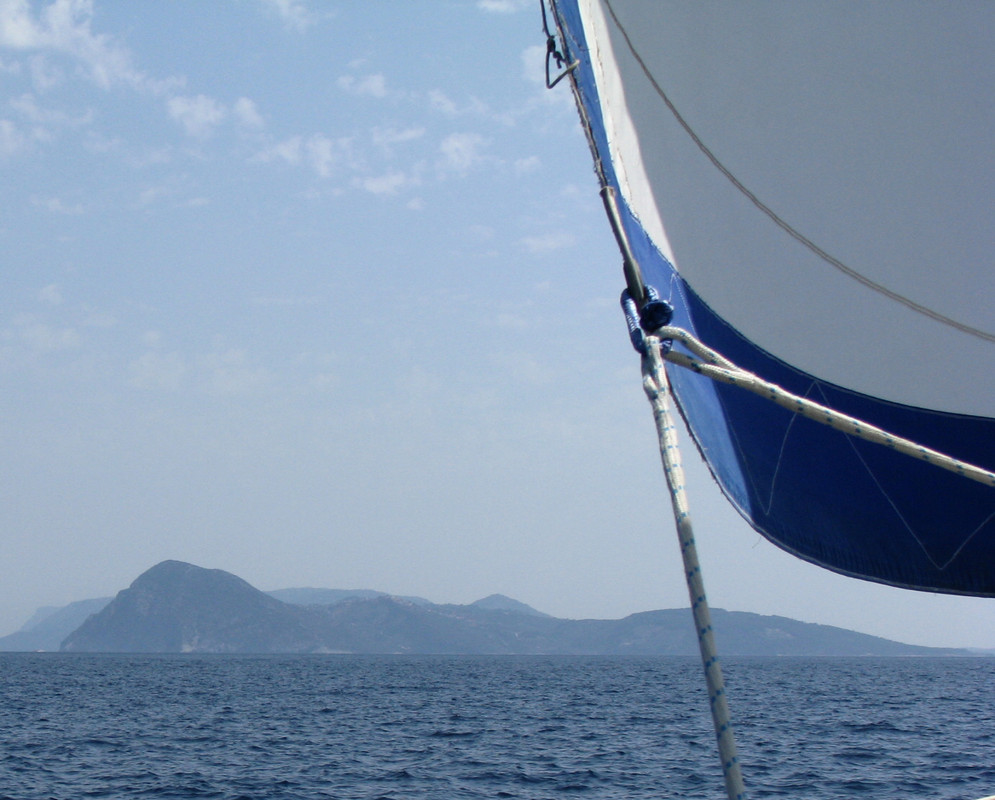
You could use that photo as a "Whereissit?";)
 
Single line, cow hitched works perfectly OK for me. Even if one side snapped you still don't lose the other "sheet". Ad a little to the overall length and you can move the cow hitch annually to move any wear points and get more life out of the sheets.

I appreciate and understand your use and reasoning ....

Personally I wouldn't use as I don't trust a hitch never designed for loads. Only place it definitely has a use - as a hitch at start of a chain stopper on wire ... to avoid a lock up of the chain when removing.

For years I used a snap shackle to give me quick change with hanked sails ... I could down a sail .. unclip .... clip onto next ... hoist and be away quick .. but in the end decided the risk of being nutted by a lump of metal albeit small was enough to go for bowlines. But I set my bowlines slightly slack to let them roll on the stays.
I do intend to spiral on some plastic pipe one day ... my Snapdragon had this and it worked well.
 
I use a long sheet and hitch it in the middle.
I have also used this method which is fashionably called a soft shackle:

How to Attach Jib Sheets With a Soft Shackle

As old as the hills, Victorian fishermen would recognise it.
As long as the ratio between the clew ring and the sheet size is sensible, it is excellent. It frees easily and yet will not unhitch even under gross provocation.
This has reminded me to make one up for the coming season.
 
I would chuck the soft shackle in vyv_coxs' picture & pass the loops through the clew & the end of the sheets through the loops. One less item to fail, No fear of releasing . That assumes that the eye in the clew is large enough. If not then I would use the eye in a single sheet with the stopper piece method instead
But to each his own.
If the OP cannot splice a loop then a whipped loop should work & by doing as I describe it will help support the whipping by tightening on the loop so effectively be stronger
 
Top