have two speed logs - what if I remove one ?

I hope that the cables follow the cable description I found online ...
I wouldn't be too sure of that. The cable in this drawing only provides an nmea output when plugged into network b and g instruments. These cables are not used to connect a log sensor to an instrument.

There is no data transferred from your speed sensor to the network instrument. The input from the sensor is an analogue voltage signal which is converted for use in the display. The display then transmits an nmea data sentence on the green cable from the display. The b and g network is connected by the white input and output wire from each instrument. This is responsible for data transfer not the nmea green cables. They are not interconnected between instruments.

On the sensor outputs
check with a meter that the red wires are +12v The black ones are the 0v commons.
I would expect the green ones to be analogue voltage outputs from the sensors. A variable voltage from either of them might be checked with a meter if you can spin the paddle wheel (blow on it).

White and brown cables are typically used for any temperature output on combined units.

Something doesn't add up given the above as you have a black and green wire connected together in your terminal Box!

There should be a tag on the log sensor wire with the model code.

Airmar technical help might help you with the exact wiring colours, outputs and specification if you contact them specifying this code. They usually will offer advice on how to splice a new replacement sensor into existing wiring.
 
Hi TSB240 ..

Understood your post - the cable is as you say the interconnect cable .... it is a concern .. but the manuals make no mention of an adaptor to change from pulse to NMEA ... but do give a diagram of cable connections to complete the network ..

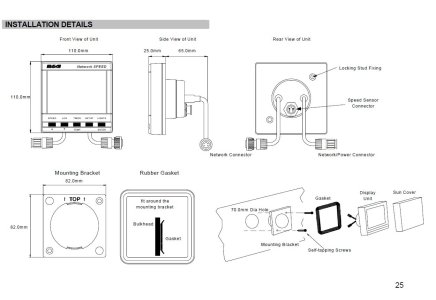
Note the far right rear view .. which shows a Speed Sensor connection. I'm hoping that this feeds a convertor inside the display body ...
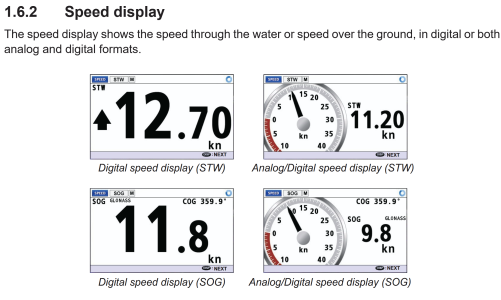
Display speed.jpg

I've spoken to other B&G users with this older Network as well as later .. and none can recall having any 'blue box' or extra ....

Once I get back to the boat - I will taking apart the hatch garage display and will see if the cable goes to that #7 junction box ... if so - then I am fairly confident I can remove the second transducer ... once I can see its working - then consider a switch to have option of either ...
 
It does actually contradict you - because you mistakenly state Doppler is for STW ... its not. Its an attempt to get the most accurate ... I use the word Geographical to stay away from the word Ground ... geographical speed ... what it produced actually in deep water was a figure that wavered between STW and SOG in effect. As you entered shallower water and the Doppler could use sea bottom instead of water layers - the speed was more SOG ...

Don't know what ships you sailed on ... but in all the 17yrs I sailed as Nav Officer in all Oceans / Seas ... I only ever calculated tidal vector once or twice ... and I cannot recall any others doing it either !
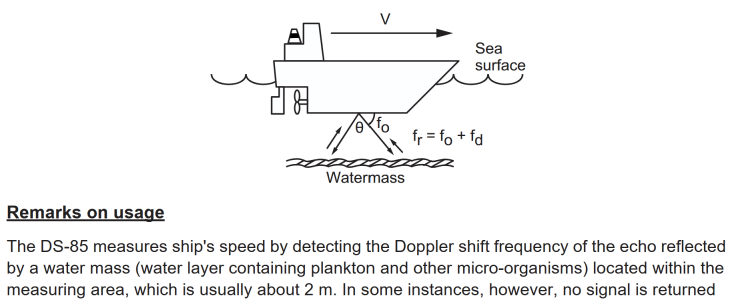
Doppler speed logs are used for both STW (tuned to a boundary layer, as you mentioned yourself), and SOG (off the bottom). You choose this by setting the "tracking depth". Default setting is 2m, which gives you STW. See: https://www.furuno.it/docs/OPERATOR_MANUAL/DS85_OME72880B1.pdf

What was really interesting for me, and hard to understand, is that ARPA calculations on ships are water-referenced instead of ground-referenced like on yacht systems. Seems kind of backwards to me, but maybe that's held over from pre-GPS times.

Screenshot 2025-07-17 180212.pngScreenshot 2025-07-17 181318.png
 
Sa Refuler sails mainly in the Baltic Sea which has little tided like the Med STW would have little real use except maybe on his river

I can recall some time ago there was a twin speed log setup posted in PBO using a tilt switch to change the speed log that feed the indicator depending on which tack the boat was on
I spent many years sailing in the Baltic. The water surface is always moving there, and unlike the case in tidal waters, there's no way to reliably predict how strong or even what direction the currents flow.

So I would say on the contrary accurate STW is even more important in a body of water like the Baltic.
 
I spent many years sailing in the Baltic. The water surface is always moving there, and unlike the case in tidal waters, there's no way to reliably predict how strong or even what direction the currents flow.

So I would say on the contrary accurate STW is even more important in a body of water like the Baltic.

Sorry - but baltic water flow is highly predictable ... based on three factors :

Wind direction.
Barometric pressure areas
Temperature.

Putting it simply ... prevailing SW winds push water northward.... etc.
 
Sorry - but baltic water flow is highly predictable ... based on three factors :

Wind direction.
Barometric pressure areas
Temperature.

Putting it simply ... prevailing SW winds push water northward.... etc.
OK, I stand corrected.

Let me rephrase that:

Baltic currents are bafflingly unpredictable FOR SAILORS LIKE ME WHO LACK THE KNOWLEDGE TO CALCULATE ALL THE DIFFERENT FACTORS WHICH INFLUENCE THEM.

Better?

And -- are you really able to forecast the currents yourself? If so, can you teach us? I for one would be grateful.

I have charts of the Skaggerak and the Sound which shows what kind of currents to expect based on wind direction, but only wind direction. As you said, there are other factors, so this chart is somewhat but only vaguely helpful.

The DMI publish some current data embedded in their model outputs, but only for the Western Baltic, I believe. Perhaps that would be helpful, but one would need to learn to read it.
 
Pardon our interruption...

This is a link to an airmar part number for a B & G network speed sensor for sale on ebay.

If it helps I can see that it has red, black, green,white and yellow cores and a shield that have been stripped. I think I can make out a blue one cut off close to the end of the outer sheathing.

The sheath also has transducer printed near the end on the outer case.

Hope this helps you ID your sensor cables. I would trace back the yellow and white doubled cores in your junction box. I suspect these are unused cores on each of your speed sensor cables.
 
Appreciated TSB ..... all info is going into the 'pot' ....

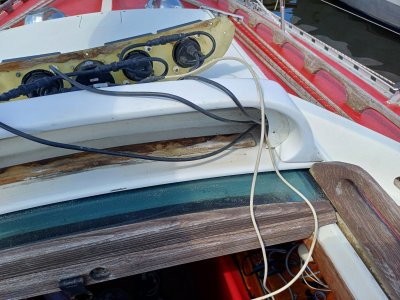
Interesting ... the transducer you link to is not same as what I have ... and the blanking plug I have - does not have any hand nut to hold it in ... it is a friction fit only ... you can see the two 'plugs' in the photo ... sitting under the top wooden strip and the transducers at bottom of photo :

UjSjWwcl.jpg


But they must have similar cabling ...

Having a 'sick' MIL .. and a business that is increasing as markets adjust to a certain 'orangemans' actions - I cannot rush onto and stay on the boat .. it gives me time to sit and think about it all ...

The inter-relation of the Wind and Speed data on the network is important regardless of STW and all that ... its the continuity of data on the network bus.
Studying various online info and photos - I think its a good sign that Wind .. Speed ... Depth ... each has a third connection. The cable tails of the network to interconnect each display (which also carries NMEA) ... plus the thjird socket that the Transducer plugs into.

This tells me - hopefully - that I can play with the Transducer cables without causing failure of the network.

The Wind is not receiving wind speed from the MHU - that's obvious ... so a trace and use of the MHU test procedures is called for. But its receiving water speed from the Log speed display.
The Log speed display is therefore receiving from the transducer(s) .... remains to be seen what now happens with 'blue box' disconnected ..
 
I always liked the story of the captain of a ship putting his whole fist on a paper chart and saying we are some where here.
Thread drift ....

70,000 tonner bound in ballast from Japan to Arabian Gulf ... this is late 70's before general use of GPS ... Transit was only on a few ships ...

We are east of India and storm hits ... we have had no sights for a day .. so we are running on 'yeh well - somehere there ???' ..... storm lets off and we have total overcast for days after .... I'm 3/O on the 8-12 watch ... bored and nothing to see ....
Sheer boredom - so I play with the RDF set ... and I pick up an Indian ADF signal (primarily for aircraft and inland) ... I identify the signal in the book ... and take bearing ... later in the watch I take another bearing ... angles not going to change much - but thought to check ...
Calcualted the bearing to plot ... the signal is a long way away by our DR ...

I put the position line on chart and then start working back based on ships speed estimated etc .. and it says we are a long long LONG way south of expected position .. I mean a huge amount !!

I circled and added time to the plot on the chart with a small note .....

2/O took over at midnight ... looked and laughed ! No Way mate ... but we'll leave it on chart and see how things pan out ....

C/O took over at 0400 and 2/O passed on the info ... sky cleared enough at twilight for C/O to take stars .....

WOW !! my plot night before turned out to be correct ... give or take a few miles !
 
OK ... back at boat again ...

Took the hatch garage panel out with the displays .... thinking - hey this will be easy now to relate to junction 7 box ..............

Not so ...

Cabling dissapears again behind pannelling but not in direction expected !! You would think it would go off to the side to join the box ... but no - it goes fwd into the headlining ...

20250718_125621.jpg

Interesting that the old analogue speed meter has B&G network cable spliced into it ....

I've just bought a Tone Cable tester .... you clip one part to end of cable ... then with second part with probe you can touch cables till it sounds a tone - telling you that's the same cable ... silly me - I left it at home.

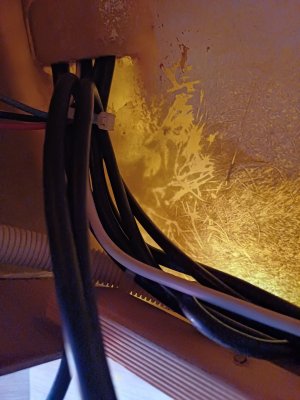
I opened up above the stern bunk again and took some photos inside ... ugh ! Looks ok - but there's no labelling / no info what is what etc


20250718_130210.jpg
20250718_130244.jpg
 
Trip to Gotland showed that even though I had removed a lot of connections and risked causing a conflict for the dual speed clog system - speed log worked fine ...

In fact I only had same error on B&G as I had prior to ripping wires out .. the WIND is not working correctly.

But strange that when going TO Gotland and good weather - it showed correct direction - but speed was wrong - it showed STW from the log.
On the return journey - all was same until we had water over deck / heavy rain ... then direction went nuts !! did a few 360's and then settled about 90 degrees wrong to opposite side of real wind ... Looks like water must have got into either MHU or the through deck connections...
 
Top