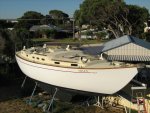
Hardstanding at home... how?

Paulg25

Well-Known Member
Joined
20 Oct 2019
Messages
2,038
Location
Afloat
Visit site
I have searched the forum ( and google ) but probably don't know what terms to search for.
If I have a cruiser delivered to my house what do I stand it on? I have space, on soft ground (grass) to put it but do I need a cradle of some sort? Seen a few pictures on the internet and blocks of wood seem to be commonly used. Are there areas on the bottom of the boat that should be used? Like jacking points on a car.
The cruiser will be old GRP like Princess or Fairline. Up to 37 feet long.

Thanks
 
A cradle is by far the best.

If grass, then you will need some form of adjustment as the ground settles . A screw jack is a good solution, but telescopic slides with pins is fine.

d1CiiZ0.jpg
[/IMG]


Jacobs cradles seem to very popular.
http://www.jacobsboatcradles.com/yacht-images-boat.html
 
Last edited:
Soft ground. The weight of the boat will compress the ground, depending on the composition of the soil, could easily compress by up to 3 inches. The more you can spread the load with extra supports will be better for safety of the boat. The supports will need frequent checking for the first few days, and constant monitoring especially after heavy rain.

You will also have to consider the crane lifting the boat from the transport. This will make a mess of the lawn with its wheels and jacks. Talk with the crane hire firm for advice.
 
I endorse the comments above as the ground will compress where there are props: one windy night and the props will drop to the ground.

I think I have the ultimate in cradles for soft (lawn) type pad. Each Acrow prop cost about $A55 and they are adjustable.(They are used in the construction industry)

I am quite sure you could build some "self standing props" out of heavy scrap timber (or steel) but they would have to be adjusted as necessary.

IMG_1646.jpg
 
Last edited:
And if you are in the UK, check the deeds of your home for restrictive covenants.

Especially if you have a home built in the 1950's and newer, there may be conditions to the use of your property that prohibits boats, caravans and trailers of over a certain size to be placed on your land, even temporarily.

Make sure you do your homework on this one...
 
Another thing to watch for is that cradles placed on soft ground can rust quite quickly when they sink into it.
 
Not just heavy rain you need to watch out for buy the ground drying in the summer.

Sit the keel on railway sleepers or some other decent wood and spread the load with props on a decent sized pad as mentioned, if the boat will be there a while then digging a hole and creating a concrete "pad" for the props may not be a bad idea.
 
And if you are in the UK, check the deeds of your home for restrictive covenants.

Especially if you have a home built in the 1950's and newer, there may be conditions to the use of your property that prohibits boats, caravans and trailers of over a certain size to be placed on your land, even temporarily.

Make sure you do your homework on this one...


+1. My house has such covenants prohibiting me from parking caravans or similar on my drive. Not a problem - I have no intention of parking Capricious on my drive - but I did note it when the solictor went through the paperwork. I think it is very common on new builds these days. In my case, I suspect it arises from the complex drainage works under the road and drive-ways.
 
I'm not aware of any restrictive covenants in Australia: certainly not in regard to the weight of trailer or caravans (what about cars?) If a 20 ton truck drove down the road could it collapse the road into the drain!!
 
If you can't weld yourself, I am sure a local engineering shop would be happy to weld up a cradle for you. Especially if you cut everything to size first as that is the time consuming part of the job. Acrow jacks (already mentioned) can be found on Ebay and Gumtree and make superb supports when welded into the cradle. Remember this is something you will be able to use in the future at the boatyard when the boat is hauled out for the winter layup.
 
+1. My house has such covenants prohibiting me from parking caravans or similar on my drive. Not a problem - I have no intention of parking Capricious on my drive - but I did note it when the solictor went through the paperwork. I think it is very common on new builds these days. In my case, I suspect it arises from the complex drainage works under the road and drive-ways.

A big car probably weighs more than a caravan; I imagine the drains are fine but they didn't want people parking big ugly white boxes or rotting project boats long term and lowering the tone for the neighbours.

My property has covenants prohibiting turning the house into a church (not likely!), knocking it down and using the land as a quarry (it's a suburban semi with a small garden, not going to extract great mineral wealth from that), or "erecting a steam engine upon it". I suppose that was a concern when the plots were being laid out in 1889.

The steam engine clause tickled me so much that I transcribed it into the contract I used when I used to rent out a room to colleagues from work. Partly to see whether anyone actually read the wording and would query it. Over the years the rate was about 50-50.

Pete
 
I think the concept of a cradle is far safer. Whilst props may seem OK they are only held in place by the pressure on the hull. If for some reason like ground subsidence or even strong cross wind the pressure comes off one side then the prop can fall down. A cradle will support the prop in place at all times.
The keel of OP mobo should be fairly strong to take the weight in 2 or hopefully more locations, However it might be safest for long term to spread the pressure on the keel as far as possible. ol'will
 
No offence meant, Paulg25, but from the nature of your question I have deduced that you may not be a person of practical bent, who could execute many the suggestions in the above posts. Hence I would suggest that you buy a trailer to suit your boat, have it loaded on at its present location and towed to your home, thereby avoiding the alterations and damage to your garden necessitated by other solutions. When said trailer is in position, jack it up on some breeze blocks topped with stout pieces of timber, (the wood prevents the breeze blocks being split by the trailer chassis), and remove and store the wheels under cover.
You can find suitable used trailers on www.Apolloduck.com or similar websites, at quite reasonable prices in the context of the cost of your boat, and after all, you are in the happy position of not having to pay out for winter storage elsewhere. Keeping the boat on a trailer also removes the necessity of hiring a crane, with the consequence of further damage to your garden when the time comes to bring the boat to the water, (and bring it home again at the end of next season!).
 
Last edited:
Faced with this problem a couple of times recently, I built 'yard trailers' First was out of RSJs and two truck axles, one steerable. That was for a 4/5tonne boat. The keel sat between the two RSJs and the side supports were cut down akros. Second was for a lighter launch, around a tonne. So just fabbed up two steerable axles with small road wheels on plain bearings and adjustable side props. Both of them used to launch and haul out the boats on slips and a short (err...) road trip.
Big plus is the boat can be moved around, esp if a crane cannot reach. Like Sp of Glen's post, but DIY, or a DIY friend with a welder..:-)
 
37ft is a big boat to be taking home.
For any boat that can't be towed with a family hatchback, the further it gets from navigable water, the more of a liability it becomes. Even something which can legally be towed by a land rover can be grief. When you get bigger than that, it will always be aggro and expense, and what happens if the road layout changes while the boat's in your garden and you no longer have a viable route?
Craning on and off transport is expensive, enough to pay for some months ashore in a yard generally.
So towing on your own trailer is a less bad idea.
I do know of boats being moved on farm-type trailers for short dstances by road.

It's not worth taking a fair size boat home for a winter.
Long term, there may be a risk of it costing a fortune to take back to water.
 
Yes. The cost of loading and unloading does seem rather high. Was thinking of getting a 'project' that needed, amongst other things, new cutlass bearings but, as you point out, the price of the extra unload and load at my house is a big chunk of cash towards a non project boat.
 
Top