
MapisM
Well-Known Member
LOL, he didn't say processes for nothing, P: the list is rather long...Interesting. What do you do for your "winterisation process"?

I'm on a mobile atm, but will follow up later if nobody else does in the meantime.

LOL, he didn't say processes for nothing, P: the list is rather long...Interesting. What do you do for your "winterisation process"?
Interesting. What do you do for your "winterisation process"?

LOL, he didn't say processes for nothing, P: the list is rather long...
I'm on a mobile atm, but will follow up later if nobody else does in the meantime.
Most years I pay someone a lot of money to drain everything, lubricate everything, wash everything, dry store everything, service everything etc etc !
Well, to start with, you should consider that when the boat stays is in the water, it's extremely rare that anything onboard can reach freezing temperature, because the sea water acts as a huge thermal damper. I'm talking of the Med, mind: this might well not be true for UK boaters, let alone Scubaman, for instance...Thanks P, I'd be interested to see what's on your list as mine is rather short!


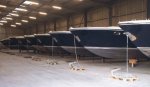

Well, to start with, you should consider that when the boat stays is in the water, it's extremely rare that anything onboard can reach freezing temperature, because the sea water acts as a huge thermal damper. I'm talking of the Med, mind: this might well not be true for UK boaters, let alone Scubaman, for instance...
But, when you put her on the dry, even if in a shed (unless it's a heated one, which do exist but are very rare), and particularly in the northern areas of the Med (N Adriatic being probably the worst in this respect), you must consider anything which can be affected by freezing temperatures:
- empty fresh water tank + holding tanks + boiler;
- empty as much as possible the whole fresh water circuit, leaving all taps opened;
- be sure to have antifreeze where appropriate (engines+genset closed cooling circuit, AC compressor+fancoils circuit);
- flush with fresh water+antifreezee all raw water circuits (engines+genset+AC+watermaker, if any);
There are also other things typically recommended, when boats are going to be stored and unused for several months, regardless of how cold the weather can be:
- seal the engine intakes (air filters)+exhausts with cellophane. This is meant to not let moisture find its way inside cylinders, through open valves;
- for the interiors, it's a good idea to leave mattresses and cushions lifted in some way, with air circulating around them, and also leave the lockers open;
- fully drying the bilges if wet is another good idea;
- putting in place some way to keep all batteries topped up, at least periodically, even if the battery switch is (obviously) left off.
...and I am sure to be forgetting something.
Since I moved to almost African latitudes, winterization is not a real concern anymore!

Thanks P, I'd be interested to see what's on your list as mine is rather short!
Pete
Thanks P, that's all standard cold climate precautions but I would be surprised if the SoF shed in which Boatbore keeps his S/S ever gets close to freezing. The Costa Blanca is similarly warm all year. So I'm rather puzzled what extensive winterisation could be required for shed storage where there is no risk at all of freezing.

 . Also, thinking of corrosion, it is much better to have glycol than salt water in the engines.
To Portofino I would say that in the nordics, tens of thousands of boats are stored ashore every year. Standard procedure in winterising is to run glycol into the engines (and some into toilets), drain the water tanks and taps, and lift the cushions and hatches. So pretty much what MapisM very accurately described above.
This has been going on for decades and usually for a period of six months per year. If there was any evidence of this being particularly harmful to the engines, the marine service sector would undoubtedly have come up with a more complicated way of doing it. But, as it is, this is also what Volvo engineers recommend.
Looking at it the other way, keeping the boat in the water and allowing marine growth to gradually clog up water intakes and heat exchangers will really mess up your EGT’s in the longer run
I can imagine PeteM , proudly getting excited at the start of a season after a winter of inactivity in a hanger say at Easter only to post a thread
“ my holding tank won’t empty “
“ Another fridge won’t work “
“ trim pump relays gone “
“ autopilot pump knackered “
I'm quoting this statement but actually replying to Scubaman, just to say that PF does have a point, in this respect.
On each of my boats, bar none, my most vivid memories of failing bits of equipment are definitely upon re-launch, rather than out of the blue in the middle of the season.
That said, sheltering the boat for half a year or so does extend the life of teak, covers, and of the boat exterior in general - no doubt about it.
And I also fully agree that it's better for any mechanical bit to stay in contact with fresh water+glycol, rather than sea water.
Drying out the hull completely is a good idea, either.
But for some other things, a regular usage seems to work well.
Of course, this is all theoretical when you don't really have a choice, as in your case.
Aside from moving the boat to the Med, of course.....
 ..
..

