Handling a single shaft part 2

realslimshady

Well-Known Member
Joined
31 Jul 2007
Messages
438
Location
Andover
Visit site
Thanks for all the advice in response to my previous thread. Have now been out twice, up the harbour to some virtually empty pontoons to practise my technique (once with crew and then single-handed) and have managed to get back into the yard without hitting anyone or getting my feet wet!
However, I have been pondering on a situation-
I am starboard-side on to the pontoon with boats in front and behind. The prop 'walks' the stern to starboard when going into reverse, which helps with berthing. But- how do I get off the pontoon if the wind is blowing me on? I am talking about being single-handed as I expect most of the time to be alone, so pushing the bow off with a boathook or something is not really feasible as I'll have to get back and into the cockpit to get to the controls...
Looking forward to learning some new methods!
 
On my CI 32 I used to walk the boat back as far as I could and then with a final push, hop back on board . If I got it right the bow would just be clearing the pontoon as I reached the engine controls. Better that way then going astern and being pushed onto the pontoon by the wind and prop walk.
 
Ensure you have a few fenders placed around your stern area. Then use a stern spring.

A line with one end attached on the boat which goes out through the mooring eye near the stern, I take that line about half way up the length of the boat (plus or minus) around a bollard (cleat or ring) on the dock, then back to the stern, through the stern eye. I then take a turn around a post. I hold that reasonably tightly and back down hard against it. This will turn the bows out against even a pretty strong wind. (I am 34 tons, and a lot of windage as well as a full keel to push through the water - so just giving the bows a shove won't have any effect if there is the slighest bit of wind).

Then once the bows are well clear, into forward gear, let the end of the line go and then pull the it all back in before it has a chance to do any mischief. I prefer to just hold the line rather than tie it so I can just let it run out when single handed.
 
You should still be able to walk the stern out. Have a large ball fender on the bow. Turn the wheel all the way to starboard, a short burst of forward power and the stern should move away from the pontoon. Make sure any forward movement is stopped. Then either reverse or use the bow thruster to get you in mid stream.
 
You should still be able to walk the stern out. Have a large ball fender on the bow. Turn the wheel all the way to starboard, a short burst of forward power and the stern should move away from the pontoon. Make sure any forward movement is stopped. Then either reverse or use the bow thruster to get you in mid stream.

When did this bowthruster appear?:confused:
 
With the wind blowing on, you would need to get the bow out a long way to stop it being blown back on whilst the ropes are let go and recovered ( especially single handed ).
I would fender the bow and with full right rudder move the stern out using short bursts ahead.
Once clear enough move astern from the berth.
 
East Cardinal has a good point.
The problem with springs is that to work well they often need to be taken right forward or aft, the length of the boat, which makes them very awkward to get in quickly singlehanded. Shorter springs can limit how far out you can get.

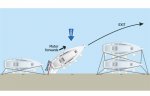
This method seems to work well to get the bow a good way out and has the advantage of using a short line right where you can handle it directly:

LRSPRING_SPRONGING_2.jpg
Yachting Monthly

There is a video on YouTube if you type in Spronging Off.
 
Last edited:
East Cardinal has a good point.
The problem with springs is that to work well they need to be taken right forward or aft, the length of the boat, which makes them very awkward to get in quickly singlehanded. Shorter springs limit how far out you can get.

This method seems to work well to get the bow a good way out and has the advantage of using a short line right where you can handle it directly:

View attachment 67946
Yachting Monthly

There is a video on YouTube if you type in Spronging Off.

Which is why I use a loop brought back to the cockpit. I can take it way forward and still be able to bring it back in single handed while steering.

I prefer if possible to come out bow first going forward. When going forward I can decide where I want to go. In reverse, I don't get to decide. A long keeler decides some things for you.
 
East Cardinal has a good point.
The problem with springs is that to work well they often need to be taken right forward or aft, the length of the boat, which makes them very awkward to get in quickly singlehanded. Shorter springs can limit how far out you can get.

This method seems to work well to get the bow a good way out and has the advantage of using a short line right where you can handle it directly:

View attachment 67946
Yachting Monthly

There is a video on YouTube if you type in Spronging Off.

Oh, I like this idea-no worries about fendering-and once pointing out enough, easy to release and recover the line. I'm going to try it!
 
Oh, I like this idea-no worries about fendering-and once pointing out enough, easy to release and recover the line. I'm going to try it!

Various good techniques of springing off already described but sometimes when single handed it is still a challenge to recover the spring and motor off in time before the strong wind drives you back, particularly on a small boat. For these rare occurances i keep a very old and tatty warp (sometimes found in the boatyard skip and one that sinks) that i just slip from the boat and leave it behind.

Www.solocoastalsailing.co.uk
 
East Cardinal has a good point.
The problem with springs is that to work well they often need to be taken right forward or aft, the length of the boat, which makes them very awkward to get in quickly singlehanded. Shorter springs can limit how far out you can get.

This method seems to work well to get the bow a good way out and has the advantage of using a short line right where you can handle it directly:

View attachment 67946
Yachting Monthly

There is a video on YouTube if you type in Spronging Off.

In my situation I actually need to make a 180, so this method looks like I could actually swing the bows through 120 or so and motor straight out....
 
For this sort of thing I use a length of 8mm ish, yellow, floating line. The stuff you see water skiers being towed about with. You can then double it around the shore cleat and secure it aboard with a turn which can be flicked off at the key moment, leaving the floating line behind you on the water till you have the leisure to bring it in.

Only drawback in a busy marina is that you can get red faced people bellowing that you have a line in the water, as you depart ;-)
 
Last edited:
You should still be able to walk the stern out. Have a large ball fender on the bow. Turn the wheel all the way to starboard, a short burst of forward power and the stern should move away from the pontoon. Make sure any forward movement is stopped. Then either reverse or use the bow thruster to get you in mid stream.

This is the answer !
 
Top