Hammerite Special Metals Primer

Skylark

Well-Known Member
Joined
4 Jun 2007
Messages
7,667
Location
Home: North West, Boat: The Clyde
Visit site
There have been many comments in numerous threads as to the virtues of this primer. I used it on my Flex-o-Fold 3 blade prop for the first time at the beginning of the season.

For the previous 5 years I used Primocol plus Trilux 33. By the end of my 6-month season most of it had been washed-off and the prop anode almost deplete. There was fouling of the prop. After a 20 minute soak and brush in 50% dilute, B&G Brick Cleaner, it looked like new.

At the end of this season the prop anode had significantly more metal left. Most of the Trilux had gone but the Hammerite was still adhered to the prop. There was less fouling. After 20 minutes soak and brush in brick cleaner the remainder of the Trilux had gone but the Hammerite remained intact. All that is required is a quick rub-down with emery paper and over coat, ready for Trilux 33 just prior to launch next year. Impressive.

I'm fairly convinced that this paint has significantly reduced the surface area of prop bare metal, reducing the potential for electrolysis, hence anode depletion.
 
There have been many comments in numerous threads as to the virtues of this primer. I used it on my Flex-o-Fold 3 blade prop for the first time at the beginning of the season.

For the previous 5 years I used Primocol plus Trilux 33. By the end of my 6-month season most of it had been washed-off and the prop anode almost deplete. There was fouling of the prop. After a 20 minute soak and brush in 50% dilute, B&G Brick Cleaner, it looked like new.

At the end of this season the prop anode had significantly more metal left. Most of the Trilux had gone but the Hammerite was still adhered to the prop. There was less fouling. After 20 minutes soak and brush in brick cleaner the remainder of the Trilux had gone but the Hammerite remained intact. All that is required is a quick rub-down with emery paper and over coat, ready for Trilux 33 just prior to launch next year. Impressive.

I'm fairly convinced that this paint has significantly reduced the surface area of prop bare metal, reducing the potential for electrolysis, hence anode depletion.

The trouble with prop anodes is that they are directly fastened to an object , the prop, with a large surface area and made of a very "dissimilar" metal alloy

There is a about 0.8 volt or so between zinc and the alloys used for folding props . This will cause rapid loss of the zinc by " galvanic corrosion". Anything which reduces the effective surface area of the prop should slow down this loss. Your experience shows that Hammerite Special Metals Primer is effective in doing this

The term "electrolysis" is usually reserved for a situation where the corrosion is driven by an external emf, such as leakage from the DC system. It is a very much more serious matter and can lead to very rapid loss of underwater components ......... even an entire sail drive leg before your realise what is happening. That happened to Nigel Mercier's sail drive
 
Last edited:
I have been posting the virtues of Hammerite Special Metals primer for quite a few years now. It was worked perfectly for me on bronze/brass, aulminium and zinc. It dries somewhat glossy, so needs abrading before applying another paint such as Velox or another Hammerite.
 
I wonder could HSMP + Trilux etc., be used on the external flanges of skin fittings in order to slow down dezincification?

Yes, I am sure it could. Anodes do very little for dezincification, zinc trying to protect zinc is never going to be a success, so painting is a useful alternative. My original P-bracket dezincified despite being bonded to a hull anode. I removed the anode and have painted the P-bracket ever since.
 
HSMP has transformed by Volvo folding propeller anode erosion for the past 5 seasons. Spray on anti fouling still only lasting circa 5 months though. I might try brushing on Trilux next year
 
As someone with an embarrassing lack of knowledge in relation to galvanic corrosion and electrolysis this is all very helpful. Is it fair to say that painting a prop and propshaft external to the Hull is recommended to slow down corrosion? The prop and shaft on my dockrell 37 are bare metal and the propshaft anode does need replaced...
 
As someone with an embarrassing lack of knowledge in relation to galvanic corrosion and electrolysis this is all very helpful. Is it fair to say that painting a prop and propshaft external to the Hull is recommended to slow down corrosion? The prop and shaft on my dockrell 37 are bare metal and the propshaft anode does need replaced...

Any paint or grease or whatever that prevents seawater from being in direct contact with the surface of metal will prevent or slow down the corrosion caused by different metals in contact with each other and immersed in seawater. The advantage of a good primer/paint compared to grease or other more "traditional" coatings is that it will remain in place and continue shielding the metal for longer. :)

Richard
 
As someone with an embarrassing lack of knowledge in relation to galvanic corrosion and electrolysis this is all very helpful. Is it fair to say that painting a prop and propshaft external to the Hull is recommended to slow down corrosion? The prop and shaft on my dockrell 37 are bare metal and the propshaft anode does need replaced...

Painting the propeller reduces the size of the cathode and thus increases the effectiveness of the anode(s). My prop anode used to barely last a season and the shaft anode was wasted after two. Since I began painting my prop with HSMP and Velox my prop anodes easily do two years and I replaced the shaft anode after four years, although it could probably have done more.
 
Are there reasons for not painting a propeller with ordinary antifouling? Would it be alright to paint my Autoprop with a copper rich antifouling? (Assuming that it would stay on for a reasonable length of time).
 
Are there reasons for not painting a propeller with ordinary antifouling? Would it be alright to paint my Autoprop with a copper rich antifouling? (Assuming that it would stay on for a reasonable length of time).

I think the normal soft antifoul would erode quickly on a spinning prop. Also, if you use copper based antifoul near aluminium sail drive or other emersed components it encourages electrolytic corrosion. Now I'm not sure if any leisure use antifoul available still contain copper, but that was why I changed to the spray on type a/f for the sail drive leg years ago.

Possibly current EU a/fs have no copper content so could be used on aluminium emerged components, but I personally wouldn't chance it.
 
I think the normal soft antifoul would erode quickly on a spinning prop. Also, if you use copper based antifoul near aluminium sail drive or other emersed components it encourages electrolytic corrosion. Now I'm not sure if any leisure use antifoul available still contain copper, but that was why I changed to the spray on type a/f for the sail drive leg years ago.

Possibly current EU a/fs have no copper content so could be used on aluminium emerged components, but I personally wouldn't chance it.

Mine is a conventional shaft drive, so no aluminium to worry about. I do still have some (ex MOD) copper antifouling, which gives excellent results on the hull, but have so far resisted from applying it to the prop, in case there might be a reaction between the copper and whatever bronze that the propeller is made of.
 
I would agree anode consumption definitely dropped after painting with HSMP, downside is the barnacles love it. This was ten weeks worth. I tried painting with trilux 33 but it fell off despite abrading the primer. Maybe I should have added some barnacle juice.
20190912_170632_resized.jpg
 
I have been posting the virtues of Hammerite Special Metals primer for quite a few years now. It was worked perfectly for me on bronze/brass, aulminium and zinc. It dries somewhat glossy, so needs abrading before applying another paint such as Velox or another Hammerite.

Vyv, it was your favourable comments that led me to try HSMP last season, many thanks. I’ve had good experience with Trilux 33 on the saildrive leg and the plastic bow thruster but found that it washes away quite quickly on my prop (regardless of primer). Is Velox longer lasting on a prop. In your experience?
 
Vyv, it was your favourable comments that led me to try HSMP last season, many thanks. I’ve had good experience with Trilux 33 on the saildrive leg and the plastic bow thruster but found that it washes away quite quickly on my prop (regardless of primer). Is Velox longer lasting on a prop. In your experience?

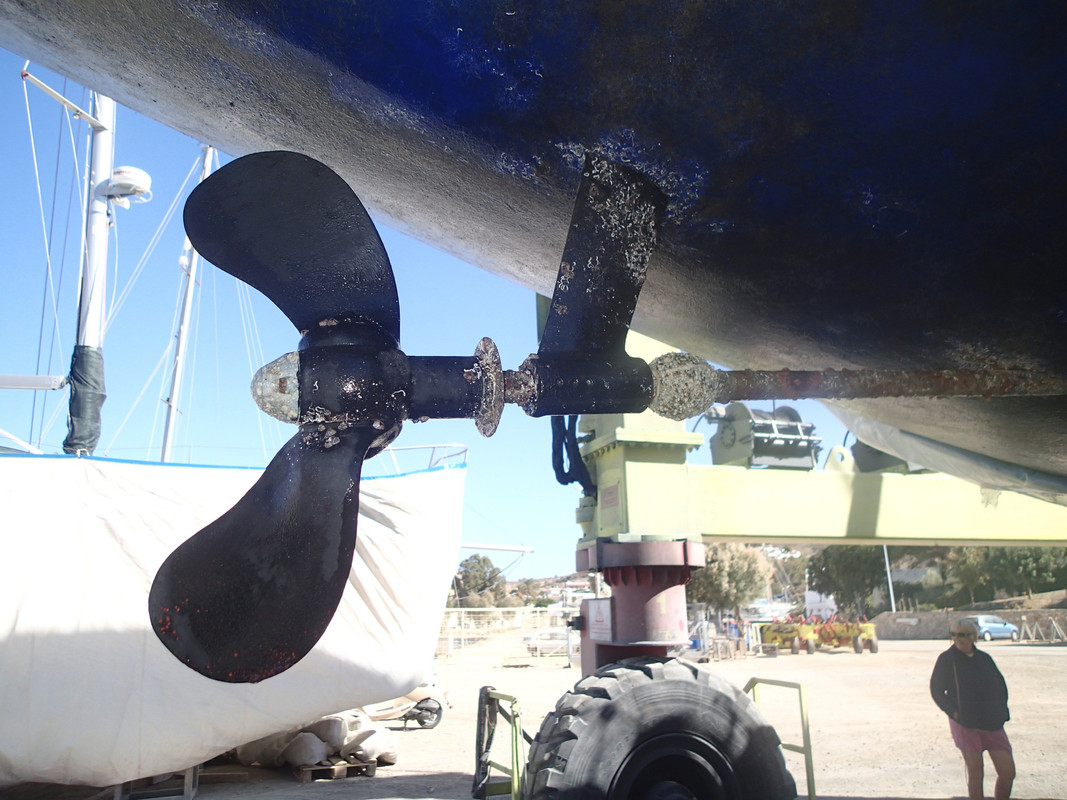
My boat is only afloat for half the year, in the Aegean Sea, so I cannot give longer term advice. This pic shows the boat hauled out at the end of the 2018 season, Velox intact and working fairly well. We spent a longer time than usual in port in the 2018 season due to unfavourable weather, contributing to more growth than we are used to seeing.

 
Mine is a conventional shaft drive, so no aluminium to worry about. I do still have some (ex MOD) copper antifouling, which gives excellent results on the hull, but have so far resisted from applying it to the prop, in case there might be a reaction between the copper and whatever bronze that the propeller is made of.

Copper is anodic to brass and bronze, so any reaction should result in loss of the copper. In the past I have applied conventional antifouling to propellers but it never lasted a full season.
 
Copper is anodic to brass and bronze, so any reaction should result in loss of the copper. In the past I have applied conventional antifouling to propellers but it never lasted a full season.

Ah. Presumably that explains why the antifouling within about 6" of the pear shaped hull anode, seems to have broken up.
 
Ah. Presumably that explains why the antifouling within about 6" of the pear shaped hull anode, seems to have broken up.

It is a confusing topic (well, it confuses me!). Here is an image that I assume are similar to those you describe. In this case it could be argued that the copper in the antifouling has been consumed in protecting the brass/bronze fittings.


However, here are a couple where the coating has failed around anodes that are anodic to the copper.


This is sometimes described as cathodic disbondment, although that term is normally applied to the lifting of coatings on metal substrates. All of these hulls are GRP. At least one authority suggests that the problem is due to over-protection by anodes, leading to hydrogen blistering that lifts the coating. There is also a tendency for calcium-based marine organisms to attach themselves to these areas, leading to large white deposits.

It seems to me that these are two types of coating failure that look very similar but occur for diametrically opposed reasons.
 
It is a confusing topic (well, it confuses me!). Here is an image that I assume are similar to those you describe. In this case it could be argued that the copper in the antifouling has been consumed in protecting the brass/bronze fittings.


This is sometimes described as cathodic disbondment, although that term is normally applied to the lifting of coatings on metal substrates. All of these hulls are GRP. At least one authority suggests that the problem is due to over-protection by anodes, leading to hydrogen blistering that lifts the coating. There is also a tendency for calcium-based marine organisms to attach themselves to these areas, leading to large white deposits.

It seems to me that these are two types of coating failure that look very similar but occur for diametrically opposed reasons.

We I'm glad it is not just me that gets this phenomena around a zinc anode, nice to put a name to it too!
 
Thanks for that Vyv. Mine was very like examples 2 and 3. To get round it, I have used ordinary antifouling close to the anode.
 
Top