
Halyard deflector

Tim Good

Well-Known Member
Joined
26 Feb 2010
Messages
2,888
Location
Bristol
Visit site
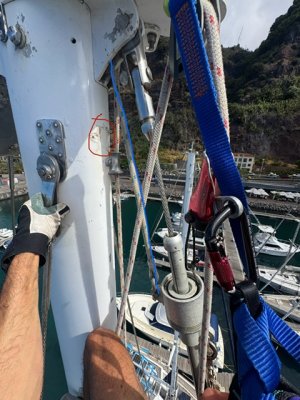
In this photo you can see the blue line is my Genoa halyard. It goes directly to the furling gear. In the red circle was a halyard deflector which pinged off going to Madeira.

As you can see the halyard has a reasonable run directly to the head of the furler. Presumably the deflector was installed to guard against halyard wrap, but in this case do you feel it’s strictly necessary to reinstall?

IMG_8208.jpeg
 
I think without something you will likely get wrap - that's a very shallow angle approach as it is.

Can you not use the deflector that the red flecked rope is going through?

Another option is a halyard deflector wheel (disc) that fits on the forestay just above the foil to create the necessary angle, but guess you would need to disconnect the forestay to fit it, which would probably be more trouble than fitting a new deflector to the mast. I also think those wheels are less satisfactory than the mast-mounted deflectors.

I think the original position of the deflector looks a bit high and like it still leaves a rather shallow angle to the genoa, though it's hard to be sure from the photo. Did it work fully satisfactory? At least a lower position might (also) be satisfactory, and avoid the existing holes from the previous deflector if they complicate fitting a new one.
 
IMHO ... fit a new deflector .... OR do as I have - a two halyard design - which was an alternative suggestion in the first days of furlers ....

EBgHerWl.jpg


With that - you can ignore all that crap about halyard tensions etc furling / unfurling ... it works !

Yes I know that genny and furler are short for the stay length ... not my fault - that was per previous owner who measured short.
 
I’ve actually got some 316 helicoils which I used on the mast for another heavy duty job a couple of years back. I might use those as they’ll be super strong.

Monel will be fine, I am getting confused another project. Use Duralc or Tefgel. I prefer Tefgel and have a few fittings own the boat attached with that coating the surfaces and no issues so far. On a recent turning block repair, I made stainless bases and used a plastic gasket between the alloy turning block and base, with the allow and stainless machine screws coated in Tef Gel. Personally I would not use the stainless inserts, unless the mast holes are oversized already, but just use the Monel pop rivets with the rivets and deflector plate coated with Tefgel

Pardon our interruption...
 
Last edited:
Monel will be fine, I am getting confused another project. Use Duralc or Tefgel. I prefer Tefgel and have a few fittings own the boat attached with that coating the surfaces and no issues so far. On a recent turning block repair, I made stainless bases and used a plastic gasket between the alloy turning block and base, with the allow and stainless machine screws coated in Tef Gel. Personally I would not use the stainless inserts, unless the mast holes are oversized already, but just use the Monel pop rivets with the rivets and deflector plate coated with Tefgel

Pardon our interruption...
Thanks. Yeah I’ve got some Tef Gel and some duralac. By the time I’ve clean out the existing holes and removed any corroded aluminium then the hole could be quite large. Tether then making new holes below for a new fitting then I figured drilling in the heli coils might be both strong and use the existing holes
 
I think perhaps monel rivets is the best choice based on strength and corrosion resistance. A plastic membrane between the fitting and the mast is a great idea, sticky back plastic for example. This simple solution solved a major problem for Hobie Cat some years ago.
 
I've a halyard deflector, but still suffered from a tendency of it trying to wrap, thus I attached the byte end of the halyard to the top end of the halyard, sort of like that in post #6, although it comes directly downwards with the tension on it to allow it to do the job. It's worked now for a couple of seasons without any worry, although the purist will say something about the added windage.......
 
I've a halyard deflector, but still suffered from a tendency of it trying to wrap, thus I attached the byte end of the halyard to the top end of the halyard, sort of like that in post #6, although it comes directly downwards with the tension on it to allow it to do the job. It's worked now for a couple of seasons without any worry, although the purist will say something about the added windage.......
The inherent problem with the diverter / 'doughnut' solutions to halyard wrap - is that if the furling gear is stiff from salt or crud ... strong wind on the sail even if luffed .. the angle may not be sufficient to prevent wrap.

The addition of the small 4mm 'control' line I have (post #6) ensures this cannot happen. Most people will never need such modification, but I have shown it to a number of people who have subsequently added same.
The advantage also is that regardless of how smooth a diverter is - there will be a) wear on the halyard at the turn point, b) harder to tension the halyard due to its non straight lead. With my two line system .. halyard can be tensioned when straight, then 'control' line tensioned.

There is one factor though to bear in mind ... the two line system can actually hide a fault in the furling gear ... so each lay-up period - its worth doing a good check of the gear ...
 
I would replace it. A halyard wrap will happen at the wrong time, for example, when you are trying to furl the genoa because of a sudden increase in wind.
 
Top