
HALLBERG RASSY - why good?

I've read through many but not all of the comments. With reference to car marques, that depends on whether you're buying new or secondhand. I was watching an old re-run of Top Gear on Dave last night (or maybe the night before) and they had three old cars tested. Richard Hammond's BMW M3 was a wreck, while Jeremy's Ford Cosworth was in good health.

In a similar vein, when we were buying our first and current boat, we looked at an old Southerly ...it was a heap, and we ended up buying an upgraded and well-maintained Macwester. Likewise we've been on-board HRs and in my opinion you have to be objective when you're looking at them. An HR that's had a hard life could easily be a poor alternative to a cherished Jeaneau, Bavaria or Westerly etc, etc.
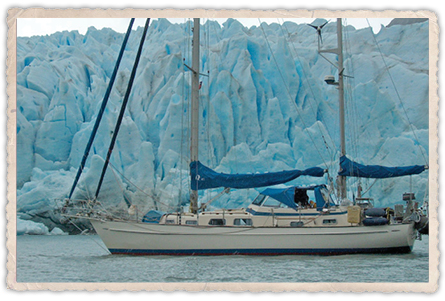
 
As the OP my interests are actually high latitudes amongst general global cruising also. I know some have said steel or alimiunum is a must for Greenland and then others have said good GRP is perfectly adequate. Does anyone know anyone that has take a HR ooop north? By the looks of this google image they clearly have but just curious on feedback?

fbw-halberg-rossy.jpg

see here:
http://belzebub2.com/?lang=en
link picked up from latest HR newsletter
 
There are many fabulous boat designs. The HR designs stand out in my opinion because of the attention to detail. For example the metal protective rubbing strip, high railing, grab rails inside and outside, rounded edges, storage, engine access, windscreen, spray hood, airing presses and so on.

My crew is my young children. We have endured some very heavy weather yet have never felt anything but secure. The boat's design rather than my skill should take credit.

And of course good service and peace of mind go hand in hand. My boat is 27 years old and I have yet to hear the work 'obsolete' from HR-Parts. Even the exterior 'look' is still, and thankfully so still à la mode.

Not flash, but definitely deserving of their reputation
{\colortbl;\red255\green255\blue255;\red0\green0\blue0;\red255\green255\blue255;}
\deftab720
\pard\pardeftab720\partightenfactor0

\f0\fs24 \cf2 \cb3 \expnd0\expndtw0\kerning0
\outl0\strokewidth0 \strokec2 \
}
 
Re-sale values are a major factor for some (certainly for me).

By coincidence I have just seen my old boat come on to the market - a HR36 MkII.

Price is £10.5k more than I paid for her in 2001 - and it is not an outrageous asking price.
 
Agree with FullCircle, as might be expected as I own the same boat, though the deep fin version. At the time I bought it I looked at the options of an older "quality" boat, and went for a less than year old Jeanneau. Have not done the same furniture mods as FullCircle, but have last year changed the (perfectly sound) brass seacocks for bronze with S/S handles.

HRs sell on really lovely interior joinery. They are generally very well built, but like almost every production boat they do a few things I don't regard as good. Many HRs have foam cored hulls, which are not my favourite, and most older ones start with a perfectly sound GRP deck and then drill hundreds of holes in it to screw down teak. Also they use brass seacocks.

HRs have a sort of split personality: they are, particularly the older ones, moderately heavy displacement pure long-distance cruisers, which makes them a bit stodgy in light-weather coastal cruising - the sort of day when you'd really like to be sailing. Yet they are so beautifully finished that you would not want to tie up alongside a rusty trawler in Valparaiso, or proclaim how much you can spend on a boat in Manaus.

I must say that the later ones are really quite desirable, as they have perked up the performance and allowed the excellent option of not having teak on deck.
 
I use the rafted out test. Heading ashore and walking over decks, the HR's I encounter always feel the most solid and reassuring underfoot for my heavy weight.
 
Not quite correct! Plenty of British built, but not company owned, cars built. Jaguar Land Rover, Mini, Toyota, Nissan, Honda, Aston Martin, Vauxhall Bentley and Rolls Royce. Also BMW and Ford build a lot of their engines here. What about Oyster, Rustler and Discovery and Gunfleet and dare I mention them Southerley!
My point is back in the 80's /90's when I supplied Westerly, going on board boats in build, the big Westerly finish and material were about the same as the HR , when looked over at the boat show. Yet we always grouped Westerly with the Jan/Bav/Ben range, not the HR build standard, the result was Westerly failed to sell against one group as to dear, the other as they were the wrong product group. We have this thing as a Nation of build status, like German cars we will pay 50% for a car because of the image, not that it's 50% better than a British built one, which we no longer have.

In this thread it's HR, Bav, Jan, Ben, no British boats.

Brian
 
I crewed this summer on a 14 (I believe) year old HR36. Very impressed with her all round sailing ability, build quality and motion. A little less impressed with the cockpit design and accommodation arrangements which I thought were trying to squeeze too much into a pint pot. But all boats are a compromise and I thought she was as good as it gets.
But we Brits have built yachts to a similar standard and size and quality. How about the Oyster Heritage 37, the Oyster 39 (ugly but very capable), the 435 etc. Unfortunately the smallest they now build is I believe the 45.
And the French can too. The Wauquiez boats were a quality job!
HR are quality boats, but they have quality advertising and PR too!
 
but have last year changed the (perfectly sound) brass seacocks for bronze with S/S handles.

.

My Jeanneau 43DS is now 9 seasons old and in the water 11 months a year.

How do I determine if the sea cocks are deteriorating?

Should they be replaced as a precaution? EDIT - I will replace next winter lift out plus all the standing rigging - don't you just love spending money on boats!!
 
Last edited:
Almost impossible to know if they are sound without cutting them through. As it happened I had to cut some of the skin fittings to get them out, as it was impossible to unscrew the retaining nuts due to access problems. Turned out that although some had pinkish surface staining (evidence of dezincification), both the through-hulls and the attached seacocks appeared sound. I cut through the worst-looking seacock metal to see what the inside was like, and it appeared solid and fine, as did the through-hulls that had to be cut away.

I could have put the uncut seacocks back in, replacing only the hose tails and the cut-through through-hulls, but replaced the lot anyway with better quality eg http://www.seaware.co.uk/Products/BRZ-BALL-VALVE--plus--SS-HANDLE--1-14__10981.aspx plus new bronze through-hulls eg http://www.seaware.co.uk/Products/BRZ-SKINFITTING---plus--HOSETAIL--1-14__10846.aspx and http://www.seaware.co.uk/Products/BRZ-HOSE-CONN--M-1-14-X-38MM__10972.aspx and new pipes and S/S hose clips.

The bits of the original Jeanneau fit that I did find were deteriorating were the hose tails that attach the pipes to the seacocks - two of these were becoming weak and slightly crumbly at at the very end. These looked a different colour (redder) brass than the other parts.

Unfortunately the fact that most of my Jeanneau-supplied plated brass seacocks were still solid (except for two hose tails) at 8 years does not mean others may be the same - corrosion can vary considerably by location, electrical installation and use, etc.
 
Top