GRP Core Material

rakaaw

Well-Known Member
Joined
3 Mar 2011
Messages
120
Visit site
I would welcome suggestions for a suitable material to use as the core of a 20mm thick fibreglass board.
I want to avoid wood because there will be several through fixings which will inevitably lead to water ingress.
I had almost decided upon PVC foam board but apparently this is prone to expansion when wet. Searching the internet I have found a product called Coosa Board which appears to fit the bill. It is an American product, which doesn’t
seem to be available here and is very expensive.
Would anybody here be able to suggest an equivalent to Coosa which is available in this country and reasonably priced.
TIA
 
Cores are often balsa / similar light wood or foam ....

Where fittings go through - it would be a matter of creating an epoxy area larger than the hole diameter - then drilling for the fitting.

On decks etc that have such work of extra fittings - the hole is drilled - then a bent L shaped nail in a drill is used to remove core material between the GRP top and bottom ... then epoxy poured in ... (clingfilm covered flat board under to seal bottom ... ) hole redrilled once epoxy set.
When fitting item - suitable sealant used as well.
 
. . . the hole is drilled - then a bent L shaped nail in a drill is used to remove core material between the GRP top and bottom ... then epoxy poured in ... (clingfilm covered flat board under to seal bottom ... ) hole redrilled once epoxy set. . .

I've just temporarily covered the underside hole with a bit of insulating tape until epoxy set. Seemed to do the job well enough.
 
I taped the underside when I epoxied deck core holes, worked well in some places but I had a few really annoying drips in others. The epoxy crept through tiny gaps surprisingly well after I'd gone home. I think next time I would tape the hole, then tape cling film over the tape over a wider area just in case.
 
I taped the underside when I epoxied deck core holes, worked well in some places but I had a few really annoying drips in others. The epoxy crept through tiny gaps surprisingly well after I'd gone home. I think next time I would tape the hole, then tape cling film over the tape over a wider area just in case.

They can put men on the moon, but still haven't developed anti-gravity epoxy! 😁
 
They can put men on the moon, but still haven't developed anti-gravity epoxy! 😁
Don't drill the hole all the way through both skins when installing a new fitting, until after the hole is filled. Obvious.

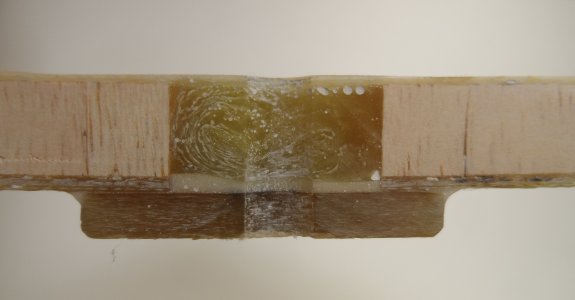
You can also remove a larger portion of one skin with a hole saw, fill with thickened epoxy (no drips), and then drill the hole. A bonded backing plate replaces the inner skin. More like a solid glass spot than just a sealed hole, since the area can be as large as you like. (This was a test piece before using this method on some high-load fittings on my F-24.)

Coosa is very good. Glass reinforced polyurethane boards of several densities. Unlike foam, the heavy grades are structural in their own right. It can be used as inserts within a foam or balsa panel during core replacement.

1770472350943.jpeg
 
Don't drill the hole all the way through both skins when installing a new fitting, until after the hole is filled. Obvious.

You can also remove a larger portion of one skin with a hole saw, fill with thickened epoxy (no drips), and then drill the hole. A bonded backing plate replaces the inner skin. More like a solid glass spot than just a sealed hole, since the area can be as large as you like.
New fitting, fine. This was replacing old ones that hadn't had any epoxy type treatment. I think I prefer the drips to the larger deck replacement I would otherwise have had to do.

Your coredrill approach is nice but presumably less of a bond between outer and inner skins than if it went some way into the sandwich like with the allen key approach? I've done something like that on occasion too though.
 
I would welcome suggestions for a suitable material to use as the core of a 20mm thick fibreglass board.
I want to avoid wood because there will be several through fixings which will inevitably lead to water ingress.
I had almost decided upon PVC foam board but apparently this is prone to expansion when wet. Searching the internet I have found a product called Coosa Board which appears to fit the bill. It is an American product, which doesn’t
seem to be available here and is very expensive.
Would anybody here be able to suggest an equivalent to Coosa which is available in this country and reasonably priced.
TIA
Are you looking for light and stiff or just none rot? Coosa board tends to get heavy as it absorbs resin during construction. It will also use plenty of resin.
We have used this core. Its excellent.
Epoxy Armacell PET Foam - Pro Quality - Fast Delivery - ECF
 
... Your coredrill approach is nice but presumably less of a bond between outer and inner skins than if it went some way into the sandwich like with the allen key approach? I've done something like that on occasion too though.
No, quite the opposite.

When you remove a core with a bent nail or other tool, you never really clean the core from the skins because of poor access. With this method, the new backing plate is clean and prepped, and you have good access to clean the upper skin. The only downside is that it takes a little longer, requires more prep, and creates more mess in the cabin. I would do it this way every time ... but I'm lazy, and for many things it's not that critical. How good is good enough? My F-24 is 30 years old, and distressingly many fittings were installed with no sealing at all, explaining why I'm skilled at core replacement .... 🥴
 
oh, I think I didn't follow right the first time, sorry. I was thinking of the plug edge-on to one of the deck skins but in your design the backing plate makes up for it. I agree the bent nail thing has limits, though perhaps not that bad.

The number of older makers that just drilled balsa core and no more is simply... daft. I laugh whenever I see "rock-solid Westerly quality" (etc) praised when they didn't bother to put a solid bit of glass in the deck where fittings were going to sit. My knowledge of putting small plugs in deck core is limited by the several times I needed to do larger patches instead, building a near-rectangular slab of epoxy-glass between the deck cores and then a little flowcoated plinth on top. I do think bonding to both sides over a decent area is pretty important, but your backing plate gets a similar effect.
 
The 'bent nail' method of clearing out between GRP skins has served many boats for many years .... its quick and easy ...

The matter of getting the 'space' wholly clean is actually not as important as one may think ... the important part is to get a more solid foundation for a fitting ... as long as the epoxy filling fills the space - the job is good. The fact of a few spots of old core missed - gets buried in the epoxy.
 
oh, I think I didn't follow right the first time, sorry. I was thinking of the plug edge-on to one of the deck skins but in your design the backing plate makes up for it. I agree the bent nail thing has limits, though perhaps not that bad.

The number of older makers that just drilled balsa core and no more is simply... daft. I laugh whenever I see "rock-solid Westerly quality" (etc) praised when they didn't bother to put a solid bit of glass in the deck where fittings were going to sit. My knowledge of putting small plugs in deck core is limited by the several times I needed to do larger patches instead, building a near-rectangular slab of epoxy-glass between the deck cores and then a little flowcoated plinth on top. I do think bonding to both sides over a decent area is pretty important, but your backing plate gets a similar effect.
Strange comment about Westerly. They were known to fit marine plywood pads in all the usual places for equipment like anchor winches, midship cleats, turning blocks, under the mast step, genoa and halyard winches, spinnaker gear, davits, etc. as it was simpler to fit the pads to all decks than dependant on which options were selected before being built.

If a previous owner fitted something in an unusual place without reinforcing the deck then that is not the builders problem. For example, I decided to fit side gates to my Fulmar. The new stanchion was in an area that part of the deck was balsa cored, so I used an alum key in a drill and epoxy filled as explained earlier in the thread.
 
I'm not talking about owner mods, I know the difference. Westerly used plywood pads for things like stanchions, but on many models they put coachroof fittings straight through balsa-core coachroof right from the factory, relying on sealant to keep the core safe. This is for stuff like hatch woodwork, spray rails, hatch garage, deck organisers where they knew exactly where it was going to go. Maybe your Fulmar as a larger top-end boat of its time has less of this, maybe not. My early Griffon, same build year I believe, has lots of it.

I didn't particularly mean to pick on Westerly as while mine & many others have these problems, so do boats from lots of other makers. On the other hand some manufacturers were avoiding this flaw as early as the 70s. It's not common in new boats, they have different problems. Boats with no problems don't exist 😁

It's not that hard to build in larger solid-glass strong-patches retrospectively. I had to do that for the deck organiser areas, which were too far gone to just reinforce the holes with the epoxy plug method.
 
I'm not talking about owner mods, I know the difference. Westerly used plywood pads for things like stanchions, but on many models they put coachroof fittings straight through balsa-core coachroof right from the factory, relying on sealant to keep the core safe. This is for stuff like hatch woodwork, spray rails, hatch garage, deck organisers where they knew exactly where it was going to go. Maybe your Fulmar as a larger top-end boat of its time has less of this, maybe not. My early Griffon, same build year I believe, has lots of it.

I didn't particularly mean to pick on Westerly as while mine & many others have these problems, so do boats from lots of other makers. On the other hand some manufacturers were avoiding this flaw as early as the 70s. It's not common in new boats, they have different problems. Boats with no problems don't exist 😁

It's not that hard to build in larger solid-glass strong-patches retrospectively. I had to do that for the deck organiser areas, which were too far gone to just reinforce the holes with the epoxy plug method.
Fitting hatch woodwork, spray rails and hatch garage are all none load items. None of these items has caused any leaks on my 1980 boat. The deck organisers are a load bearing fitting and should have had a plywood backing plates. Part of the problem may be that Westerly tried to make all deck fittings waterproof by fitting them to the deck before titting the deck to the hull. This meant they turned the deck upside down and glassfibred over all deck fittings to stop leaks. You should realise that sealants used 40 to 50 years ago have performed remarkably well for all deck fittings. Any slight movement could cause the sealant to loose adhesion causing a leak and the only place for the water to go was into the balsa core.

We all have to live with manufacturing faults to boats that were never expected to last for so long. I cannot remember the brand but one small builder used a mild steel plate to secure the forestay to the deck. This had no protection from salt water and rusted away. It was a pig of a job to fix, compared to a few pounds to have used stainless steel. Marine Projects, builders of Sigma and Moody yachts, used soft wood to secure the bottom of main bulkhead of the Sigma 33 and most have had rot problems there. No doubt there are many other builders who never thought of the long-term problems that might cost an owner dearly in the future. This is not just in the past as brass seacocks have been used in many factory built yachts and require replacement after about 5 years, whereas builders like Westerly used Blake's which are to a high marine quality meeting naval standards. The cost difference of the fittings are different, so why were the builders allowing the accountants to specify the cheapest against long term ownership. Simple, the main buyers are charter companies and they keep changing their boats before problems occur. Comes back to the PBO - poor bloody owner picking up the bill and the charter company making slightly higher profits as the original cost was lower. How the RCD ever allowed this has always surprised me.
 
Last edited:
Try Nidaplast - it's an octagonal plastic core bonded with fabric each side. No worries with water or drilling, comes in a nice 20mm depth , very light and dimensionally stable. Leaking holes only ever allow one 8mm honeycomb cell to get water in - its can't go further - and most importantly for those who are not super experienced its really easy to use. Cut with a stanley knife, etc and easy to get a very good bond with either polyester or epoxy. Foam isn't exactly hard to stick to but if you're not used to working with it then you'll find Nidaplast easier. It's also very cheap
 
Top