Ground tackle for Isles of Scilly

So if an Anchor is a SHHP anchor can a lighter one be used for the same hold as a HHP?
Have a look at the wording of these "HHP/SHHP" standards, basically anchors that hold 2x or 4x their weight (the holding of a stockless anchor)... Most modern anchors are holding tens of times so well, well above the shhp rating.
 
So if an Anchor is a SHHP anchor can a lighter one be used for the same hold as a HHP?

Yes.

The market is fixated by weight but an aluminium Fortress is clearly better than a steel Danforth of the same size and an aluminium Excel or Spade has similar characteristics to their identically sized steel versions - you would not tell the difference. A Viking has twice the hold of a Mantus if you compare 2 anchors of the same physical size (the Mantus is heavier)

Anchors work by design not weight.

A 15kg Delta or Bruce will develop a hold of about 1,000kg. In the same seabed, set alongside the Delta and or Bruce then a 15kg steel Spade, or Excel or an 8kg aluminium Spade or Excel will develop hold of 2,000kg. The current SHHP anchors are Rocna, Supreme, Knox (I believe) Excel, Spade, Ultra and Fortress - I might have missed one, some :). Neither the aluminium Spade or Excell have been included in SHHP testing (which also incorporates a Proof Load test)
If you test, for hold, Rocna, Spade, Excel, Knox, Supreme, Ultra in the same seabed under the same conditions they will return a hold of approximately 2,000kgs - for a 15kg steel anchor. Note if you double size - you do not double hold - it might increase by about 70%.


We sail a 38' cat of weight 7t - we use all aluminium anchors, Spade, Excel, Fortress and the Spade and Excel weigh 8kg. We were using a steel Spade and steel Excel and have retired them in favour of their identically sized aluminium versions. We also use 6mm high tensile chain - in a quest to save weight (but still offer the same strength and hold).
 
Last edited:
By definition, yachts tied up in marinas are not anchored or anchoring, so what does that tell us?
It tells us that when you walked round the marina they were there not at anchor.

It is when the boat is at anchor one is needed. Walking round looking at them would be far more difficult, what we can see is lots of boats safely at anchor and not littering the beach.

It would be interesting to see how many boats are lost each year to the failure of an anchor.

I know of a boat in the last month that has gone up in flames and sunk in a marina.
 
Have a look at the wording of these "HHP/SHHP" standards, basically anchors that hold 2x or 4x their weight (the holding of a stockless anchor)... Most modern anchors are holding tens of times so well, well above the shhp rating.

Not entirely correct.

The SHHP rating for leisure anchors was first awarded to Rocna and the measure was how the Rocna performed against a previously measured HHP anchor. I don't know which HHP anchor was used but the prime choice would have been CQR, Delta or Bruce. Since then SHHP anchors have been compared with other SHHP anchors, which initially was tested against Rocna. To be awarded SHHP all subsequent anchors had to be as good as a Rocna and then as other anchors achieved this designation the choice of standards has increased.

These tests are conducted in the presence of a representative from the Classification Societies CS, Lloyds, RINA, ABS et al.

However if you search for anchor testing by the media - for example search for 'West Marine', SAIL, YM, Anchor Testing 2006 you will find their results and virtually all testing has returned holds for the new designs twice that of the older designs. There is consistency - enough to believe in the data.. Another source would be Voile et Voileurs - but the article might be in French (though the 2 tests I recall were published in Y World or Monthly).

Anchor testing by the CS is expensive and there are good anchors that have not been awarded SHHP but would meet the requirement, for hold. For the non CS tested anchor check the media tests.

Jonathan
 
Last edited:
By definition, yachts tied up in marinas are not anchored or anchoring, so what does that tell us?

I find that if the chandler stocks CMP product then the common anchor in a marina is from CMP, Rocna, Vulcan. I f I walk round a Med marina, particularly eastern Med I find more Bugels, on German yachts and often made in Turkey. In the western Med I see more Brittany and Spade. I see more Spades on French yachts, whether in the Med or Tahiti. I see more Ultras on flash MoBos. I see Fortress on bow rollers on yachts in marinas in America. I virtually never see Fortress on yachts anywhere else (presumably they are stored below).

Anchor are bought from a convenient location, the local chandler. There is much nationalistic fervour in anchor choice. Americans defend any criticism of Mantus with a passion completely ignoring data.

Jonathan
 
Last edited:
The SHHP rating for leisure anchors was first awarded to Rocna and the measure was how the Rocna performed against a previously measured HHP anchor. I don't know which HHP anchor was used but the prime choice would have been CQR, Delta or Bruce. Since then SHHP anchors have been compared with other SHHP anchors, which initially was tested against Rocna. To be awarded SHHP all subsequent anchors had to be as good as a Rocna and then as other anchors achieved this designation the choice of standards has increased

There is no requirement for SHHP anchors to be tested against HHP, nor to be as good as any existing model let alone a specific brand, just take a "Hall" anchor (other name for lump of steel) and check that your anchor holds at least 4x (straight pull, variety of bottom, etc etc).
Anchors holding 10x ,50x or 100x will all be SHHP, it does not say anything about their relative performance.
Screenshot_20220606-064647_copy_762x640.png
 
Yes.

The market is fixated by weight but an aluminium Fortress is clearly better than a steel Danforth of the same size and an aluminium Excel or Spade has similar characteristics to their identically sized steel versions - you would not tell the difference. A Viking has twice the hold of a Mantus if you compare 2 anchors of the same physical size (the Mantus is heavier)

Anchors work by design not weight.

A 15kg Delta or Bruce will develop a hold of about 1,000kg. In the same seabed, set alongside the Delta and or Bruce then a 15kg steel Spade, or Excel or an 8kg aluminium Spade or Excel will develop hold of 2,000kg. The current SHHP anchors are Rocna, Supreme, Knox (I believe) Excel, Spade, Ultra and Fortress - I might have missed one, some :). Neither the aluminium Spade or Excell have been included in SHHP testing (which also incorporates a Proof Load test)
If you test, for hold, Rocna, Spade, Excel, Knox, Supreme, Ultra in the same seabed under the same conditions they will return a hold of approximately 2,000kgs - for a 15kg steel anchor. Note if you double size - you do not double hold - it might increase by about 70%.


We sail a 38' cat of weight 7t - we use all aluminium anchors, Spade, Excel, Fortress and the Spade and Excel weigh 8kg. We were using a steel Spade and steel Excel and have retired them in favour of their identically sized aluminium versions. We also use 6mm high tensile chain - in a quest to save weight (but still offer the same strength and hold).


Will going lighter not affect the ability for the anchor to set into tougher seabeds?
 
Will going lighter not affect the ability for the anchor to set into tougher seabeds?

Why do you think that?

The setting ability of the anchor is a function of its design and the tension in the rode. If there is no tension the anchor will not set, it will simply sit there (feeling abandoned and naked :)). The tension is dictated by your engine (if you power set), the movement of the yacht due to wind as you set and later the windage of your yacht. In order to set the anchor it needs to be pulled across the seabed and with movement the design, the shape of the fluke, the sharpness of the toe the geometrical relationship between toe, fluke edge and shank and the centre of gravity (its balance not its weight)

Gravity does not come into it. Or it does but equally for all anchors.


IMG_4753.jpeg

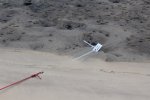
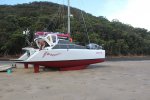
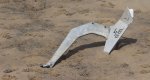
We beach our catamaran, see above, in a nearby isolated bay in order to wipe down the hull and check the anodes. There is a lot of time taken waiting for the tide to do its thing and I occupy myself by testing anchors. I also need some of the anchors if we are to stay overnight to ensue we don't float away. So we beach the cat and I deploy the anchors from either the transom or bow and set using sheet winch. The bow anchor is set using the windlass, one of the aft anchors, red dyneema rode, is set using the sheet winch. The anchors are all set underwater and then I wait for the tide to recede. Unlike King Canute the tide performs effortlessly. Sometimes I use an all chain rode and sometimes a short length of chain and an old dyneema halyard. These are a series of images all taken in the same bay at different times - but similar, or same seabed, same or similar rode.

This is an Excel anchor I have deliberately not set, much. I illustrates part of the setting process. I have simply tensioned the anchor with the sheet winch. The anchor has aligned itself, the shank roughly 'points' toward out cat and I have applied a small amount of tension. The toe has just engaged but the anchors is still lying on its side. This is a steel Excel, 15kg
IMG_7518.jpeg

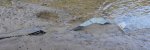
This the same anchor set at a different time, but same place. Slightly different rode. The anchor has set more deeply and is self aligning, it is becoming more symmetrical. Its not 'well' set but more tension would allow it to dive deeply and be symmetrical
IMG_9752.jpeg

This is not my work but of a friend who sails his cat in the Caribbean. This is his Rocna anchor well set, the anchor is symmetrical, or nearly so. This anchor weighs 33kg -and a bit big.

DSC00357 (2).jpeg

And returning to the bay we use - this is a well set Fortress. 8kg.

IMG_5028.jpeg

This set in a different location, 5m depth, 5:1 scope. Its an aluminium Spade anchor, you can see the fluke heel to the left, the green cord is attached to the rode. The fluke is well buried - as is the anchor chain.
phonto.jpg


All of these anchors have been set using the tension in the rode - no gravity involved - of they are all subject to the same gravity. Now tell me how the gravity has impacted them differently (at all).

On tough seabeds - if the anchor toe engages and starts to set then it is the tension that drives the anchor into the seabed. These anchors weight 8kg or 15kg. The rode tension will be 300kg - gravity is simply not significant.

Jonathan
 
Last edited:
Gravity does not come into it. Or it does but equally for all anchors.
While I agree with your sentiment, this just isn't true. Imagine a super lightweight plastic anchor (ignore the other reasons this is stupid!) that's almost neutrally buoyant but not quite. If there is insufficient weight to press the tip into the ground then it will rely on hitting and catching on something before it digs in. That will eventually happen but it will be less effective.. For this reason mass does come into the equation, but I agree at normal anchor weights doesn't actually affect the outcome all that often.
 
Thanks for the explanation Jonathan, I have been trialing a few different anchors at the moment being a 4kg, 6kg delta and a 6kg mantus. This is all on a relatively small 21ft trailer sailer with a low wind profile.

My main aim is finding an anchor easy to stow on the small foredeck.

I trialed the 4kg delta in a muddy estuary also in a known sandy anchorage and my 5hp outboard with the anchor warp made off astern would not budge the anchor full ahead with max throttle.
 
While I agree with your sentiment, this just isn't true. Imagine a super lightweight plastic anchor (ignore the other reasons this is stupid!) that's almost neutrally buoyant but not quite. If there is insufficient weight to press the tip into the ground then it will rely on hitting and catching on something before it digs in. That will eventually happen but it will be less effective.. For this reason mass does come into the equation, but I agree at normal anchor weights doesn't actually affect the outcome all that often.

I was sticking to reality. Anchor need to be well designed to set and hold but also be strong - they thus have a 'reasonable' weight. It is weight distribution and design. The Excel and Spade, aluminium version, both have weighted toes which allows the anchor to rotate such that the toe engages - this rotation depends on gravity - but I interpreted that was not the OPs question. Fortress works based more on design - the mud palms lift the heel up allowing one (sharp) toe of one fluke to catch or engage, it then 'rears up' on that toe and the stocking sticking our at the heel and this force one edge of the fluke to engeage (the angle determines the shape of the forward part of the fluke.

I do have a picture but on another computer .... and its late here :(


I have just read Yachtingsouthwest's post, see below

Have a look at a Kobra and or a Viking. Viking looks similar to a Mantus but for the same size will give you twice the hold, but for the same size is about half the weight. I have a Kobra it is a good anchor and there are enough people here who rely on it. Kobra is cheap and has a moveable shank that you might find easier to stow. Kobra you can get from many UK chandlers, Viking has stock, just refreshed, in Belgium and does mail order. I have a 10kg Viking a very good anchor, light weight, good hold (similar to the hold of the 8kg aluminium Spade and Excel or 15kg steel versions. I'd carry one but it does not fit on our bow roller, though I am wondering about carrying one - dismantled....?

An important characteristic for smaller anchors is the sharpness of the toe and Viking is very good. Sharp toes engage easily and once the toe engages - generally the anchor will then hold and set deeply. I'd suggest a small Excel - but as they come from Australia I fear they might be expensive (I simply don't know). Don't get carried away with weight and buy big, heavy chain - go for some 6mm chain and rope. Weight is a killer on a small yacht.


Thanks for the explanation Jonathan, I have been trialing a few different anchors at the moment being a 4kg, 6kg delta and a 6kg mantus. This is all on a relatively small 21ft trailer sailer with a low wind profile.

My main aim is finding an anchor easy to stow on the small foredeck.

I trialed the 4kg delta in a muddy estuary also in a known sandy anchorage and my 5hp outboard with the anchor warp made off astern would not budge the anchor full ahead with max throttle.

Take care, stay safe

Jonathan
 
I have just read Yachtingsouthwest's post, see below

Have a look at a Kobra and or a Viking. Viking looks similar to a Mantus but for the same size will give you twice the hold, but for the same size is about half the weight. I have a Kobra it is a good anchor and there are enough people here who rely on it. Kobra is cheap and has a moveable shank that you might find easier to stow. Kobra you can get from many UK chandlers, Viking has stock, just refreshed, in Belgium and does mail order. I have a 10kg Viking a very good anchor, light weight, good hold (similar to the hold of the 8kg aluminium Spade and Excel or 15kg steel versions. I'd carry one but it does not fit on our bow roller, though I am wondering about carrying one - dismantled....?

An important characteristic for smaller anchors is the sharpness of the toe and Viking is very good. Sharp toes engage easily and once the toe engages - generally the anchor will then hold and set deeply. I'd suggest a small Excel - but as they come from Australia I fear they might be expensive (I simply don't know). Don't get carried away with weight and buy big, heavy chain - go for some 6mm chain and rope. Weight is a killer on a small yacht.


Jonathan

Just had a look at the alloy Sarca Excels and cannot find them anywhere in the Uk for sale, I am toying with the idea of a 4kg Vulcan, or 4kg Kobra. Would like to avoid rollbars if possible found it an awkward obstruction on the mantus.
 
Yachtingsouthwest


I don't know Vulcan, other than seeing one and reading comments - but it probably is a better buy, but more expensive, than a Kobra.

Jimmy Green sell the SARCA Excel.

I had noted you had found the Delta adequate - but you have a trailer sailor and your local waters may extend to all of the UK - the rest of the UK is only a days drive away. Consequently the Delta make not work so well - everywhere.

Keep you eyes opened on eBay - people up and downsize anchors, find they have too many and a number have been bought by people on YBW. Mantus has a particularly larger roll bar, as does the Viking - look at Rocna - it has a smaller roll bar. If you were thinking of a Rocna, as you mull over your decisions, then consider a small Spade - it disassembles.

Jonathan
 
My main aim is finding an anchor easy to stow on the small foredeck.

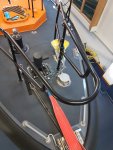
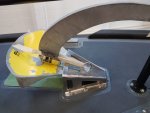
There are a number of options to storing an anchor. The RNLI need to work seriously on their foredeck and need to have the anchor handy - but not used as a lethal weapon on a bow roller.

Pictures courtesy of Barmouth RNLI. Spade on a Shannon
IMG-20220607-WA0007.jpegi
IMG-20220607-WA0004.jpeg


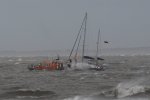
and, below, courtesy of the RNLI

Simply an example of the RNLI at work, Hoylake, Atlantic and off picture the New Brighton boat, attending to Quo Vardis in a Strong Gale - (the RNLI Crew have the white helmets) and the Atlantics had the Delta secured similarly, but not quite as neat as the Shannon).

shout to Quo Vadis (strong gale 9) 010.JPG

It is possible to find a way to secure an anchor on the foredeck. We have secured a spare anchor to the mast base.

The restrictions are the limits of your imagination

Jonathan
 
Top