GPSMAP 750/Raymarine ST60 compatibility?

Thanks for the reminder, I should take that down ...

You can feed the balanced output via a 1k resistor to an optocoupler, feed the output to the device via another 1k. It might work ...

View attachment 31265
Ignore the pin numbers!

Optocoupler example: http://uk.farnell.com/vishay-semiconductor/cny65/optocoupler-transistor-o-p/dp/1469507

Thanks will investigate that but will take a bit of time. I can't buy one off from Farnell can I, would Maplin do anything suitable? They have these http://www.maplin.co.uk/productsearch?criteria=optoisolator and this http://www.maplin.co.uk/productsearch?criteria=optocoupler

Question - I thought the standard was space high, mark low but this appears to be mark high doesn't it?
 
Last edited:
I can't buy one off from Farnell can I, would Maplin do anything suitable? ... I thought the standard was space high, mark low but this appears to be mark high doesn't it?

Yes, you can buy from Farnell. The Maplin (spit) 4N25 would probably do, but increase the input resistor to 1k5.

The circuit I posted will go high when the input is high, it doesn't "know" about mark-space.
 
Nigel

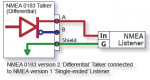
What about this idea (from Actisense) on connecting a differential talker to a single ended listener?
https://www.google.co.uk/url?sa=t&r...JDd6Sycz4Ma3O0w&bvm=bv.45645796,d.d2k&cad=rjt

To connect the device to the differential output, connect
‘NMEA +/A’ to the device’s ‘NMEA’ input and ‘Ground’ to
the ‘Ground’ on the single ended device. It should be able
to receive the NMEA data correctly.
Never connect the ‘NMEA -/B’ to the ground of a single
ended receiving instrument. The resulting extra load will
at best increase the current consumption of the driver, at
worst it could cause serious damage to it.

Of course the two grounds are already connected so I just have to remove the NMEA - to try this.
 
Last edited:
No it's not going to work like that. The Ray is not a full differential output. Look at the cct dia.
A is at a constant 11.2V (limited to 80mA) which goes to the listener's high input and will also appear at its low input - no differential voltage. B is floating.
I think B goes to ground for a pulse so that the voltage then appears across the listener's differential input.
So with the Garmin's input being single ended to ground , it is in effect constantly seeing on. Is that right?
I've tried to work out a way of doing it with resistors (at the expense of reducing the signal voltage) but I reckon your optocoupler is the right way.
A pox on them both for not doing it properly!
 
Are you sure of this. Mine doesn't!


Yes, however it us an ST50 not ST60. I just connected to it and it worked. The depth displays on the top strip of the Garmin the whole time. Speed only shows in chart mode when on the selected display data.

It would still prove Troubadours Garmin functionality or not.


This is the extract from the ST50 Tri Data plus manual
Chapter 7: Connection to other Marine Equipment

The ST50 Plus Tridata can only be connected to other SeaTalk products. However, the ST50 PIusTridata Repeater can communicatewith other onboard marine electronic equipment, using the NMEA0183 protocol.
A lm (3ftl NM!4 interface cable is supplied with every repeater unit. The red wire should be connected to the signal input. Up to two NMEA0183 receivers may be connected to each repeater with NMEAoutput.
The ST50 Plus Tridata Repeater has an NMEA0183 data output connector. The following information will be transmitted every 1 to 2 seconds if it is available on the SeaTalk bus.
RED (Signal) 2
i-‘-
BLUE (Ground)


Full manual here. http://turbo36.files.wordpress.com/2013/01/st50_plus_tridata_repeater.pdf
 
Last edited:
Indeed, and you asked previously if I had connected a Raymarine instrument, I simply at that time did not check the nicety of whether it was an ST50 or 60. Only when I just consulted my manual for the NMEA details did I see that it was St50., and I have now advised this.

I have a mix of ST50 ST60 and ST6000 auto helm. IMHO a simple confusion to make. Anyway surely the real question here is why Raymarine have reduced functionality of later equipment.
 
.. Anyway surely the real question here is why Raymarine have reduced functionality of later equipment.

Slight thread drift, but I don't think that they have. The ST50 & ST60 "Tridata" are both of very similar functionality. In fact the ST60 has repeater capability.
The ST50 "Tridata Repeater" can't be fed with transducer signals, and performs a different, slave only, function using either seatalk or NMEA. A direct equivalent seems to have been discontinued, presumably because Raymarine feel that the ST60 "Multi", and the later "Graphic" can perform similar roles, with greater functionality than the older instrument.
 
Checked the cct and found my Skanti radio has a pukka balanced RS422 output as expected (from a MAX483 chip).
I've tried connecting it to the Garmin as per Actisense's suggestion i.e. Tx+ to Garmin input, no connection to Tx- (see post 44) but the Garmin diagnostics still say no DSC sentence received.
However I don't know if that sentence should be present all the time or only if a position message is received by the radio.
 
Nigel
(Relevant comments from others also welcome of course!)
I had an alternative idea about the Raymarine connection.
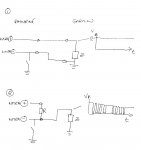
If I put R across Ray NMEA out + & -, and connect the out - to the Garmin NMEA in +, and the Garmin input impedance is Z, then the Garmin input will sit at approximately
12(Z/(R + Z))V for space and go to near 0V for mark i.e. it will have -ve going NMEA signal pulses.
Do you think that might work or will the Garmin insist on +ve going signal pulses?
Of course I can put another R in parallel with Z if Z is high to reduce V if necessary.
 
Of course I can put another R in parallel with Z if Z is high to reduce V if necessary.
I don't see why inverting the signal would help. A series and parallel resistor could be used to reduce the voltage, but is that the problem? Much better to use the opto-coupler, you can get it from my Farnell link above.
 
Last edited:
Sorry I obviously wasn't clear. Inverting is not the point. The point is that it is a way of getting a signal, at the moment there isn't any.
Basic situation is case 1 below. The Ray has a constant +ve output and switches the - to ground for signal. As the Garmin input is permanently grounded it overrules this and only sees a constant +ve voltage, no pulses at all.
I'm suggesting case 2 below which means the Garmin does see pulses, but they are negative going to near 0 from a +ve base of something up to 12V.


img089.jpg
 
Last edited:
ST60 to GPSMAP750 - success!

Thanks to Nigel for pointing me in the right direction.
Have used optocoupler as per the attached diagram, worked perfectly, my GPSMAP750 now receives NMEA sentences DBT, HDG, HDM, MTW, VHW and MWV from the NMEA output of the ST60 Multi instrument.
Total cost £3.47 for 5 devices and 10 resistors - enough to do 5 instruments!
Alternative was Raymarine's interface at £100 plus.
coupler.jpg
 
I realised that but it made sense. I needed pointing at optocouplers, was vaguely aware of them but no idea how simple and cheap they are.
The key thing was working out why direct connection didn't work.
Naughty Raymarine with a non-standard output, but not nearly as naughty as Garmin claiming the 750 is NMEA0183 ver 2 compliant. Its sentences are but not its hardware. They could have done it right for a few cents more.
 
Top