GPS for budget AIS system (eg Matsutec / Quark electronic etc)

Captain Crisp

Well-Known Member
Joined
1 Mar 2015
Messages
414
Visit site
Looking to buy a budget AIS system to hook up to my Raymarine A75 chart plotter which can use either NMEA 0183 or 2000.
Given that the chart plotter has built-in GPS, is there any reason to add a GPS antenna to the AIS (which some AIS models seem to require/offer as an option).
Thanks
Crisp
 
Receive only ais units don't need a gps. Save yourself a few pennies but I would rather be transmitting my position in bad conditions or crossing shipping lanes.

I recommend you talk to the UK agent for Onwa who are the established budget brand for AIS units. If I had a modern chartplotter I would have probably have opted for their latest black box unit class b+ unit which also incorporates wifi for data transmission to tablets and will connect with both old and new nmea standards.
 
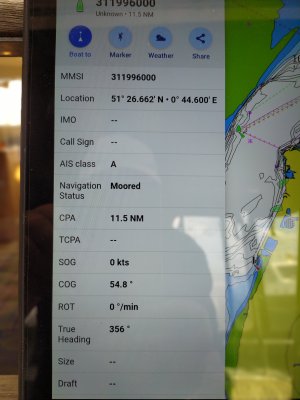
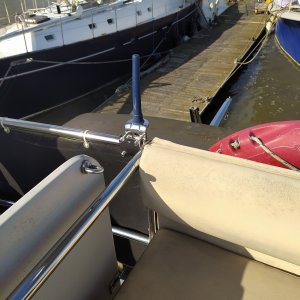
Just bought a Onwa KS 200a B plus from Alan at Aves marine, it comes with a GPS antenna, I also bought an ariel from him as well, arrived quickly unpacked today and a quick test up on the flybridge.
My plotters are legacy items so I already had a Yakker attached to a S.H. radio and used that for my tablet.
Worked fine, but the work starts tomorrow...
Just a word about Alan at Aves, a very nice helpful person to deal with.
Addition. Just seen above, that is a KS 200A plus with an integral GPS.
 
As far as I know AIS units MUST have their own dedicated GPS to comply with legislation. They can share VHF ariels, but not GPS.
Almost correct but not quite -
Legal Requirements (UK, EU, ITU, SOLAS context):

1. Class B AIS transponders (like the HA-102):

Must have a built-in GNSS (GPS) receiver or a dedicated external GNSS source that is integrated into the unit and always connected.

Required by IEC 62287-1, which mandates that position input must be automatic and not reliant on user intervention.
 
Almost correct but not quite -
Legal Requirements (UK, EU, ITU, SOLAS context):

1. Class B AIS transponders (like the HA-102):

Must have a built-in GNSS (GPS) receiver or a dedicated external GNSS source that is integrated into the unit and always connected.

Required by IEC 62287-1, which mandates that position input must be automatic and not reliant on user intervention.

For clarity, does this mean that AIS will not accept GPS from say a networked plotter, only a dedicated internal GPS or dedicated external GPS antenna plugged into an AIS port dedicated for that purpose.

For example, my Emtrak AIS is networked with my Axiom+. The Axiom+ can take GPS from its own internal GPS or from the Emtrak. I am assuming here that the Emtrak can not accept GPS from the Axiom+ because that is "user intervention" i.e. I can switch off.

Curious to understand.
 
For clarity, does this mean that AIS will not accept GPS from say a networked plotter, only a dedicated internal GPS or dedicated external GPS antenna plugged into an AIS port dedicated for that purpose.

For example, my Emtrak AIS is networked with my Axiom+. The Axiom+ can take GPS from its own internal GPS or from the Emtrak. I am assuming here that the Emtrak can not accept GPS from the Axiom+ because that is "user intervention" i.e. I can switch off.

Curious to understand.
That is correct. AIS transceivers must have a dedicated GPS, but can then share GPS data with other devices, as yours does. In your case, let the Axiom use its own GPS so it does not rely on the AIS being on/working. Disable GPS output in the AIS software.
 
This is a slight thread hijack but is pertinent to the topic so here goes !
When viewing "Vessel Characteristics" on an AIS receiver, does that data come from the details programmed into the AIS Transponder or does it just pick up the MMSI number & then get vessel length/draft etc... from MMSI details on file elsewhere in the web ?
The reason I ask is that I am considering buying a "Net Finder" AIS Transponder designed for fishermen to locate their drift nets/lobster pots. Really simple device with an inbuilt battery for 1 week of transmit but only a limited amount of data can be entered - definitely Callsign, ship name & MMSI but other fields vary depending on the model/brand. If all the AIS Transponder unit does is transmit GPS location and MMSI then one of these cheap basic AIS devices would suit my requirements perfectly without overcomplexification.
 
This is a slight thread hijack but is pertinent to the topic so here goes !
When viewing "Vessel Characteristics" on an AIS receiver, does that data come from the details programmed into the AIS Transponder or does it just pick up the MMSI number & then get vessel length/draft etc... from MMSI details on file elsewhere in the web ?
The reason I ask is that I am considering buying a "Net Finder" AIS Transponder designed for fishermen to locate their drift nets/lobster pots. Really simple device with an inbuilt battery for 1 week of transmit but only a limited amount of data can be entered - definitely Callsign, ship name & MMSI but other fields vary depending on the model/brand. If all the AIS Transponder unit does is transmit GPS location and MMSI then one of these cheap basic AIS devices would suit my requirements perfectly without overcomplexification.

Vessel details are entered into the AIS device via connection to laptop, tablet. phone and are transmitted with the AIS data. Did this a couple of months ago with my new AIS unit.
 
Thanks for response, I suspect thats not quite the full story though. When I look at Marinetraffic.com for example the "vessel details" often have a photo of the vessel along with classification fishing boat/sailboat etc... & other details. The photo is definitely not from AIS device so my question is what does it get from the AIS data & what from other sources (MMSI database ?). The photo is less useful but knowing if something is a trawler or an oil tanker is helpful. I'm trying to work out if I would be able to enter sufficient of my valid details on one of these net locators.
 
Thanks for response, I suspect thats not quite the full story though. When I look at Marinetraffic.com for example the "vessel details" often have a photo of the vessel along with classification fishing boat/sailboat etc... & other details. The photo is definitely not from AIS device so my question is what does it get from the AIS data & what from other sources (MMSI database ?). The photo is less useful but knowing if something is a trawler or an oil tanker is helpful. I'm trying to work out if I would be able to enter sufficient of my valid details on one of these net locators.

Edit: you may have a point about other databases. Various vessel tracking web pages know my vessel is flagged under the UK, Part 1 registration, I did not enter that in the AIS unit. Hence the MMSI / Call Sign might be getting cross checked outside of the AIS unit.

Marine Traffic and other vessel tracking service providers, get details from AIS unit. The photo is uploaded by being a subscriber to their system. Go to Marine Traffic, select a yacht that you know has AIS (or any vessel), go to the "General" box, there is an option to upload an image of the vessel. You need to create an account so that an image can be uploaded. In my case, the data in Marine Traffic is exactly as entered in the AIS unit and I have no image of my yacht loaded.

You can enter into the AIS vessel description from a list of vessel type, in my case "Sailing Vessel" was selected on the AIS unit and that is what is shown in Marine Traffic, along with the details noted below, on a Class B AIS unit.

Standard List of AIS Vessel Types

The Em-trak B900 Series AIS Manual describes the data that you enter via their software in section 3.6.2 Vessel data configuration using proAIS2. If you haver a Class A AIS unit, then more vessel details, such as voyage details, cargo, ETA, can be entered into the AIS unit (from other integrated systems, or a dedicated AIS terminal) and be transmitted for other vessels to see. Class B AIS units don't offer this functionality, as I understand it.

You will require the following information in order to configure your
AIS transceiver:
•MMSI
•Vessel name
•Vessel type
•Vessel dimensions and position of your GPS antenna
installation.

Raymarine's description of AIS types and features.
 
Last edited:
Thanks for response, I suspect thats not quite the full story though. When I look at Marinetraffic.com for example the "vessel details" often have a photo of the vessel along with classification fishing boat/sailboat etc... & other details. The photo is definitely not from AIS device so my question is what does it get from the AIS data & what from other sources (MMSI database ?). The photo is less useful but knowing if something is a trawler or an oil tanker is helpful. I'm trying to work out if I would be able to enter sufficient of my valid details on one of these net locators.
Users of MarineTraffic register online and provide details of their vessel including photos etc. AIS itself ONLY provides MMSI, name and VERY basic details of the type and size of the vessel.
 
Thanks for that very comprehensive answer Mr Runagroundhard. I'll get myself a Receiver to start with then Transponder when funds allow. I'm realising that AIS is very useful but if visibility is zero then Radar is still superior as not all vessels transmit AIS. I guess as costs come down then more pleasure boats will Transmit & the usefulness increase.
 
Top