GPS feed to DSC VHF from NMEA2k network

Red Panda

Well-Known Member
Joined
3 May 2017
Messages
175
Location
Fastnet
Visit site
I'm in the process of upgrading my instruments to a B&G NMEA 2k network, but so far I've ignored the VHF. The VHF is a fairly recent but basic DSC set, and only accepts NMEA 0183 as a GPS source. I don't have a separate GPS, only the inbuilt one in the new B&G Vulcan chartplotter.

The options, as I see it, are:
1. Upgrade VHF to NMEA2k compatible, e.g. Simrad RS12
2. Buy a 2k<->0183 converter (Actisense NGW1 or similar) to feed the GPS signal from the NMEA2k network to the VHF.
3. Buy a discrete (second-hand?) GPS with a NMEA0183 output, to feed GPS and as a backup.

The intention of moving to NMEA2k was to drastically simplify the wiring, so I'm reluctant to start adding much legacy kit, which leads me to favour options 1 or 2. Is there anything I've missed? Has anyone done a similar exercise?
 
Option 1 could be ok if you want a new VHF anyway and don't mind paying for it. Otherwise, I would choose option 3 over option 2. A standalone GPS receiver (basically just an aerial that emits NMEA, not something with a screen and buttons) will probably be cheaper than a specialist converter, and if you wire it up to the GPS's data and power connections then the whole set will be completely standalone, not relying on the navigation backbone.

Pete
 
Option 1 could be ok if you want a new VHF anyway and don't mind paying for it. Otherwise, I would choose option 3 over option 2. A standalone GPS receiver (basically just an aerial that emits NMEA, not something with a screen and buttons) will probably be cheaper than a specialist converter, and if you wire it up to the GPS's data and power connections then the whole set will be completely standalone, not relying on the navigation backbone.

Pete

+1 to all of that. A NMEA0183 receiver can be fitted under a deckhead or somewhere similar, internally, no need to run cabling outside. Mine, for instance, is stuck in the ceiling of an aft cabin wardrobe.
 
I had the exact same problem.

I thought it pointless getting rid of a perfectly working VHF especially when recoding the MMSI makes selling it neigh on impossible.

Instead, I bought a serial data cable (£35) for my handheld Garmin Oregon, that allows it to transmit GPS over NMEA 0183. It's mounted inside next to the VHF and picks up GPS and Glonass.

I had to do it this was, as I was already using the NMEA port on my Simrad MFD at baud 48000 for AIS from the VHF, and the MFD can only listen and receive at one single baud rate.

The other way to to do it, is to get the Raymarine SeatalkNG to Seatalk (basically NMEA0813) kit. This costs about £100, then you'd need a SeatalkNG to deviceNet cable (female) to connect it to either your MFD or your backbone network.
 
I used an old Garmin GPS45 that I found in the back of a locker. Powered directly off 12V, and an NMEA cable off eBay, straight to the VHF. The GPS45 can often be found on eBay for around tenner.
 
I used an old Garmin GPS45 that I found in the back of a locker.

Fair enough if you have one hanging around anyway, but a handheld cable-tied to a bulkhead seems a bit gash compared to a nice neat puck properly mounted.

Does it at least turn on automatically when power is applied?

Pete
 
I have a handheld - an old Garmin Etrex - on board as a backup GPS, but I'd like something a little more integrated.
Those of you who've used NMEA-connected GPS antennas, is there any particular make/model you recommend?
 
Last edited:
Fair enough if you have one hanging around anyway, but a handheld cable-tied to a bulkhead seems a bit gash compared to a nice neat puck properly mounted.

Does it at least turn on automatically when power is applied?

Pete

It doesn't turn itself on when power applied, but it's a triviality to push the power button once on every trip.

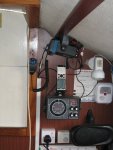
It sits in a purpose made cradle, screwed to the bulkhead, and the cabling runs trough conduit, so it looks decent enough. The bundle of cables tiewrapped on top of the VHF has been eliminated since that photo.

IMG_4704.jpg
 
I hadn't thought of getting just a NMEA-connected GPS antenna, I was considering a completely separate GPS system. Let's call it option 3b ;-

The Evermore SA-320 is often recommended, at about £80. This is less than a converter, and has the added benefit of redundancy so you don't have to turn the plotter on to get the radio working properly.
 
It doesn't turn itself on when power applied, but it's a triviality to push the power button once on every trip.

It sits in a purpose made cradle, screwed to the bulkhead, and the cabling runs trough conduit, so it looks decent enough. The bundle of cables tiewrapped on top of the VHF has been eliminated since that photo.

View attachment 68839

Works for you, clearly. But this kind of added visible kit is exactly what the OP said he's hoping to avoid.

Pete
 
Can I perhaps suggest option 3b with the addition of option 2 to follow...

The reason I use a separate GPS source is that my independent GPS and the VHF are on their own power breaker. They power on together and are the only items on this circuit. Useful if that's all you want to power on. Also in a due emergency, e.g. Batteries and floor boards under water, I can still power up that circuit with a motorbike battery in an upper locker. I digress... Anyway. I agree with others on the separate GPS input for the VHF.

I would however then add the option 2, the actisense, on the output from the VHF in order to display DSC distress positions on the plotter... and possibly even DSC position request replies as well, although that would be a bonus. You'd have to check the PGNs understood by the Vulcan.

I have a Standard Horizon DSC VHF connected this way to a couple of B&G Zeus plotters and they happily display this DSC information. Easy to then immediately see bearing and distance to any distress alert and exactly where it appears on the chart.
 
....
I would however then add the option 2, the actisense, on the output from the VHF in order to display DSC distress positions on the plotter.......
Good idea, but it'll have to wait until phase 2, which may also involve a Linux laptop / Raspberry Pi. I want to get the essentials installed and working first.
 
I have a handheld - an old Garmin Etrex - on board as a backup GPS, but I'd like something a little more integrated.
Those of you who've used NMEA-connected GPS antennas, is there any particular make/model you recommend?

GlobalSat BR-355 if you are able to make up a 5V power supply from the boat's 12V (the guts of a car charger USB socket thingy will do it). The BR-355 is about £31.
 
GlobalSat BR-355 if you are able to make up a 5V power supply from the boat's 12V (the guts of a car charger USB socket thingy will do it). The BR-355 is about £31.

That's what I have, with a power regulator chip on a scrap of veroboard rather than a dismantled USB socket. The BR-355 was closer to £20 when I did it, and today I'd buy a ready-made 12v -> 5v power supply from eBay for a couple of quid, rather than messing about with loose capacitors and chips.

Pete
 
GlobalSat BR-355 if you are able to make up a 5V power supply from the boat's 12V (the guts of a car charger USB socket thingy will do it). The BR-355 is about £31.

I had a similar problem, Most of boat runs on B&G fastnet backbone, bridged to NMEA2K for the newer plotter. That works OK, but the radio was lacking GPS position.
The best option was a garmin GPS 35 HVS - puts out position only and runs on 6-40V DC. No extra power supplies!! They were supplied as OEM gear for cars mainly. Dead simple to wire up - same power source as the Radio. https://buy.garmin.com/en-US/US/p/62
Found one (used) on Ebay for about £15. It lives behind the radio and works perfectly well.
If you have a separate 5V supply - you may find some "Serial" GPS modules which put out NMEA 0183 at "TTL" levels. That will generally work OK also , but will need environmental protection.
 
If you have a separate 5V supply - you may find some "Serial" GPS modules which put out NMEA 0183 at "TTL" levels. That will generally work OK also , but will need environmental protection.

That's essentially what the BR-355 is, but in a ready-made plastic case.

The bare circuit board version was under a tenner last time I looked.

Pete
 
Top