Googled "Replacing incandescent navigation lights with LED's"

aquaplane

Well-Known Member
Joined
16 Sep 2006
Messages
2,679
Location
West Yorkshire
www.utilitywarehouse.co.uk
And got this:
http://www.pbo.co.uk/news/warning-not-to-use-led-bulbs-in-filament-bulb-navigation-lights-23781

well, I'm not particularly bothered about insurance implications, which seems to be the main slant of the article, I want to be seen soon enough to be missed. Bearing in mind I'll be avoiding stuff too.

So, are the LED replacements bright? That's it, are they visible?

I won't be changing the fittings.

I'm not interested in "the best", I want good enough.

I'm sure this has been done to death but the Google search sent me into depression.

Crap internet so don't fire loads of questions at me and expect answers.

Thanks in advance.
 
Well strictly speaking the details of the item are correct. With the exception perhaps of LED bulb with different coloured LEDs for different sectors on a 3 colour mast top light. (made for the job)
The real question is... Does it make much difference and ... Is the boat then uninsured. I doubt very much for both questions. An insurance company would be pretty bloody minded to refuse a claim if you were hit at night because your lights were a bit dodgy in sector division or precise colour. But then individual must decide. olewill
 
And got this:
http://www.pbo.co.uk/news/warning-not-to-use-led-bulbs-in-filament-bulb-navigation-lights-23781

well, I'm not particularly bothered about insurance implications, which seems to be the main slant of the article, I want to be seen soon enough to be missed. Bearing in mind I'll be avoiding stuff too.

So, are the LED replacements bright? That's it, are they visible?

I won't be changing the fittings.

I'm not interested in "the best", I want good enough.

I'm sure this has been done to death but the Google search sent me into depression.

Crap internet so don't fire loads of questions at me and expect answers.

Thanks in advance.

Boatlamps are the experts in this field and offer a range of replacement LEDs for nav lights. You will find loadsa information and advice on their website https://boatlamps.co.uk/pages/navigation-lights-led-replacement-bulb-information

The one thing that stands out as not good enough is to use standard LEDs. They do not emit light in a continuous spectrum like filament lamps so there is no guarantee that they emit light that matches the colour spectrum of the coloured lenses. You have no knowledge of the light intensity and hence visible range when used in nav lights.

The use of Boatlamps warm white leds in red and green lights, bicolour and tricolour lights falls into the good enough category, although the use of cool white LEDs does not.

The better approach is to use the appropriate red and green LEDs in red and green lights, sectored LEDs in bicolour and tricolour lights and cool white LEDs in white lights.
 
Last edited:
And got this:
http://www.pbo.co.uk/news/warning-not-to-use-led-bulbs-in-filament-bulb-navigation-lights-23781

well, I'm not particularly bothered about insurance implications, which seems to be the main slant of the article, I want to be seen soon enough to be missed. Bearing in mind I'll be avoiding stuff too.

So, are the LED replacements bright? That's it, are they visible?

I won't be changing the fittings.

I'm not interested in "the best", I want good enough.

I'm sure this has been done to death but the Google search sent me into depression.

Crap internet so don't fire loads of questions at me and expect answers.

Thanks in advance.

Happy birthday. I have converted and have checked for colour and range at 2 miles and can't tell the difference. Just make sure you get warm white leds. Suppliers usually quote an equivalent wattage to a incandescent bulb but i suggest you go up to the next brightness as some of the claims are a bit optimistic and leds do get (very slowly) dimmer over time.

Www.solocoastalsailing.co.uk
 
The use of Boatlamps warm white leds in red and green lights, bicolour and tricolour lights falls into the good enough category, although the use of cool white LEDs does not.

Agreed. I have Boatlamps warm white in both my bicolour and tricolour. They are (a) much brighter than before and (b) clearly red, green or white. No possibility of a mistake. My green is green, and not that strange blue in the YBW photograph. Incidentally, I generally assume "this might invalidate your insurance" to mean "I don't have any good evidence, so I'd try some vague scariness." It's a very popular argument on Mumsnet.

The better approach is to use the appropriate red and green LEDs in red and green lights, sectored LEDs in bicolour and tricolour lights and cool white LEDs in white lights.

With the caveat - which you probably had in mind - that any old red and green LEDs may not be "appropriate". If they miss the colour of the lens as much they'll not do much. I would expect Boatlamps ones to be the right colours.
 
Last edited:
The better approach is to use the appropriate red and green LEDs in red and green lights, sectored LEDs in bicolour and tricolour lights and cool white LEDs in white lights.
In fact using green LED with a green lens could be worse than using a white one with the same lens. A green LED can easily be a single wavelength whereas a white one does at least attempt to cover the spectrum.
 
And got this:
http://www.pbo.co.uk/news/warning-not-to-use-led-bulbs-in-filament-bulb-navigation-lights-23781

well, I'm not particularly bothered about insurance implications, which seems to be the main slant of the article, I want to be seen soon enough to be missed. Bearing in mind I'll be avoiding stuff too.

So, are the LED replacements bright? That's it, are they visible?

I won't be changing the fittings.

I'm not interested in "the best", I want good enough.

I'm sure this has been done to death but the Google search sent me into depression.

Crap internet so don't fire loads of questions at me and expect answers.

Thanks in advance.

Yes, they are very bright. Much brighter than the incandescent bulbs, as judged by naked eye.

I have a NASA tricolour at masthead, and boat is easy to spot in an anchorage as it is usually brightest boat. The nav lights are just as bright. I also have deck level nav lights for inshore navigation, and I replaced the normal incandescent bulbs with LEDS - they definitely look brighter than the old angry ones.
 
Well strictly speaking the details of the item are correct.

Bebi, the company that supplied my replacement lamps, did a test with colour-measuring equipment using their warm white lights in the commonly-used Aquasignal housing. They found that all three colours were comfortably within the Colregs specifications, though it was indeed the green that was closest to the edge. They published the graph on their website, but sadly it's no longer available since the company closed down.

The sector separation problem is theoretically true (standing in front of the stationary boat at the pontoon I can see a narrow band where the light isn't clearly either colour) but it's not going to matter in practice at sea where everything is moving.

As others have said, the brightness and reliability of these lights make them safer overall than incandescents. Every connection in mine is soldered, potted in resin or adhesive, and sealed in plastic. Far better than a couple of bits of metal pressing together in a wet and moving environment.

Pete
 
Last edited:
Thanks for the info, looks like Boatlamps is the place to go.

I have 3 separate fittings , red and green forward and a white stern light all Hella 3562 10W ones.

The first job is to waterproof the cable entry glands, since a recent rewire they probably leak.
 
Have you considered replacing the entire fittings? Probably not much more expensive and you have the benefit of properly designed LED lamps. Also I would expect LED fittings to be much more waterproof than the old ones as they do not need to be openable to allow for bulb replacement; and more reliable as they don't rely on dodgy bulb contacts.
 
The MCA Guidance Note linked to from the PBO article is 8 years old. Things have probably moved on a long way in the LED bulb world since then.
 
The MCA Guidance Note linked to from the PBO article is 8 years old. Things have probably moved on a long way in the LED bulb world since then.

Maybe not so much with light spectrum they emit, physics doesn't change that much. Having datasheets for the LEDs used would tell. I roughly graphed out cree 503 red & green LEDs a while ago, one was well inside the IRPCS limits & the other was just inside can't remember which though..
 
I looked at a couple of cheaper LED nav light fittings - bicolour and stern, and chose not to buy them on two counts: they came with short wire tails so on a pulpit the light would have to have an external cable joints, and the LEDS inside just looked like plain white ones mounted at various angles - really did not look as thugh much thought had gone into design.

I have also compared a warm white 360 degree column festoon LED in a bicolour fitting against the incandescent original, at about 200 yards definitely considerably brighter than the incandescent, very little practical difference to the cutoff separation, and the red and green still looked red and green, though the green was a slightly bluer green, but still clearly green. I can't belive colour will change further just because of distance, and brighter has got to be better. Not scientific though.

The bulbs I used looked a bit like this - https://d114hh0cykhyb0.cloudfront.net/images/uploads/4210-xhp12-led-festoon-base-bulb-storejpg.jpg with the front face of three facing directly ahead.
 
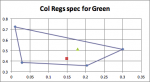
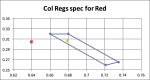
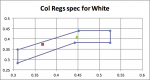
There are two main problems with LED replacements. Colour, as already stated, and angle. As regards colour, I did the modelling for this with the following results:

green.png
red.png
white.png

The boxes are the IMO specs for nav light colours. The green triangle is a typical incandescant bulb, and the red square a warm-white LED from Cree. The filters were pretty much perfect ones, ie brand new and un-faded or scratched: one that's not absolutely brand new won't be better! The white and green look ok and it was the red which looks a mite purple. However imho the colour resulting is unlikely to be perceived as anything but red so in my opinion it's not colour which is the real problem.

It is cut-off angle which is problematic. I don't see this as serious in nav lights which have seperate red and green lamps on either side of the bow, but in tri-colours it's a real problem. The resulting light looks white rather than red or green over quite an angle, maybe as much as +/- 10 degrees, and certainly +/- 5 degrees. This is because the light isn't a filament about 0.5mm wide but a distributed source about 8 times that width, with correspondingly poorer angular definition. I very much disagree with the poster above about this: I have certainly seen on many yachts absolutely dreadful cut off angles and really quite confusing signals.

In case anyone's interested, the process for colour modelling was:
- obtain the spectra of the light emitted b the sources (incandescent and LED)
- convolve these with the spectral response of typical filters
- convolve these two with the spectral responses of the three receptors in the eye(1), and sum, to give the three perceived intensities for each of the two sources
- normlise to get only colour info, not intensity
- convert to (x,y) colour coordinates
Obviously the white one was not passed through a filter.

(1) CIE 1964 Supplementary 'standard eye' model
 
Last edited:
Maybe not so much with light spectrum they emit, physics doesn't change that much. Having datasheets for the LEDs used would tell. I roughly graphed out cree 503 red & green LEDs a while ago, one was well inside the IRPCS limits & the other was just inside can't remember which though..

Physics hasn't changed since the dawn of time, but the range of LED bulb products available has evolved considerably...
 
Physics hasn't changed since the dawn of time, but the range of LED bulb products available has evolved considerably...

Well the graphs I showed were using data from recent bulbs (and in fact were made specifically for the work the results of which which were reported by PBO).
 
Top