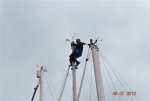
Going up the mast

You can get high enough on a bosuns chair if you tie the halyard to the ring at your waist.I can get higher if I want
masthead.jpg

I was up the mast for 2 hours 2 weeks ago in that hot spell so got a bit dehydrated I only used one halyard as it was 8mm dynema with 3 tonnes SWL

So what could possibly go wrong?

I had to drill holes for a new wind instrument. After 2 hours I was feeling a bit faint & drilled the holes wrong & had to drill one twice & rushed it.
Then had to come down a bit sharpish as I started to go giddy in the heat so could not finish it
When I got down my son said . " I thought you said this halyard was OK"
guess what I had been drilling? Fortunately I had not been able to finish the job due to feeling faint
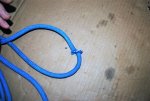
halyard 1.jpg
Cost me £ 200-00 for a new b..dy halyard!!!! Made me feel faint all over again
 
Last edited:
I had to drill holes for a new wind instrument. After 2 hours I was feeling a bit faint & drilled the holes wrong & had to drill one twice & rushed it.
Then had to come down a bit sharpish as I started to go giddy in the heat so could not finish it
When I got down my son said . " I thought you said this halyard was OK"
guess what I had been drilling? Fortunately I had not been able to finish the job due to feeling faint
View attachment 70744
Cost me £ 200-00 for a new b..dy halyard!!!! Made me feel faint all over again

Wow !!!
Great post BTW
 
Climbing masts doesn't need to be as difficult or complicated as people make out. Some good suggestions on this thread.

My own method is to use an external halyard, i.e. one that does not go inside the mast, as the primary means of ascent. One end is attached to my harness, and I pull on the other end to haul myself up. A second halyard, which can be an internal one, acts as a slack backup and SWMBO will take this up every so often and cleat it off, allowing me to have a rest. I generally have three stops before reaching the top.

To come down, the two halyards take the opposite role: the external one is given a few feet of slack and cleated off, and then SWMBO eases me down on the other halyard, stopping every time the first halyard pulls tight.

If one halyard were to fail, the furthest I would ever fall would be about six feet, which would be unpleasant but probably not fatal.

As others have said, do not trust bowlines or snap shackles. Use a figure 8 knot and/or spliced eyes and carabiners. Always use two separate halyards and eliminate single points of failure wherever possible.

After using the TopClimber thing, I'd never go back to being winched up a mast. The only person I would have trusted on that line, my father, has most lamentably snuffed it. With the TopClimber thing, the lines are always made off, there is no chance of jamming (or someone letting go!), and if I do faint at the top, or whatever (I'd hope I didn't as its not that much hard work getting up there and its like an armchair when I've arrived) I can get lowered down by someone at the foot of the mast lowering the rope.
 
Eee gads man! That's exciting... Did you have a backup line / fall arrester?

As my post stated - I only used one halyard.
I might normally have backed up with the topping lift but in the interests of windage & streamlining & changed this to a very thin line which would only carry the boom- not me.
I spoke to the local rigger & he said that he had done a similar thing when fitting a radar dome but always had 2 halyards when up the mast.
 
Last edited:
As my post stated - I only used one halyard.
I might normally have backed up with the topping lift but in the interests of windage & streamlining & changed this to a very thin line which would only carry the boom- not me.
I spoke to the local rigger & he said that he had done a similar thing when fitting a radar dome but always had 2 halyards when up the mast.

My topping lift is pretty beefy (I keep it as a sort of backup halyard I guess), but this time when I went up thats what I was going up to repair, so couldn't use it. I took my spinnaker halyard around the spreaders and used that for my fall arrester this time around. Alarming stuff, thank heavens you came back down when you did.
 
Most people draw their halyards every year to check them. Makes sense to do so before going up the mast.

If you're using an extra halyard as backup with a prussik tie it to the base of the mast and pre-load it; it's easier to slide a prussik up a tight rope. I use a pair of petzl ascenders which are a breeze to use on a tight line.

Don't trust your life to the strength of any single thing sailing related. Use the clutches by all means but then tie off.

Have spare halyards/prussiks/ascendeurs for plan B,C in case you drop something. Don't end up on the front page of 'All at Sea'.

Avoid shock loading anything. Sailing stuff is the antithesis of climbing stuff in that it is designed NOT to stretch. Shock loads will be huge.

Top of the mast is quite strenuous. I pass a snake sling over the mast head (avoiding any cables!) and then clip the ends to a sling that is run round the mast. You can then slip your foot in and stand up without doing the splits.

If you're replacing a bulb etc. dig out a pdf of the fitting before going up! Are the screws captive?

It's quite strenuous hanging about for any time. So suggest going up and coming straight down - it will give you confidence!

If you're lubricating the luff groove do so on the way down not on the way up. For some reason it wasn't obvious at the time.

Don't stand on the middle of the spreaders. Unless you're 9. They aren't designed to bend! Roots should be ok.

Tools in a bag is best. Too easy to tip a bucket. I tend to put an individual lanyard on heavy tools.

etc.

One more thing. If you need a foot hold or attachment mid mast, take 6' of line and tie a bowline loop in one end. Wrap the line half a dozen times round the mast and run the end through the loop. Pull on the end and it will lock solid.
 
Last edited:
I thought of the chain block because I happened to have one. Good point about reaching the masthead when sitting in the bosun’s chair, I will have to check the measurements. Thanks
A couple of short Prusik loops with thick rope around the mast at thigh height can give you a few extra feet to stand up if you can get your feet in them
 
+1 for loops - the built in loops with this kit help get well above the mast head (if you don't cock up like I did and have the join between the climbing rope and the halyard a foot from the top of the mast!)

1eWv8rSl.jpg
 
Last spring I struggled to bend on my furling headsail, so had to go up the foil to investigate.
I did this using my normal harness with a strop going around the foil, and a helper taking in the slack on two halyards. The actual climbing was done entirely by me, monkeying up the foil itself, and every time I wanted a rest I just asked him to make off the halyards. No winching involved.

I was surprised at how easy this was- possibly because of the angle involved. I wonder how much easier it would be with a sail bent on and furled? You'd then have much better purchase with your feet. Obviously you'd have to secure the furler to avoid rotation.

I'm probably a bit younger/lighter than the average yachtie but I'm giving this method serious consideration for this year's masthead inspection.
 
I did this using my normal harness with a strop going around the foil, and a helper taking in the slack on two halyards. The actual climbing was done entirely by me, monkeying up the foil itself, and every time I wanted a rest I just asked him to make off the halyards. No winching involved.

I was surprised at how easy this was- possibly because of the angle involved. I wonder how much easier it would be with a sail bent on and furled?

Agree. And for a mast climb grippy trainers and gloves enable the climber to do most of the work. My other half can pull me up by hand using this method. Anyone with a gym membership will know those chin-up machines where one pegs in a weight which is deducted from your body weight. If one can do say 20 reps with 20kg off bodyweight, then with the assistance of one’s feet and knees it is possible to whizz up in stages between the spreaders. Good fun too ;)
 
I use a'Mast Mate' type fabric loops ladder hauled up on the main halyard. The ladder is held close to the mast by 'slugs' running up the mast track. I wear a climbing harness attached by a short strop to a climber type 'ascender' to a taut spinnaker halyard. As I go up I push the ascender up ahead of me. If I fall it should only be a short distance.
At the masthead I use a safety belt round my waist and the mast. The ladder has a pair of loops(steps) at the same height so that I can stand with my waist just below the level of the masthead and work with both hands. To make standing more comfortable whilst working I wear stout walking boots and I have put timber inserts in the top steps to prevent the loops squeezing my insteps. A canvas bag is attached by a caribiner to the backstay so that parts and tools can be hauled up on an endless line.
The benefit of this system is that I can work alone and I can go up and down the mast as often as I need to. I reckon the modest outlay for this ladder has been well repaid. For instance it is easy to remove vulnerable masthead gear for winter and do a closeup mast check at the same time
 
Agree. And for a mast climb grippy trainers and gloves enable the climber to do most of the work. My other half can pull me up by hand using this method. Anyone with a gym membership will know those chin-up machines where one pegs in a weight which is deducted from your body weight. If one can do say 20 reps with 20kg off bodyweight, then with the assistance of one’s feet and knees it is possible to whizz up in stages between the spreaders. Good fun too ;)

I was on one boat where three of the crew used to compete amongst themselves to climb the mast without a harness. One of them went up once at Cork Week to play his saxophone whilst standing on the spreaders. I found it amusing that he put a safety line on his saxophone but not himself. Fortunately all of them still live and have grown old enough to be cautious and now go up attached to a halyard.
 
"I use a climbing harness with an advertisement attached."
Peter, what are you advertising?
QUOTE=pcatterall;6419846]Worth having dedicated kit for this job just in case you have to do it again in a hurry
I use a climbing foot board which you will find diagrams for on line. I use a climbing harness with an advertisement attached.
One fixed line has he foot board attached and this is where the main climbing effort takes place, the ascender is also on this line. Push ascender up to maximum extent, with weight on harness bend knees raising the foot board, stand up on foot board, raise ascender to maximum reach and repeat till you get to the top.
Sounds complicated but quick and not hard work.
You still should have lifeline of course but that crew has no lifting to do.
Coming down I use a figure of 8 descender but if you trust your crew they could lower you.
Good at sometime to get two folding steps at good working hight near the top
Enjoy[/QUOTE]
 
GM.....I guess I meant ascender though quite how this blooming predictive text managed to mangle that out of it I don't know. I can't turn it off and Gwyneth and I are having some interesting conversations where Northern of us knows what the other has written!!( Good example ....northern means neither!!!)
 
Top