Going to windward obsession!

If it was the recipe above, the process must have stank horrifically. We had a biology teacher, who, in the interests of science, boiled some of her own piss to dryness. The whole science block had to be evacuated. I recall it very clearly after48 years. I daresay the sails stank for at least months after that.
Sort of like tanning leather,that smells awful
 
Thames barges otherwise though, amazing boats. We don’t often see one on the south coast, but we used to be based in South Dock, Surrey Quays, then the Medway, so I am very familiar. I’d love to have a go. I have plenty of classic gaffer experience, does that help with sprit rigs?
 
Thames barges otherwise though, amazing boats. We don’t often see one on the south coast, but we used to be based in South Dock, Surrey Quays, then the Medway, so I am very familiar. I’d love to have a go. I have plenty of classic gaffer experience, does that help with sprit rigs?
we had a great day out with theses folks, they'll even take you racing

Welcome to Tiller & Wheel -
 
I read an account from the 1890s of a ship taking a cargo from the west coast of Australia to Melbourne. The wind was hard against them for week after week. They battled away but couldn't make any sustained progress, and in the end the skipper said f- it, turned around and sailed right around the world to reach Melbourne from the other direction.
Melbourne is on the south coast and the dominant wind is westerly so it was more likely going from the east coast, or from Melbourne to Perth, for example. You'd have to go past Melbourne to do a round the world from the west coast of Australia if going downwind.
 
Melbourne is on the south coast and the dominant wind is westerly so it was more likely going from the east coast, or from Melbourne to Perth, for example. You'd have to go past Melbourne to do a round the world from the west coast of Australia if going downwind.
Whichever way it was, it shows how important being able to make headway to windward is. Though anyone could be excused for not making windward ground in the roaring forties. You might well be just scudding, whichever way you meant to go.
 
Melbourne is on the south coast and the dominant wind is westerly so it was more likely going from the east coast, or from Melbourne to Perth, for example. You'd have to go past Melbourne to do a round the world from the west coast of Australia if going downwind.
Yes - I could well have remembered the direction wrongly! As it's a Sunday I'll see if I can find time to dig out the original story.
 
I think the Thames barges went pretty well to windward given their draft, cargo capacity, crew size and construction materials. But on the East coast there are times when you just wouldn't bother sailing to windward - for the middle few hours of a contrary tide that might reach 2-3 knots in the wrong direction, in a narrow channel, with safe anchorages all around, a non-perishable cargo and a rig that can be furled away in seconds, it's the most natural thing in the world to drop the anchor, do a few maintenance jobs and wait for the tide to turn. After all, if you're a year-round working sailor and you want to be able to use a fair wind and tide whenever you find one, you've got to rest and sleep sometimes.

Many years ago I read "Sailorman: Barge-master's Story" by Jim Uglow. Unfortunately it was a library book and isn't on my shelf. I'm pretty sure he spent a lot of time waiting for wind or tide. I doubt it was becaise the boat physically couldn't sail upwind. I prefer your theory. I've also got a vague recollection there was an element of "skive" to it as well.

I've just bought a copy on Abe Books. It's well due a reread. I'll report back if I was far off the mark.

If Jeremy Thomas' "Rythm of the Tide" is correct there was a barge that went between Emsworth and Chi Harbour entrance using nothing more than tide. Drifting it both ways. (It might not be accurate - the book is essentially fiction stitching fact together and all the better for it.)
 
Last edited:
For many years since retirement, we have taken the view that gentlemen do not beat. Before that, we had to rely on forecasts. On one occasion, I had to telephone my office (it was that long ago) and say that we were stormbound in St Peter Port. We came back with the tail end of a gale warning.
 
I was always amazed at the fortitude of so many club mates who managed to sail back across the North sea with a force nine on the nose, when force four was about my maximum in open water, and even that was pushing it over such a distance.
 
For many years since retirement, we have taken the view that gentlemen do not beat. Before that, we had to rely on forecasts. On one occasion, I had to telephone my office (it was that long ago) and say that we were stormbound in St Peter Port. We came back with the tail end of a gale warning.
Should have called the French Meto service for a forcast :rolleyes: :D :D :D
 
Saw this tiny but perfectly formed little boat today…in fact there are several in this port alone. And I thought of Wansey…these historical boats are often owned by societies, where someone like yourself could contribute your wood working skills and sailing knowledge….they are frequently taken out on the water


I was always amazed at the fortitude of so many club mates who managed to sail back across the North sea with a force nine on the nose, when force four was about my maximum in open water, and even that was pushing it over such a distance.
Since I started cruiser sailing in 1968 ( We will not count the silhouette in 1959 onwards) I have only encountered 2 instances of F9 in the N sea. Both times for a limited time. F9 is not a gust. It is measured across sustained wind forces. I expect that bar punditry always adds a force or two to the tale when the beer starts flowing in the club. It is only natural that sailors try to out do their fellows when describing those 20 ft breaking waves.
The prudent way to deal with it is NOT to sail to windward, but to heave too & wait.
 
Since I started cruiser sailing in 1968 ( We will not count the silhouette in 1959 onwards) I have only encountered 2 instances of F9 in the N sea. Both times for a limited time. F9 is not a gust. It is measured across sustained wind forces. I expect that bar punditry always adds a force or two to the tale when the beer starts flowing in the club. It is only natural that sailors try to out do their fellows when describing those 20 ft breaking waves.
The prudent way to deal with it is NOT to sail to windward, but to heave too & wait.
I've never met anything over F7 in open water, and that only with a free wind. That. perhaps is one advantage of sailing with a wife on board. In the rare case where a club-mate might have struggled back with an adverse wind, and our boats would have been less than 30' in those days, they would certainly have had a slant on the wind and done it in one tack. In decent conditions my 34 will get a VMG of about 4.5 kn, but in open water with F5 or more it would more likely be 2 or 3 at the most, which, for a 100 mile or more crossing would be just bloody awful.
 
Saw this tiny but perfectly formed little boat today…in fact there are several in this port alone. And I thought of Wansey…these historical boats are often owned by societies, where someone like yourself could contribute your wood working skills and sailing knowledge….they are frequently taken out on the water


Yes in the rias there is an active interest in the small inshore fishing craft.Afteryears of letting them go to ruin there are regattas all over.I had one which I put a new bottom on ,it was a bit like a dory with a lug sail but mainly they would be manned by four or six men and rowed out to the fishing grounds
 
Yes in the rias there is an active interest in the small inshore fishing craft.Afteryears of letting them go to ruin there are regattas all over.I had one which I put a new bottom on ,it was a bit like a dory with a lug sail but mainly they would be manned by four or six men and rowed out to the fishing grounds
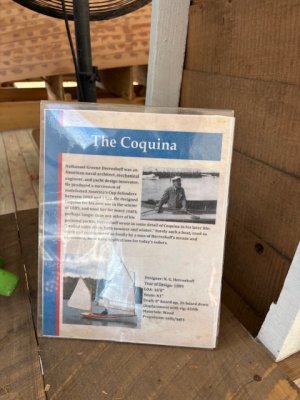
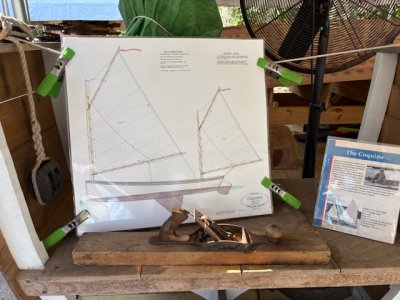
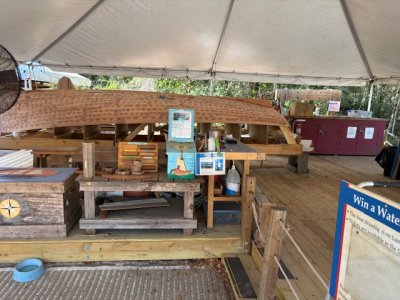
I saw a lovely Herreschoff cat boat being built in Florida and thought how much it would suit you. 2 crew quite sufficient.
IMG_1005.jpegIMG_1004.jpegIMG_1003.jpeg
 
Yes in the rias there is an active interest in the small inshore fishing craft.Afteryears of letting them go to ruin there are regattas all over.I had one which I put a new bottom on ,it was a bit like a dory with a lug sail but mainly they would be manned by four or six men and rowed out to the fishing grounds
Like this one that passed me while I was at anchor?


Top