Going to the dark side, finally

It’s also related to the amount of passengers and luggage...for example it might be a C for 8 passengers and a B for only 6
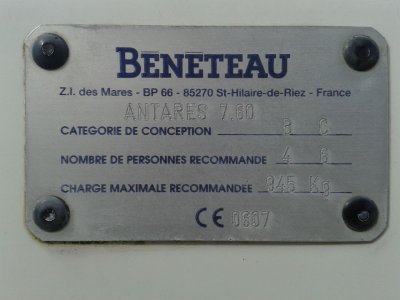
I have sometimes seen it mentioned that if a vessel is Cat B for 6 persons, it is, say, Cat C for 8 persons and Cat D for 10 persons, but is this actually in the RCD etc regulations or an urban myth? I would have thought that each category would require separate boatbuilder's testing and plating. Some RCD plates do show several categories but others show only one, the 'worst case'. If only one category is shown on the plate, do the other lower categories come automatically or not, and is it always 2 extra persons per category?
 
No they are not. The design and category needs to be externally verified and certified as meeting the standard. The only "self declaration" is that the boat is built to the appropriate standard. Post 18 is correct. The 2013 standards changed (among other things) the stability requirements for B rather than c and many builders had to either redesign the boat or change the category.
I am researching this now.....as far as I am aware (and correct me if I’m wrong)....the CE guildlines and rules are laid out by the appropriate EU body....manufacturers follow these guildlines an attach the appropriate CE mark....is there a government or Eu body that will take a (pre)production boat and subject it to sea trials to determine which mark it can carry ? They of course have a right of inspection
 
Very Unlikely - Thats what notified bodies are for.
manufacturers are self certifying - responsible for holding a 'Technical file' showing how they comply with the appropriate legislation.
Yes, thank you....that is what I was getting at....for example a big manufacturer with many ranges and sizes of boats...could have a boat that is good enough for a B (or could be with a little extra investment)....but would rather declare it C...so that it doesn’t detract sales from a larger boat in the same range...or another of it’s ranges with a more rugged image
 
According to the article I read, and have quoted there is this bit.
has undergone stability testing by Lloyd’s Register for compliance with the new Recreational Craft Directive Category B for use in wind speeds up to force 8 and wave heights up to 4 meters.
 
According to the article I read, and have quoted there is this bit.
has undergone stability testing by Lloyd’s Register for compliance with the new Recreational Craft Directive Category B for use in wind speeds up to force 8 and wave heights up to 4 meters.
Lloyds is a certifying body and stability is one of the requirements. The force 8 and 4m is the minimum for Cat B. Cat A is obviously higher.
 
The manufacturer can choose. Here is an example
View attachment 177016
They are not choosing. Payload is one of the factors and higher payload will reduce stability and in this case bring it down below the minimum for Cat B.

Nothing unusual. Many boats are certified in different categories, primarily because of payload. Once boats get larger and increases in payload have less impact on stability the dual category (lower for higher payload) tends to disappear.
 
Definitely not a myth, both my last two boats had two cert levels, the higher of the two being with fewer persons and load. One sail (had RCD A and B) and one power (had RCD B and C).
That wasn't my point, which was the case of a boat being plated/documented for one category only and people inferring/assuming that it automatically permits adding (usually) two persons for each lower category respectively. Some people do believe this. Is that a myth/old wives' tale?
 
I have sometimes seen it mentioned that if a vessel is Cat B for 6 persons, it is, say, Cat C for 8 persons and Cat D for 10 persons, but is this actually in the RCD etc regulations or an urban myth? I would have thought that each category would require separate boatbuilder's testing and plating. Some RCD plates do show several categories but others show only one, the 'worst case'. If only one category is shown on the plate, do the other lower categories come automatically or not, and is it always 2 extra persons per category?

Definitely not a myth, both my last two boats had two cert levels, the higher of the two being with fewer persons and load. One sail (had RCD A and B) and one power (had RCD B and C).

That wasn't my point, which was the case of a boat being plated/documented for one category only and people inferring/assuming that it automatically permits adding (usually) two persons for each lower category respectively. Some people do believe this. Is that a myth/old wives' tale?
Inference or assumption is wrong. It either is plated for one / two / three or not. If not, the. It has no certification for that. You might reasonably assume that an RCD B boat would be be fine in RCD C conditions but that’s not the same as assuming you can add two people. Or whatever.
 
Inference or assumption is wrong. It either is plated for one / two / three or not. If not, the. It has no certification for that. You might reasonably assume that an RCD B boat would be be fine in RCD C conditions but that’s not the same as assuming you can add two people. Or whatever.
Fully agree; 'adding two' might work most of the time but could turn sour if the MCA and insurers get involved after an incident. That said, it's a pity that the boatbuilders don't all issue multi-category plates/documentation, as per examples above. Presumably it would involve extra stability tests or calculations.
 
Fully agree; 'adding two' might work most of the time but could turn sour if the MCA and insurers get involved after an incident. That said, it's a pity that the boatbuilders don't all issue multi-category plates/documentation, as per examples above. Presumably it would involve extra stability tests or calculations.
The RCD was introduced for 2 reasons. First to harmonise standards and second to provide information to consumers so that they can make informed choices about their purchases. There is no intention to use these for determining where and how boats are actually used and there is no legal requirement at EU level to only use the categories as a basis for legislation on usage - even though many EU states (but not the UK) do. So there is no issue regarding insurance or the MCA getting involved.

In fact there was an incident involving a boat in a similar situation to that mentioned earlier where earlier examples under the original RCD were CatB but the change in stability requirements moved them into CatC. The boat involved in the (very serious) incident was a grey import from the US built under the old regs but imported after the new. It should have been replated as C by the importer. The incorrect plating did not have a material effect on the incident as the conditions were even more severe than CatB. The MCA recommendation was around the need for importers to comply with Trading Standards law (which is what CE marking is). Any prosecution would be under Trading Standards rather than operating the boat in unsuitable conditions. It might be different if it had involved a commercial operator, but they are covered by different laws unrelated to the RCD - that is Coding (in the UK) does not use RCD categories - at least not directly.

I think boat builders do plate with more than one category if it is appropriate and many boats in the 9-11m size are borderline for the higher category (C to B or B to A) primarily on the basis of the effect of payload on stability.
 
Top