GNSS Single point of failure

AntarcticPilot

Well-Known Member
Joined
4 May 2007
Messages
11,114
Location
Cambridge, UK
www.cooperandyau.co.uk
I've often pointed out that GNSS has a single point of failure, in that solar activity could, on rare occasions, knock out the entire constellation of satellites. This piece in the Register makes interesting reading! In this case it wasn't GNSS satellites, and the failure mode is one unlikely to affect GNSS satellites, but it does show that the big fusion reactor in the sky can and does affect spaceborn activities.
 
While I agree with the OP's warning that one should not become too reliant on GNSS, the example he linked to wasn't that relevant. The SpaceX system puts the satellites into a very, very low orbit in which they will reenter the atmosphere and burn up very quickly unless they move further out pretty much without delay. It was the disruption in this perilous phase which doomed them.

But the GNSS satellites are much, much bigger and are launched into higher orbits so wouldn't have been affected by this event. I also suspect that Musk and SpaceX were sloppy / gung ho in going for launch anyway, whereas the sober NASA or ESA operations would be more careful; I believe that solar storms are forecast to some degree.

The danger to GNSS is a really severe solar storm which would disrupt RF communications - something which will inevitably happen sometime but is considerably rarer that a small heating of the outer atmosphere which doomed these SpaceX satellites. Note that GNSS wasn't affected by that storm.
 
While I agree with the OP's warning that one should not become too reliant on GNSS, the example he linked to wasn't that relevant. The SpaceX system puts the satellites into a very, very low orbit in which they will reenter the atmosphere and burn up very quickly unless they move further out pretty much without delay. It was the disruption in this perilous phase which doomed them.

But the GNSS satellites are much, much bigger and are launched into higher orbits so wouldn't have been affected by this event. I also suspect that Musk and SpaceX were sloppy / gung ho in going for launch anyway, whereas the sober NASA or ESA operations would be more careful; I believe that solar storms are forecast to some degree.

The danger to GNSS is a really severe solar storm which would disrupt RF communications - something which will inevitably happen sometime but is considerably rarer that a small heating of the outer atmosphere which doomed these SpaceX satellites. Note that GNSS wasn't affected by that storm.
Entirely agree with your comments - really just wanted to make the point that GNSS has a single point of failure, and that a) it is not unlikely and b) that related effects can and do happen.
 
I've often pointed out that GNSS has a single point of failure, in that solar activity could, on rare occasions, knock out the entire constellation of satellites. This piece in the Register makes interesting reading! In this case it wasn't GNSS satellites, and the failure mode is one unlikely to affect GNSS satellites, but it does show that the big fusion reactor in the sky can and does affect spaceborn activities.
This might really upset those of this parish who don't own paper charts and will need to gestimate when the fog comes rolling in.

I hope they have some blank paper to do some dead reckoning on.
 
If all else fails, head for the shore and anchor in about 10m of water. At least the big boys won't be able to get at you. If it's a sandy or muddy shore, make it 5m, in both cases + tide.
That's an East Coast solution. On the West coast of Scotland a) at 10m depth you'd be VERY close to shore in many places and b) the holding is likely to be awful - rock!
 
Allowed to re-enter and burn up in the atmosphere so that they don't create any space junk ... just atmospheric pollution. Where's the principle of "polluter pays" when you need it?
 
This might really upset those of this parish who don't own paper charts and will need to gestimate when the fog comes rolling in.

I hope they have some blank paper to do some dead reckoning on.

What, you can't DR on your plotter? Shame.
 
Won't just affect us on our floaty things. Imagine the impact on the likes of Hermes, DHL, DPD, Yodel, etc. Half of them won't even be able to find their way home.
I used to work as a courier in the days before satnavs - drivers on regular routes will know most of the streets by name.
 
I'd like to see that demonstrated. Then an EP worked up.

Indeed, such functionality is generally lacking, but there are ways to improvise.

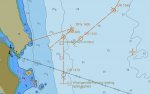
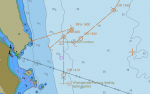
In the most basic case, you should be able to create a waypoint at your last known position, then use the EBL tool to extend a line reflecting your course and distance from that point. Add a new waypoint there, and repeat the process as you go. A consistent naming convention, e.g. "DR 1400", will help reduce confusion, and if you have tidal influences to factor in you can treat them similarly.

Now, that certainly isn't pretty, but it's better than writing on the deck with a marker as you draw the coastline from memory. It's also one reason I prefer phone or tablet; better software gives you more options, even if the symbols aren't all there. For a quick illustration:
quick-DR.jpg
 

Attachments

  • 1644456653890.png
    1644456653890.png
    298.3 KB · Views: 3
Indeed, such functionality is generally lacking, but there are ways to improvise.
Thanks for that, interesting to see what can be done. I wonder if that could be done in the heat of the moment?

I'll stick to my old school way of doing things.
 
While I daresay I could improvise a means of doing DR on my chart-plotter, it certainly isn't the optimum tool for the job, and its normal functionality might well interfere with DR - it isn't designed to operate without a GNSS input,. Carrying at least overview charts of the area you're in seems like a sensible backup.

However, perhaps the best option is simply to have an awareness of which way is safe. I always remember "We Didn't Mean to Go to Sea", where Ransome carefully has Jim Brading point out a safe heading to John, which John then remembers when they lose their anchor and by following it safely crosses the North Sea. And studying the charts to ensure that you always have an appreciation of where there be dragons, and your position in relation to them is perhaps the best route to navigational safety. I would argue that gaining that kind of situational awareness is best done with paper charts, but of course it is possible with a chart-plotter.

In the 1980s I chartered boats on the West Coast of Scotland, and of course in those days chart-plotters and GNSS weren't around. My main navigational method in those days was to study the chart and establish clearing lines for the various hazards; it mattered more that I keep clear of hazards than keeping an exact track.
 
This might really upset those of this parish who don't own paper charts and will need to gestimate when the fog comes rolling in.

I hope they have some blank paper to do some dead reckoning on.
Why? I don't have the emergency kit to deal with asteroid impact at home, nor do I have a gas mask in case a mega volcano erupts. I don't even have the kit to deal with a whale attack. I would consider it a fail for anyone who plans for such unreasonably unlikely events. I also don't carry a spare alternator or starter motor, and that's infinitely more likely than the sun taking out all of our GNSS systems. Even if I were mid atlantic when this highly unlikely event occured, sailing downwind will very likely get me to safety. I think I'd probably survive even without a compass if my sails were still working, which they would be.
 
Last edited:
Top