Global warming - a Bollockquilism

less than 10% failed

  • yes

    Votes: 0 0.0%
  • no

    Votes: 0 0.0%

  • Total voters
    0
Re: Oh for goodness sake - what will your grandchildren say about you?

[ QUOTE ]

Don't see the sceptics resorting to personal attacks.

[/ QUOTE ]

That is the strange thing. In any other sphere of debate the person who tries to demolish his opponent's reputation is regarded as losing the argument. Debasing the value of his own position.

But in the great MMGW debate it's become the main strategy of the zealots.
They never come up with the proof needed. Plenty of reports and zillions of graphs, but something that has a eureka moment is missing.

It's not up to the sceptics to prove no link.
It's up to the scientists to prove there is one.
 
Re: Non Blind denial

>(Not done the maths but I assume that a massive forestation effort would also help remove atmospheric carbon.)<

I've done the maths for a client. You're right, but it does have to be massive. The average carbon footprint of a Brit is usually quoted at about 10 tonnes CO2 per person which equals 2.7 tonnes pure carbon. The average* mature tree contains about one tonne of carbon, so we'd each need to plant 3 trees per annum over, say an 85 year life span, giving 255 trees per head. Planting frequency for commercial woodland is one every two metres (unless you propose early thinning, when it's one every metre). I make that close to 1000 sqm of woodland per person, or 15 million acres, or 6 million hectare, or 23,500 sq mi for the UK pop. Total size of the UK is 94,526 sq mi. So one quarter of the UK would need to go under NEW woodland to make us carbon neutral through sequestration.

*Getting an average amount of carbon per tree is the hard bit. Depends on species, age at maturity, climate during growing period, soil type, coniferous or deciduous. Strictly, you should also allow somewhere between 10 and 25% for wastage, for trees that don't make it to maturity for one reason or another.
 
Re: Non Blind denial

Sounds simplistic but politicians must show the way for the masses. No minister may have an official car, or driver (we'll gloss over the redundancy packages) nor may (s)he travel by air. Bike/foot/train/ship only.

I await the "justification" from same as to why this would be a reasonable thing to expect me to suffer, but not the minister...
 
Re: Non Blind denial

[ QUOTE ]
I await the "justification" from same as to why this would be a reasonable thing to expect me to suffer, but not the minister...

[/ QUOTE ] Well, I would have thought it was fairly obvious really - unless you regard your own contribution to the day to day functioning of society as equally important on a time/cost/critical function basis of course.
 
Re: Oh for goodness sake - what will your grandchildren say about you?

[ QUOTE ]

That is the strange thing. In any other sphere of debate the person who tries to demolish his opponent's reputation is regarded as losing the argument. Debasing the value of his own position.

But in the great MMGW debate it's become the main strategy of the zealots.


[/ QUOTE ]

I have some sympathy with that point of view. The problem is that both sides are full of zealots who don't let ignorance of the facts prevent them from spouting.

I care not 1 jot about the credentials are of someone with an opinion. But bullshit detectors start twitching as soon as someone calls themselves a 'scientist' or a 'climatologist'. It makes me think of those lunatics on Christian TV who say that man and dinosaurs co-existed and they are real scientists so it must be true. Whether 5% of scientists or 95% of scientists 'believe in' MMGW is totally irrelevant. Science does not move by a majority vote! I care what the consensus of those active in the field is - and for CC that is probably only few hundred people. I care that they listen to proper concerns, doubts and criticisms, and I have to trust that they do because the system is geared that way.

Everything else is just noise with industry and politicians doing what they do best - taking maximum advantage of any situation, and millions of confused sheep bleating from the sides.
 
Re: The data

Second that motion FL you really didn't need to hear that on top of your other problems right now.... Only just read your post this morning. Thoughts are with you. Agree GW seems a little less important in the face of such news.
 
Re: Non Blind denial

[ QUOTE ]
[ QUOTE ]
I await the "justification" from same as to why this would be a reasonable thing to expect me to suffer, but not the minister...

[/ QUOTE ] Well, I would have thought it was fairly obvious really - unless you regard your own contribution to the day to day functioning of society as equally important on a time/cost/critical function basis of course.

[/ QUOTE ]

So its "do as I say" not "do as I do". With one fell swoop you make the moral element of the pro-GW position untenable. Notwithstanding the size of carbon footprint of the pol compared to, say, his constituents.
 
Re: Non Blind denial

In principle I am in accord with your ideas, but there are a number of issues to consider.

Firstly you cannot move to an all nuclear generation policy.

Nuclear does not have the flexibility to meet minute by minute changes in demand, it is suited to meeting base load with more flexible systems available to meet mid and peak demand.

When the CEGB operated the grid they aimed to have roughly 1/3 base load from nuclear, 1/3 mid range from big high efficiency coal and 1/3 gas, oil, small coal and hydro to meet peaks.

The present system is not based upon an overall reliability/efficiency model but rather on an simple unit cost model. This has some strange effects - for instance, one of the reasons Drax power station went bust was because after the FGD plant (desulphurisation) was introduced the thermal efficiency dropped, which in turn increased the unit cost of the output, which meant that it began to be used to fill peak load rather than base load. Which meant it was operating only for relatively short periods which is very which increases ...etc etc etc.

So the starting point will have to be the grid.
This will change the financial model for the rest of the generating industry and this will have to be adjusted to ensure that all the essential stations are financially viable.

Secondly to move to say 75% nuclear generation will involve around around 35 GWatt of nuclear capacity.

This amounts to something like 30 Sizewold B sized stations

What the footprint of building that would be is anyones guess, but it probably doesn't matter because the same green lobby which is driving the NNGW debate will object so strongly to such nuclear development.

And even if they don't the planning applications alone will take at least 10 years before any construction could begin, and that is before you can find 30 additional sites that are suitable for nuclear installations. Sizewell B took some 8 years to build - after planning consent was achieved.

The costs of all this will be astronomical - Even today the financial case for nuclear stations is marginal particularly when you look at decommissioning, and its inevitable that moving to the 75% capacity model will be hugely more expensive, even if only repayment of capital. Perhaps worth considering 6 of the existing 8 British Energy nuclear stations are more than 25 years old and some can only operate on reduced capacity.

This will mean much more expensive electricity - which will make the UK economy much less competative than it already is.

This means that in parallel with the technical and financial issues of dealing with electricity generation you have to have some sort of plan to maintain the economy and hence peoples standard of living. If you fail to do this the you will lose the political support you need to carry out the overall plan.

Inevitably you will have to find a good answer to the question:

"We are a small country MMGW is a global issue. Why do we have to suffer all this if the rest of the world does not and continues to produce CO2 which will destroy the world no matter what we do"

The true believers hate this question and almost invariably resort to abuse and insults.

But at some stage there needs to be a convincing answer produced.

Somehow there is a need to convince at least a sizeable minority of the necessity, the absolute life or death necessity or this. Otherwise there will not be the sort of support necessary to implement this sort of policy.

It seems clear from this thread and others that such support is absent. Threats and abuse will not win support, rather it will be seen as the lack of a convincing argument.

Dunno how you square that one.

But at least there is a plan for electrical generation, all thats left is transport and industry (whats left of it) to worry about.

I will agree on the principle that electricity generation is the single most important factor if you want to reduce CO2 emissions.
 
Re: Non Blind denial

I'll say again.

Petroleum sourced energy is, to date, the single most effective means by which personal transport can be achieved over anything more than about a mile. It is also the single most effective means of long distance (>500 miles) mass transport of people. Effective is not equal to effcient in this case, perhaps fit for purpose is a good alternative. There is a limited supply of said petroleum, although this has been said before and as trechnology marches on the supply becomes extended. It makes sense to reserve petroleum for this purpsoe. The remaining need then becomes bulk energy generation for power. This bulk generation must suply base and fluctuating load. Apparently we can't go for coal, so turn the coal into petroleum to run the petrochemical industry without which life as we know if may be hard. Go on, give up all that plastic, lots of the paint and, well whiter grp? We are left wth renewables, with their various levels of relaibility, or nuclear. We know we can build small nuclear plants that run for years, make a fair amount of electicity and we expect folk to live nearby. We put them in submarines. Makes for a rather more flexible set of options, including large barges and relatively portable power. Need a few extra tens of MW for your big sporting ocasion? Stick two mobile plant into the narby docks...
 
Re: Non Blind denial

Yes I heard that.

Really for one so committed to talking about MMGW he consistently seems to work against any sensible means of addressing the issue.

Wind and wave are ok in principle but in truth they have little more than novelty value. The total output is only a tiny fraction of what the country needs. The availability is unmanageable and unpredictable.

For example there will be tonight a surge in demand at the end of Coronation street.

It is impossible to plan for meeting this demand with wind or wave because we have no control over the availability of either wind or wave, This means that we have to have supply capacity available at a specific time so we must rely on conventional generation. Even if wind or wave IS available we still have to ensure conventional is available as well - which generates a considerable mass of CO2 even if ultimately the power is generated by wind or wave. Widespread power cuts losing the second half of Coronation St or Eastenders would inevitably bring down the government, worse it may induce some the unthinking masses to start to thinking a bit and GB won't risk that.

As for solar - the most obvious limitation is the lack of sun - not only due to rotten weather - this is manageable to an extent - its the latitude - You cannot generate solar power when the sun is below the horizon ( or very low on the horizon.

Further the area required to generate a meaningful quantity of power would make them extremely expensive and would substantially distort the market for land prices and hence housing - Which would be politically difficult.
 
Re: Non Blind denial

No small nuclear isn't sensible.

Its ok in a submarine where the vehicle itself forms a barrier to radiation leakage. To use that type of plant in some sort of mobile unit is impossible the unit would be far too big and heavy to move.

It would need a second power unit to drive its pumps before you could start the thing up - unless you operate it underwater.

Sorry - that hare won't run.
 
Tidal?

Wind and wave - obviously weather dependent. But what about tidal? 20 hours of tidal movement a day in most places (allowing for 4 hours of slack). And staggered around the coast, so available 24/7. And predictable down to a few minutes. Not barrage schemes, but 'in water' turbines, especially off of headlands, in narrows, etc. I'm sure it could be done without mucking up navigation too much. Problems - hostile environment and fouling, but surely not insuperable.

Plus, look at the water wazzing under bridges on rivers. Why not drop turbines in the fast flowing rivers to supply, partially at least, local needs?
 
Re: Tidal?

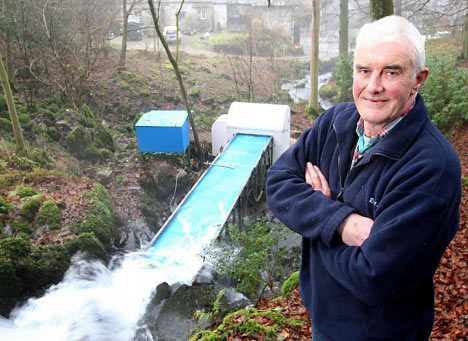
This bloke got a £15,000 grant from the LDNPA (!) for this invention

Generating WaterWheel


GilmartinWaterPA_468x341.jpg
 
Re: Tidal?

It makes more sense than wind, wave or solar but to generate enough to make any sort of economic sense means a barrage set up.

This of course brings in a whole range of environmental problems as well as ensuring continuation of navigation (important to us)

There has been talk for years about the Humber being barraged.
There is certainly the volume of water movement but how it would cope with the 30,000+ shipping movements a year I am not sure.

The Severn would be a likely contender - big tides and If you go above the Avon relatively low volume of shipping.

I don't know what sort of power you could expect probably a reasonable amount, but it would of course be cyclical which would need to be factored into the existing grid - but not impossible to do.

I'll leave you to take on the Greenies on that one.
 
Top