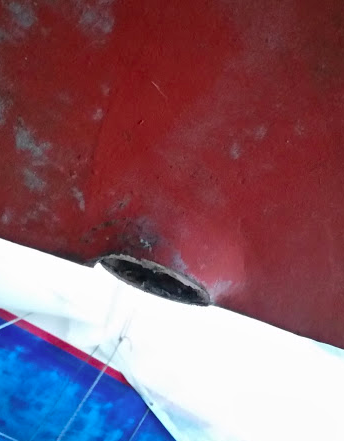
Glassing old tranducer hole to install new one

slawosz

Well-Known Member
Joined
26 Sep 2018
Messages
625
Location
London
Visit site
Hi,
I removed Airmax thru-hull transducer and I would like to glass the hole. Hole is in front of keel, so in quite a crucial place. The trick is, I want to leave space for Nasa transducer. So my idea is to make layer of glass around 15-16 mm thick, as Nasa recommends. I think of following steps:
* Insert plug covered in peel ply around 16 mm from the bottom
* Cutting CSM circles of proper diameter, filling the hole
* Putting few layers on top of repair, overlapping around 10 cm of hull
* After resin will set, I will remove plug and install tranducer
I will use West System epoxy and proper epoxy CSM - probably 600 g/m2. Before work, I will sand hole with 40 paper for better attachment and clean with acetone. I am planning to do 'dry run' on plywood, to properly estimate amount of matt I might need.

I will use CSM as especially the last layers will have a tricky shape.


Is there anything else I should do? Drawing of the hole below:
 
I did this job a few winters back, moving from an Airmar to a NASA. I glassed in the hole totally, feathering the edges inside and out, and a bit extra on the inside. Then I moved to mounting the transducer in a tube inside the hull. Glassed the tube to inside of cleaned hull, and filled with oil. Now, no thru hull, no hole, and perfect readings unaffected by wash, bubbles or foam etc. Good to about 90m, but that's plenty for my 1.4m draft!
 
When I did it, I tapered the hole from both ends and epoxied successively larger layers of glass cloth over it. In a normal area, you probably don't need to do this for 50mm of thickness, but it seems to be where, should you run into something awash, that's a possible impact point so, out of cowardice, I probably would, working wet on tacky.
 
Thanks. Problem is, I don't have really better place to install transducer. Its quite small boat, V shaped bottom. Thats why I need to keep transducer where it is.
 
Thanks. Problem is, I don't have really better place to install transducer. Its quite small boat, V shaped bottom. Thats why I need to keep transducer where it is.
If it is a 'quite small boat' then the hull is not very thick? Glass over the hole with a bit of chamfering and then bond a tube to take the transducer assuggsted above.
If it involves a paddle-wheel for distance, then don't bother. They are not terribly good and a GPS gives better info.
 
If it is a 'quite small boat' then the hull is not very thick? Glass over the hole with a bit of chamfering and then bond a tube to take the transducer assuggsted above.
If it involves a paddle-wheel for distance, then don't bother. They are not terribly good and a GPS gives better info.
A paddle wheel gives speed through the water GPS gives speed over the ground. Different values for different purposes.
 
Yes, if you want a paddle wheel log to work reliably, you'll need to pull it out when leaving the boat and bung it back in before going out. Both operations will involve a litre (if you're quick) or several coming in, so it wouldn't be a good place to keep your bedding
 
So this is for echo sounder transducer. I will have paddle wheel too, but with it, I am relaxed - I do only short sails, and I will use it more for understanding trimming, as I have some racing ambitions. Echo sounder is important for me, as risk of going aground is quite high where are sail.
 
So this is for echo sounder transducer. I will have paddle wheel too, but with it, I am relaxed - I do only short sails, and I will use it more for understanding trimming, as I have some racing ambitions. Echo sounder is important for me, as risk of going aground is quite high where are sail.

if it's just a depth transducer, post #2 is the answer (y)
 
Hi,
I removed Airmax thru-hull transducer and I would like to glass the hole. Hole is in front of keel, so in quite a crucial place. The trick is, I want to leave space for Nasa transducer. So my idea is to make layer of glass around 15-16 mm thick, as Nasa recommends. I think of following steps:
* Insert plug covered in peel ply around 16 mm from the bottom
* Cutting CSM circles of proper diameter, filling the hole
* Putting few layers on top of repair, overlapping around 10 cm of hull
* After resin will set, I will remove plug and install tranducer
I will use West System epoxy and proper epoxy CSM - probably 600 g/m2. Before work, I will sand hole with 40 paper for better attachment and clean with acetone. I am planning to do 'dry run' on plywood, to properly estimate amount of matt I might need.

I will use CSM as especially the last layers will have a tricky shape.


Is there anything else I should do? Drawing of the hole below:
A couple of layers of ordinary polythene is a good release agent.
You can mould grp around the polythene covered sensor, then dismantle and re-assemble with sealant.
Or you can make a wooden dummy to the shape of the transducer.
There is no particular gain is using epoxy over polyester in a job like this.
Epoxy is fine, but it costs 5x as much for no gain.

If you've never used GRP before, practise on something before doing a job below the waterline!
 
A couple of layers of ordinary polythene is a good release agent.
You can mould grp around the polythene covered sensor, then dismantle and re-assemble with sealant.
Or you can make a wooden dummy to the shape of the transducer.
There is no particular gain is using epoxy over polyester in a job like this.
Epoxy is fine, but it costs 5x as much for no gain.

If you've never used GRP before, practise on something before doing a job below the waterline!

I did some GRP work before. I will do some other works first. Along previous knowledge, I read du Plessis book and with West System manual. I will do other repairs first - probably including glassing in old log transducer hole - but this one is simple, as I can do backing from other side. This repair is tricky, so I am looking for as many opinions as I can. Reason why I am using epoxy is temperature. 205 hardener from West System is much more tolerant. I will do this job late April/mid May.

Below there is photo of boat hull. There is not a good place to put transducer inside due to V shape. I had it done it last year and sometimes readings were lost - although on the mooring was fine. Other photo shows place where old transducer was located.


You absolutely must taper the hole by grinding out before refilling with progressively larger circles of mat otherwise there is a high chance of your new plug not bonding and popping out. I would fill it like that, then drill for the new transducer. It is too important to risk having the new insert fail if you do it any other way.
 
You absolutely must taper the hole by grinding out before refilling with progressively larger circles of mat otherwise there is a high chance of your new plug not bonding and popping out. I would fill it like that, then drill for the new transducer. It is too important to risk having the new insert fail if you do it any other way.

I see what you mean. If I would abandon idea of making plug to fit transducer, I could work from both directions - top and bottom. Thats tempting. My temporary transducer fit wasn't perfect, but good enough. How could I drill 40 mm hole with flat bottom though?
 
I did this job a few winters back, moving from an Airmar to a NASA. I glassed in the hole totally, feathering the edges inside and out, and a bit extra on the inside. Then I moved to mounting the transducer in a tube inside the hull. Glassed the tube to inside of cleaned hull, and filled with oil. Now, no thru hull, no hole, and perfect readings unaffected by wash, bubbles or foam etc. Good to about 90m, but that's plenty for my 1.4m draft!

This is exactly what I did and (among others) would recommend.

And, if you use the NASA installation kit, you can cut the plastic tube at an angle to ensure your transducer faces straight down when you install it off centre.
 
I think I might not be specific. In addition to drawing, hole is in the middle. Its diameter is 57 millimeters and thickness is 40 mm. Its quite tick for 24 ft boat. I don't really have possibility to tapper this hole, as its on the hulls halfs intersection. Although I am planning to cover repair with few layers ot mat, which will cover the hull around the repair.
 
Top