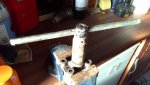
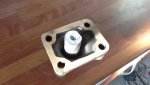
Getting Yanmar 2GM anodes out to change them

webcraft

Well-Known Member
Joined
8 Jul 2001
Messages
40,439
Location
Cyberspace
www.bluemoment.com
.
The one at the back of the engine is relatively accessible - I can get a 24mm scoket on it (nice tight fit) and a cheater bar (once I have removd one of the cockpit drain hoses) - but no amount of levverage or hammering will encourage it to begin moving.

The one between the cylinders is under the exhaust maniforld and impossible to get any decent leverage ion, so if I cannot get the aft one to budge what hope for the forward one?

How essential is replacing these anodes, and what else should I try? (engine is in a boat new to me, engine has only run less than ten hours in the last four years but it is at least 4 years since the anodes were changed)


- W
 
Last edited:
Well I know they are tough to shift but on my raw water cooled GM20 I use a long 24mm ring spanner and if necessary hit the far end with a hammer to break the lock. But my puzzle is that these anodes seldom show much sign of wear.
 
Well I know they are tough to shift but on my raw water cooled GM20 I use a long 24mm ring spanner and if necessary hit the far end with a hammer to break the lock. But my puzzle is that these anodes seldom show much sign of wear.

I have used a socket with a tommy bar which I have walloped with a hammer. However, I suspect a ring spanner has a lot less spring, so will get a 24mm one and try that.

Do both anodes show little wear, or does one of them show more than the other?


- W
 
The anodes in my 2gm seem to wear equally, usually get about 4 or 5 years out of the anodes. Yes they can be tight, usually loosen with a crack then finger tight the rest of the way. Just make sure that the remains of the old one hasn't dropped off into the water gallery behind where it sits.
 
I can get a socket from a 3/8 drive set onto both, with extension and then adaptor to 1/2 inch and then a breaker bar, which loosened both of mine on purchase, now checked annually so no problem. On my engine rear one seems to get more abated.
 
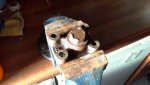
I've never had trouble with the one under the exhaust but the one at the rear has been very difficult. I ended up taking off the housing. It's about 4 inches by 3 inches and held on with 4 bolts. I took the housing and anode home got the lot in vice, heated it and got a good socket onto the anode bolt, still needed 2 extension bars but it came off.
When re-installing I had to make a new gasket after cleaning up the mating faces of the housing plate.

anode 1.jpganode2.jpganode3.jpg
 
Last edited:
It is about 13 years since I last worked on a 2GM but I would try with the engine hot and rather than a shock load, use a jack under the spanner or breaker bar to break it, like getting a seized prop off. Once heated and under a steady turning force with the jack a shock strike with a hammer can work... possibly.

Good luck.
 
It is about 13 years since I last worked on a 2GM but I would try with the engine hot and rather than a shock load, use a jack under the spanner or breaker bar to break it, like getting a seized prop off. Once heated and under a steady turning force with the jack a shock strike with a hammer can work... possibly.

Good luck.
The amount of force I was applying with the engine insitu and using a breaker bar I was getting concerned about my engine mounts. :)
 
The amount of force I was applying with the engine insitu and using a breaker bar I was getting concerned about my engine mounts. :)
While my physics is a bit rusty (pun intended) I think that a steady force will better break a corrosion joint along with heat and a hit with a BFH on the nut or bolt, not the bar.

Let us know how you get on Webbie.
 
I had a 2GM20 in a Westerly Centaur for 5 years. I used to buy all my service bits from George Hulley at Dumbarton. George told me that it was very important to check the anodes regularly. On my engine they would be be at least half gone every year.
 
I had a 2GM20 in a Westerly Centaur for 5 years. I used to buy all my service bits from George Hulley at Dumbarton. George told me that it was very important to check the anodes regularly. On my engine they would be be at least half gone every year.

Our 3GM raw water cooled engine required some effort to get the (3) anodes out. 24mm socket. Big breaker bar did the job. The anodes were regularly eaten so I'd not forget about them. They were generally replaced by generic pencil anodes, rather than "Yanmar anodes"
A little PTFE tape on the tapered thread did not much obviously interfere with function, but made it a little easier than breaking out rusty threads.?
 
Top