
Alex_Blackwood
Well-Known Member
No problem. Was only an observation and didn't really solve your problem! You are of course quite right about the noise level with lower revs.Sorry I’ve reread your post. My mistake.

No problem. Was only an observation and didn't really solve your problem! You are of course quite right about the noise level with lower revs.Sorry I’ve reread your post. My mistake.

impressive performance: 240W for 50lph!!!


50 litres per day should be enough for two people. It's about what we use but we make that in 15 mins on the 220v watermaker.All good points.
The water makers I’m looking at are either the Osmosea 12volt ones or the Zen (Osmosea N12ES 12/24V Semi automatic 25-100l/hour - Sailfish Marine - Watermakers, Marine Generators, Solar Panels and more.. or Mactra Marine Equipment - Schenker Watermaker - Zen 50)
I didn’t want to go down the 220 v water maker route as if the generator packs up you’ve got no water making ability. With 12volt you’ve still got wind generator, main engine and solar potentially topping up the batteries.
50 litres an hour is enough for two of us to shower etc surely?
Those are all good points and I guess (as I've said before) that it really is a matter of paying your money and making your choice. It's a bit of swings and roundabouts AFAICS atm except we don't have a 3Kw inverter...50 litres per day should be enough for two people. It's about what we use but we make that in 15 mins on the 220v watermaker.
If we lose the generator we can still make water using the 3kw inverter. We start the engine so the alternator is charging. With the solar and wind or Duogen in water mode the draw on the batteries is not an issue. It helps that we need to run the watermaker for such a short time to make all of our daily water needs.
One thing to consider is that energy recovery watermakers are complex. They are expensive to purchase and parts are expensive. They make a relatively small amount of water for their cost. By comparison, our 220v watermaker has no electronics, no relays and a very robust HP pump. It's super simple.
There are merits in both approaches. Our previous watermaker was 12v. We have been very happy with the 220v high output watermaker for the last 8 years.
It seems to me that with modern well designed acoustic boxes you don't hear the generator. Adding extra complexity to change the speed just increases the risk of failure. What the upside? A constant running generator controlled by a capacitor will use fuel dependant on the applied load not the revs.Coming back to my original question, I still can't work out whether to go for the load following control on the generator or not...
It depends on how much solar you can squeeze on and what you are expecting out of your installation. We have 720w of solar and two fridges. We make hot water for showers and washing up from solar. We wouldnt have spare capacity for making water as well so we would have to give up the available hot water. Not the end of the world but would you be happy with cool showers? I know many people do just that or wash in salt water. Not for me. The generator gives so many options and allows you to maintain a good lifestyle regardless of whether the sun shines. Yes you can run the engine to keep the batteries topped up when the sun doesn't shine but that could mean far more engine hours than you realise. We know so many people that do that but do t like to admit it. An engine running in the background in support of a tiny output watermaker is not the environmental statement most people want to makeagree with geem, but tbh, if the stats for the energy recovery watermaker are real, you really DONT need a generator to run it! Unless your batteries are silly small, you can spare 20Ah a day (assume 12V system) for 50lt of water a day, that's really peanuts. A half decent fridge will cost about that a day in hot weather...
Maybe you can save the generator money and get a decent inverter, mppt and a bit more solar ?
I completely agree with that. There are so many yachts that run a 40hp engine for and hour and a half to charge about 15A and produce a bit of hot water, it really is environmental lunacy.....It depends on how much solar you can squeeze on and what you are expecting out of your installation. We have 720w of solar and two fridges. We make hot water for showers and washing up from solar. We wouldnt have spare capacity for making water as well so we would have to give up the available hot water. Not the end of the world but would you be happy with cool showers? I know many people do just that or wash in salt water. Not for me. The generator gives so many options and allows you to maintain a good lifestyle regardless of whether the sun shines. Yes you can run the engine to keep the batteries topped up when the sun doesn't shine but that could mean far more engine hours than you realise. We know so many people that do that but do t like to admit it. An engine running in the background in support of a tiny output watermaker is not the environmental statement most people want to make

It would be easier to run the watermaker directly off the engine assuming you have space for a second alternator. A Cat 247 pump with an electromagnetic clutch. Three 40" membranes and 200/250 litres per hour.What about a really big alternator instead of a generator?
This you would use to charge a big battery bank.
E.g. Alternator: 98-24-220-IG-BL - Balmar
220 Amps at 24 V
Which would be good for a 900Ah 24V battery bank.
Otherwise in similar form factors you can get an AC generator to bolt onto your engine instead of an alternator.

I don’t see the point. More cost, complexity and things to break. They in theory allow for a small genset to produce higher loads, but the difference between min and max is not great and fixed speed sets have a big enough output range. The fixed speed units, especially the 1500 rpm units are not terribly noisy anyway, so little to gain from throttling back on noise either.Coming back to my original question, I still can't work out whether to go for the load following control on the generator or not...
Where is the power coming from to charge the lithium, make water, make hot water, run the fridge, lighting etc?I don’t see the point. More cost, complexity and things to break. They in theory allow for a small genset to produce higher loads, but the difference between min and max is not great and fixed speed sets have a big enough output range. The fixed speed units, especially the 1500 rpm units are not terribly noisy anyway, so little to gain from throttling back on noise either.
I suspect you can find a better way forward than to get a genset. Or are you totally set on it? If you want to look at it, to get to the question of what is the best power solution requires analysing how much daily power you need for each consumer and total. What are those figures?
For example, I suspect you need really little AC power (above battery charging, which can be done other ways) to justify a genset. Just for water heating (maybe a watermaker) and a hairdryer? If that is correct I I think an inverter will easily cope. It is a fraction of the price of a genset. Simpler install, less space, far less maintenance, noise and far more reliable. It's also a big convenience. I leave mine on all day. Instant plug in power, no genset to fire up. I suspect you may want one anyway. If worried about redundancy, then get two. The second could be a cheapy,non marine version and they really are cheap. I would estimate 330Wh/day for water heating per person (20 mins on a 1kW immersion heater). 120Wh/1 person/day for hairdrying. So 780 Wh/day all in. Peak demand 1.5kW. Not much.
You asked about watermaker size and if 50 lt/hr was enough. I am happy with the 30lt/hr Zen. Limitless showers, deck washes in fresh water, washing machine. They are pretty cheap now. I paid £3,500 delivered from Man.el in Italy. Output isn't important. You just let it run until you have enough. I typically run all night once every 5 to 7 days. I can barely hear it at night. It is also cool running, unlike the old cabin heater, high pressure version. Getting one helps you get off the genset requirement. 30l/day/person x 2 at 4W/lt is only 240Whrs of DC power by the way.
As part of revisiting energy needs, you may consider some extra batteries, or better still, go to LiFePO4 as well. With extra capacity it will allow you to buffer better and get through windless/sunless periods. I can go for 4 days at a push without charging. LiFePO4 batteries are very light, very compact, faster to charge, more energy efficient, full power and volts right down to zero capacity, enormous peak current discharge capacity, far longer life and nowadays if you assemble your own pack maybe half the price of lead over the lifecycle.
As we discussed elsewhere, from diesel for now, genset and engine, but I am switching to 100% solar as the source. Solar is the original source of all of our energy on boats, including the wind to drive them, so in a sense the answer is 100% from the sun already.Where is the power coming from to charge the lithium, make water, make hot water, run the fridge, lighting etc?
I've got something similar. It's more suitable for back up power as it is not so nice or efficient to run a big engine for relatively little power. I haven't looked at the spec of that one closely, but they don't usually like to put out max power. They can overheat. Actual power is a lot less. In my case about half that. Not bad though. Very useful it has been too on the occasions when the genset died. It would also be good backup for solar. Mine is a far less costly Leece-Neville bus alternator.What about a really big alternator instead of a generator?
This you would use to charge a big battery bank.
E.g. Alternator: 98-24-220-IG-BL - Balmar
220 Amps at 24 V
Which would be good for a 900Ah 24V battery bank.
Otherwise in similar form factors you can get an AC generator to bolt onto your engine instead of an alternator.
The OPs problem is possibly not have space for sufficient solar. That is my case on a 44ft boat.As we discussed elsewhere, from diesel for now, genset and engine, but I am switching to 100% solar as the source. Solar is the original source of all of our energy on boats, including the wind to drive them, so in a sense the answer is 100% from the sun already.
We’ve currently got just over 500 Ah of lead acid battery but lead acid batteries have a limited ability to accept charge so fitting a huge alternator isn’t necessarily going to reduce charging time. I’ve specified a 120A alternator and in the past I’ve always fitted a ‘smart’ alternator controller but I’m told modern alternators don’t necessarily need such things.What about a really big alternator instead of a generator?
This you would use to charge a big battery bank.
E.g. Alternator: 98-24-220-IG-BL - Balmar
220 Amps at 24 V
Which would be good for a 900Ah 24V battery bank.
Otherwise in similar form factors you can get an AC generator to bolt onto your engine instead of an alternator.
Lithium can be charged ça 4x faster than lead acid. For the 220A alternator I linked to above, I said it would suit 900Ah of batteries. This is a lower ratio than your 120A into 500Ah of batteries.We’ve currently got just over 500 Ah of lead acid battery but lead acid batteries have a limited ability to accept charge so fitting a huge alternator isn’t necessarily going to reduce charging time. I’ve specified a 120A alternator and in the past I’ve always fitted a ‘smart’ alternator controller but I’m told modern alternators don’t necessarily need such things.
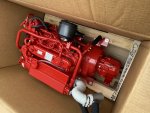
The engine is brand new and waiting to be fitted.
View attachment 134158
I have a Balmar 110A 12V alternator connected to 4 x 110AH batteries. If the batteries are down to 50%, I do see 110A from the alternator. Even on a days with 35C temperatures (more in the engine compartment).Im afraid you wont see anywhere near 120 amps from your alternator continuously, maybe 80 on a good day.
Generator will of course be limited by the battery charger you fit. 80 amp battery chargers are not cheap, so worth considering that! 80 amps at 12 v is around a 1kw so even your smallest availible generator will be significantly under loaded....so being able to drop the rpm off to save some wear and tear and noise may be pretty advantageous.
The main bit to go wrong is the inverter anyway which is common to both PMG fixed speed or variable speed units
