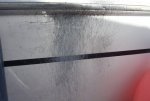
Gelcoat or Flowcoat?

The reason I asked for some pics was just to determine the depth of the scratches and amount.

Rule of thumb is if you can catch your nail on them, then add gel.

Think I have a tin of 9003 flowcoat that's never going to get used as I never use pre-mixed.
Pre-mixed is great for projects, but is not great for repairs due to the lack of pigment, repairs need to be at full 10% pigment or you will just get a see-through repair.

Personally I wouldn't go down the peel ply route (unless you were re-finishing the area), nor would I use flowcoat, gelcoat is so easy to cure with other methods, but a pain to apply more with decent adhesion due to wax, even after sanding.

If you are indeed thinking of brushing gelcoat or flowcoat onto the area then sanding down anything above the actual surface and hoping this fills the scratches, it's going to be a disappointing and messy day.
Could it be possible (as you say they are too deep for polish, but not deep enough for filler) that they could wet sand out?

How many scratches are we talking?

Pics would help advise, appreciate you might not be carrying them around with you.
 
The reason I asked for some pics was just to determine the depth of the scratches and amount.

Rule of thumb is if you can catch your nail on them, then add gel.

Think I have a tin of 9003 flowcoat that's never going to get used as I never use pre-mixed.
Pre-mixed is great for projects, but is not great for repairs due to the lack of pigment, repairs need to be at full 10% pigment or you will just get a see-through repair.

Personally I wouldn't go down the peel ply route (unless you were re-finishing the area), nor would I use flowcoat, gelcoat is so easy to cure with other methods, but a pain to apply more with decent adhesion due to wax, even after sanding.

If you are indeed thinking of brushing gelcoat or flowcoat onto the area then sanding down anything above the actual surface and hoping this fills the scratches, it's going to be a disappointing and messy day.
Could it be possible (as you say they are too deep for polish, but not deep enough for filler) that they could wet sand out?

How many scratches are we talking?

Pics would help advise, appreciate you might not be carrying them around with you.

I am on holiday in France without photos here!
Yes you can easily feel the scratches and in a few places they are down to the substrate. If I sand out there will be no gelcoat! Area is maybe 500mm square. Scratches are vertical or nearly so. An adjacent boat with a sharp sticking out metal stanchion base was rubbing against it in a storm after fenders popped out.

Would appreciate your suggestions.
 
I am on holiday in France without photos here!
Yes you can easily feel the scratches and in a few places they are down to the substrate. If I sand out there will be no gelcoat! Area is maybe 500mm square. Scratches are vertical or nearly so. An adjacent boat with a sharp sticking out metal stanchion base was rubbing against it in a storm after fenders popped out.

Would appreciate your suggestions.

Yes, that helps picture it a bit better, perhaps take some when you return though as it would really help the thread as it progresses and confirm that the advice you are given is relevant.
No rush :) enjoy your holiday.

The advice you've been given already is sound, I just wanted to ensure you weren't going to be re-gelcoating a large area for the sake of a couple of scratches.

The techniques are different if you had a few scratches snaking accross the 500mm x 500mm area, as opposed to that area being worn down or dished out.
If the main profile is there, then of course you have something to build up to, but if the area has been worn away, you'll be looking to build the profile back up to the same level as original.

By the sound of it with prep, you are going to have a slightly dished out area that needs filling.

You could go down the filler method route or use gelcoat that has been thickened a little, or glass, it depends again on the depth and what sort of job your are looking to do and how long you want it to last.
If you did use peel ply, you might need something as a backer, again determined by how much material is missing and how dished out it is.

A few tips IMHO:

Use gelcoat not flowcoat, it will act the same and you can add to it easily if you need another fill or another coat. You can fully cure at any time, but you cant take the wax out from the cured easily. You can sand and add more, but it won't have the same attractive bond. Over time this might show.

On-line sellers do offer some good pigmented gelcoat (sometimes) but do tell them it's for repairing, hopefully they will ensure there is the right amount of pigment, personally I wouldn't want to find out if they did or didn't at the point of applying, so check by spreading some out on a mixing stick before you get to that stage to check to see how transparent it is.
It might be better for you to buy clear gelcoat and then add the 9003 in pigment form yourself, max 10%.

If the surface is more than a couple of years old then the new gel will seem as if it's whiter, if you've sanded down the area to accept and the 9003 has been mixed correctly, then they should of course match. You should check this before catalysing the gel.

Lots of other stuff comes to mind, but perhaps best to wait for your pics.
The biggest thing is personal protection. Gelcoats are not nice to breath in or get into the skin and eyes, have a think about this side of things with the same degree of detail as the above.

Gas and odour mask is a must, many will say they don't use one and feel fine, don't risk it!


A simple job as others have mentioned can save you a ton of effort, marine filler or even Milliput might be the best option for you unless you fancy a challenge of course, which I hope you do :encouragement:

Tony
 
Last edited:
Tony
Thank you. Are you suggesting that I need to sand down and recoat the whole patch? The worst scratches only just penetrate the gel coat, most are within it, and the surface profile is still there. They are discrete scratches not general abrasion.
I didn't think a filler paste with solid material in it would be needed, I have satisfactorily filled chips with gelcoat from ECFS in the past, overfilling a bit, covering with cling film and rubbing down afterwards. i repaired a fingernail size chip on a rounded edge in the cockpit and my co owner couldn't find it.
Or is the problem that scratches are too small to hold the gel coat?
Do you ever do jobs in Shoreham?
Mike
 
Tony
Thank you. Are you suggesting that I need to sand down and recoat the whole patch? The worst scratches only just penetrate the gel coat, most are within it, and the surface profile is still there. They are discrete scratches not general abrasion.
I didn't think a filler paste with solid material in it would be needed, I have satisfactorily filled chips with gelcoat from ECFS in the past, overfilling a bit, covering with cling film and rubbing down afterwards. i repaired a fingernail size chip on a rounded edge in the cockpit and my co owner couldn't find it.
Or is the problem that scratches are too small to hold the gel coat?
Do you ever do jobs in Shoreham?
Mike


Mike,
Some confusion due to the depth of the scratches and the area covered as you said some were down to the substrate.
I've offered the above assuming that scratches have eaten away the profile and dished it out, if you just have a few scratches within the original profile then no, just work on bringing the scratches only up to the original level.
Ideally if you have sound level profile, then leave that alone.

So on a sliding scale with the original profile being at zero, a deep scratch might be -1mm, or minus 0.1mm. Of course the -1mm will require gel but the 0.1mm will just need wet sanding and polishing.

If the worst scratches only just penetrate the gelcoat, then perhaps you don't need any gelcoat at all.

If the gelcoat is say 1mm thick (which would be very thin) and the scratches only just penetrate (say 0.2mm in) then you can wetsand down 0.2mm then polish, no filling with gelcoat required.

Either way, it certainly sounds as if they are not deep enough to require filling with something other than gelcoat, at worst.

So let's assume they are a little deeper (perhaps 0.8mm in 1mm thick gelcoat) then it would be too close to wetsand out and you'd want to fill these with gel as you've done before.
Instead of overfilling and covering with clingfilm, then sanding down, try underfilling with a spreader or splastic queegee.
As it's gelcoat and not flow coat you can just cure with pva and wash that off once cured, then add another fill until level with original profile.
This will be much safer than trying to sand down the proud parts of the overfill and will ensure the surrounding remains at near on full thickness.

It does depend on how well you prep the bits that need a fill, try to bevel the edges of the scratches even if they are small and shallow as a hard edge will be difficult to lose.

Again though, pics would be really helpful here. Macro (close up ones) with something like a coin in the shot to help determine depth.
Or we are going to go round in circles with different options.

I do go down to Shoreham, but I'm afraid I'm fully booked to the end of the year.

How does the deepest one you have compare to this one.

Gelcoat depth forum 2016 .jpg
 
This pic might help, not certain if this is the same thickness as yours, but I would say this was average thickness of gelcoat.

I'm guessing that this is 2.5mm thick blue gel.

Note the masking tape is probably 0.25mm thick, 10% of the gel.

Gel depth forum 2 .jpg
 
Grr another unintended deletion.
At a guess gelcoat not much above 1mm. Scratches various depths but many too deep to sand. A very few broken through but no indent into substrate. Total quantity of scratches in the 10s maybe 100+ so a lot to treat individually.
ECFS tell me their RAL9003 gelcoat will have 15% pigment so that should be fine.
 
Grr another unintended deletion.
At a guess gelcoat not much above 1mm. Scratches various depths but many too deep to sand. A very few broken through but no indent into substrate. Total quantity of scratches in the 10s maybe 100+ so a lot to treat individually.
ECFS tell me their RAL9003 gelcoat will have 15% pigment so that should be fine.

I have RAL 9003 gelcoat. How much do you need? I'm based in Portsmouth. PM me.
 
I have RAL 9003 gelcoat. How much do you need? I'm based in Portsmouth. PM me.

Only just seen your post as I've spent all today driving back from France.
Thank you very much for the thought but I ordered from ECFS yesterday it should arrive tomorrow!
 
Disappointed with ECFS. Paid on Wed for overnight delivery Thursday dispatch, had acknowledgement, it hasn't turned up, no reply to an email query.
 
Very disappointing for you, certainly after paying for an overnight delivery!

I have to say though, of the orders I've put in with them, they have delivered on time.

If it left them on Thursday, the hold up is with the courier. I would want a refund on the postage and they can take it up with them.
Did you get a tracking number?
 
Disappointed with ECFS. Paid on Wed for overnight delivery Thursday dispatch, had acknowledgement, it hasn't turned up, no reply to an email query.

I've had dealings with ECFS over the years, and would put their record of performance over that of most courier companies, so suspect that's where the problem lies. But as post #33 suggests, if that's the case you're entitled to recompense, the route to which would be via ECFS.
 
Arrived this morning, ECFS did dispatch on Thursday, delay was with UKMail courier.
Now I have the consignment number off the label I can look at their tracking website and it says "delayed".
Difference in cost for overnight delivery was 70p I think, not worth pursuing a refund.
Grrr!

Edit - just had an email from ECFS saying sorry, UKMail had a vehicle breakdown from main hub delaying 1500 deliveries.


Here is the only photo I have of the damage, it's misleading, the scratches are deeper than you would think from this.

P1060223.JPG
 
Last edited:
Ouch!

Can see that they are deep going by the damage to the rubbing strake.

Has certainly nibbled a fair amount of gelcoat away, you're going to need to rebuild the profile, going by the pics, but could be a trick of the light.
Have you placed a straight edge just beneath the strake? This will show you how much profile needs building if any.

Looks as though everything an inch or two beneath the strake can be sanded out though IMO.

What are your plans for the strake? This could potentially be more of a pain than the gelcoat side of the repair.
 
Indeed the strake is a problem.
I think I have identified the source (with help from the forum), Osculati, but cost is very high, don't think there is any stock in UK. Ali comes in 3m lengths but min order 24m, PVC insert only as 24m coil. Several £'00s.
Only alternative I can think off is fill it and shape it and try to find paint (alloy wheel touch up?) matching the clear anodising as closely as possible.
 
Last edited:
Indeed the strake is a problem.
I think I have identified the source (with help from the forum), Osculati, but cost is very high, don't think there is any stock in UK. Ali comes in 3m lengths but min order 24m, PVC insert only as 24m coil. Several £'00s.
Only alternative I can think off is fill it and shape it and try to find paint (alloy wheel touch up?) matching the clear anodising as closely as possible.


Just some thoughts through lunch:
It would be very helpful of them to supply you with a small sample (say 1ft in length) if you are thinking of replacing the entire strip?
Osculati are in Italy, google translate helps compile an email in local lingo and is sometimes worth the extra effort of communication.

Certainly worth an email, I've found Trend marine in the UK though to be very helpful in matters similar to this.


You can go down the re-build / fill and fair route as an option, chemical metal etc, it would save having to scarf in a new section of ally.
Opt to spray on an ally paint though rather than a touch up. Halfords do one that sprays with decent spray pattern and should be a close match, you may have to do entire strip to get perfect though as you'd have an edge where paint meets ally.

New rubber easy enough to match and scarf in.

I'd undo the strake, just take out the rubber and unscrew it. Raise it away from the surface as much as phisically possible, or remove completely if you can but support it as you go or it may bend and twist.
If doing on your own then just see if it will come away from the surface far enough for you to work on the gelcoat, this way it is safely held in place and would'nt get trod on or twisted, or will be a pain to put back on.

Re-build the profile of the gelcoat, by either building and sanding flat or sheet of perspex, or peel ply on a flat sheet of something that won't stick to wet gel / glass.

Cover gel once finished with a plastic sheet or something and re-fix strake back on, this way you can build up profile of the strake but it wont bond to your new gel repair and would be flush with where the strake and gel profile meet.

You have your work cut out for you though, interesting challenge would positively describe it.
 
Top