Gel color matching - technical advice / how to?

EugeneR

Well-Known Member
Joined
21 Aug 2009
Messages
1,251
Location
Hamble
Visit site
So far, the only gel coat repairs I have done were screw holes which could be filled and blended in using "off the shelf" white without being overly noticable. However, I noticed a 8cm spider-web crack around one of the flybridge seat back-rest mountings. It is cosmetic only, mostly underneath the seat cushions and affecting only the box upon which one sits; however, I still would like to repair it. As the affected area is larger, the repair is more likely to be seen (with cushions off) so I want to get the color matched as perfectly as possible without paying someone to do it. Yes, a bit perfectionistic but that is me.

I was thinking, how easy would it be to match colors using a smartphone app? I imagine it working as follows - take a picture of the existing gel-coat, then take pictures of available pigment colors and then calculate the amount of each color needed to match the desired color. One would take steps to ensure samples are taken under the same conditions e.g. from a fixed angle and distance using flash so as to reduce the impact of wider lighting, averaging across selected points, etc. The result might not be perfect at first; however, if one take a picture of the resulting mix, the app can then improve it's calibration, advise what more to add to get it closer to the intended result, and the process repeats itself - until an acceptably close mix is obtained.

Is there something like this already out there? If not, what would the best approach to matching colors be? What would be the issues e.g. color maybe changing as it dries, etc? Anyone with experience in this area?
 
One option is contact the manufacturer if the boat is still in production. Some of them will sell you a bit of gel. Polish up the rest of the area and bingo...
 
SWMBO was getting 'colour matched' in Boots the other day. They put some gizmo on her skin and then set about matching the tone. I must admit I wondered about my cockpit gelcoat... :)
 
When I needed to get some of my DS repainted, one option was colour matching the existing paint. A small chip of the old paint is sent away, analysed and replicated. However. what you get back is unfaded paint, and when it does fade the match goes again. So OK for patching very recent paint, but not sensible for older stuff. I paid the extra to have the whole car painted.

I need to have some small repairs to my gel coat done this winter, and the plan is for the yard to match it by eye. However, they'll need to polish the hull first, they say, because there is no point in matching the oxidised top surface.
 
I had a large profesional repair this year (don't ask!!!) and they compounded the surrounding area before repairing and matched to that.... perfectly I'll add! I now have a meter square 'white' patch on the hull but the repair is invisible. I now need to do the rest of the hull in the spring.
 
If your boat is actually 'WHITE' - not cream etc - With 'pure white' gel coat on the hull what I found was that they are all actually 'shades of grey'. Forget the cream/blue its grey you need. Now the professional repair was done using black pigment into white gel but I've found pigmenting the off the shelf stuff with a tiny amount of a 'dust grey' pigment (like a few drops in half a kilo) takes the edge of the new stuff and it blended perfectly. So much so the professionals paid for the boat to be lifted out and redid the repair they did using my method.

Using your glove, dab a finger print onto a polished part of the hull and let it flash off I bet you notice the old stuff looks grey, then just add the dust grey pigment until you reach perfection! Remove the spots you make with acetone!
 
I have found that keeping the material removed when sanding prior to the actual repair helps.

This sanded material has the same amount of faded gelcoat as the rest of the area you are about to repair.

So when mixed with a little of the new white the match is pretty close. using this method means you have 'some' surface material that has been exposed to UV so will continue to fade at the same rate avoiding some of the regular polishing later.

Good luck and fair winds. :)
 
Last edited:
When I needed to get some of my DS repainted, one option was colour matching the existing paint. A small chip of the old paint is sent away, analysed and replicated. However. what you get back is unfaded paint, and when it does fade the match goes again. So OK for patching very recent paint, but not sensible for older stuff. I paid the extra to have the whole car painted.

I need to have some small repairs to my gel coat done this winter, and the plan is for the yard to match it by eye. However, they'll need to polish the hull first, they say, because there is no point in matching the oxidised top surface.

Spot on. Play d'eau has just had some major GRP work completed. A chip was sent for analysis and match. Perfect. The issue now is to keep it all looking the same. To do this, the UV effects of the sun on the gel must be shielded by regular hard waxing to prevent the older gel from fading quicker than the newer, especially on surfaces facing the sun.
 
I like your thinking Eugene, there are some promising gadgets in the pipeline that not only read colour but also chemical composition.
Exciting what the future promises on that front.

To find an exact colour match via a machine requires the use of a photospectrometer (some call them spectrophotometers) these are not cheap (think thousands) are usually the size of a printer and are not practical to purchase for repairing a star crack.
There are various hand held models on the market, they read the spectrum of colour and return colour values to the user.
Even with the measurements the machine provides, you are still in the position of trying to match the readings, but it would at least give you a guide.
Unless you are a gel coat manufacturer and have the equipment to do so, this is not as easy as one might think.


There are lots of small details that make up a decent repair. On their own they seem insignificant, but the final results are telling. The correct colour is just one of those details.

I should mention that these chemicals are not to be played with without the correct PPE. Full face mask with gas filters to breath through. Eye protection if not a full face mask, gloves and a protective suit are a good idea.

Colour matching can be very difficult to master, but very easy to try. With a little practice there is no reason why this should be a professional job only.

Possibly the first thing to get across is to start with the right kind of gel coat.
Many glass fibre firms offer a small amount of gel coat in say 500g amounts that is pre-pigmented, so would seem a close colour match to start with, but the problem with these is that there is very little pigment in them. When you do add the gel coat to the repair it will be virtually see through and offer no real depth of colour.
I guess it would be suffice to say that all gel coats are not equal. There are good and bad types of gel.
I use a crystic gelcoat that is 65pa, when you compare this type of gel to an off the shelf pre-mixed one, the difference is obvious. The trouble is, is that these seem to only be available in large quantities of 25l and up.

The next thing to think about is adding pigment to your start gel.
If you are mixing up gel for a white boat you should start with white gel, this may seem obvious, but it is debated.
There is a need however for clear gel, say for example you are mixing gel to result in a strong colour like black, then it would take forever to reach black by adding black pigment to white, you will just end up with grey as the white pigment is so strong.
Even adding more and more black pigment to the white, it will still result in a grey. It may be getting darker and darker but will be miles away from the black you are looking for.
In this case, if you started with clear then added black pigment, it will be black instantly, you would just need to add enough of the pigment to achieve the right depth so it is not translucent.
This is in it's basic form, there are many shades of black and of course white, blue etc.


Finding the right colour, or I should say the ability to change your base colour.

You will need some pigments to add to the base, to offer slight changes in colour that will enable you to get a better match.
The more the better, you need what you need, but a general selection would be similar to what you would find in a normal water paint set to achieve an array of colour.

For an example and to make life a little easier for myself, I'm going to suggest the scenario that we are matching a white as it's a little easier than most.

You have to make sure you are matching to the original colour of the gel and not aged or contaminated gel. For this reason we often compound polish or colour sand with wet & dry if need be, to reveal fresh gel.

The next thing to consider is how light hits a surface and changes the perceived colour.

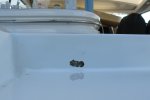
P1100002.jpg


The picture above is of the same gel coat (apart from hatch lid) you can see that the difference in colour seems obvious, yet it is exactly the same gel. So which reflection do you match to?
You should also be able to see how even the lightest / whitest shade in the picture is nowhere near the background of the forum white screen.

Another picture of the same gel, this time it's giving us a completely different shade to those above., with more of a blue tinge to it.

P1090999.jpg

What I am trying to show is how hard it is to match to one viewpoint. You have to be on the move and look at the gel from many angles, with as little corruption from other light sources or reflections as possible.
The first pic looks as though it could be achieved by adding some ivory or possibly even brown types of colour, but the second picture looks as though adding a smidge of blue would help.

I use something called a Sun-gun from 3M to reduce unwanted colours and shades. It's a powerful torch basically but the bulb replicates the same light as the Sun.
This helps gain a better view to take from, quite helpful when matching dark blues or blacks. £400 for a what is essentially a torch though.


There is a way however to match this using eyes only.

It's quite simple really, you use the surface you will be matching as a pallet.

Gel coat cures the same colour wet or cured, so you get to play around with the colour / shade prior to adding the catalyst.

Starting with your base white, smear a finger full onto the surface and rub in a small circle.

If you have a good white base gel then the difference in colour will be as obvious as the pics above are in comparison to the forum white.

Lets say that picture 2 is what my eyes are actually seeing, after I change angles etc, it's not what went down mix wise, but to keep things simple..

I add a tiny bit of green pigment to my finger and smear it into one half of the white circle i've just applied to see what happens.
It's completely wrong as I can see the difference in colour is further away not closer. - No worries, just wipe the wet gel off the surface with some acetone and start again.

Now this time I add a small amount and I do mean small (the point of a tooth pick size) of blue.
This time it seems that it's a closer match, so there is certainly a bit of blue in there.

I then add a small amount of blue into my base gel coat pot and try another smear. Confirm that I've taken a step closer to the colour.
I also thin the gel base ever so slightly with some styrene so the pigment can be consumed a little easier by the gel.

I might go too far and add to much blue to my base pot, in this case I can add more pure white from the original base and lighten it back a bit.

At this point I might try adding a tiny amount of ivory or mustard for example (with the smear technique) to see if that takes things even closer and so on.


The benefit of this is that you can just wipe clean your pallet and start again, as I've said, it won't cure without a catalyst so you can continue to practice to your hearts content.
You may nail it with one go, add a little ivory and you are there, others may take much longer and many more colours.


Now there are other things to consider that may change the colour once you have found it.
Too much catalyst, contaminates from anything you have used to seal from oxygen, too much heat etc.
Even once it has cured with the perfect colour, how far you go down the 'blending' stage can have an effect on the final finish.

For example if you just sanded down the repair with 320 grit and stopped there, you would have a difference in surface reflection. This difference wil reflect light differently giving the impression of an incorrect match.
It needs to have the same surface profile as the surrounding and this is done as most know by working through the wet & dry grades before polishing.
 
Last edited:
So far, the only gel coat repairs I have done were screw holes which could be filled and blended in using "off the shelf" white without being overly noticable. However, I noticed a 8cm spider-web crack around one of the flybridge seat back-rest mountings. It is cosmetic only, mostly underneath the seat cushions and affecting only the box upon which one sits; however, I still would like to repair it. As the affected area is larger, the repair is more likely to be seen (with cushions off) so I want to get the color matched as perfectly as possible without paying someone to do it. Yes, a bit perfectionistic but that is me.

I was thinking, how easy would it be to match colors using a smartphone app? I imagine it working as follows - take a picture of the existing gel-coat, then take pictures of available pigment colors and then calculate the amount of each color needed to match the desired color. One would take steps to ensure samples are taken under the same conditions e.g. from a fixed angle and distance using flash so as to reduce the impact of wider lighting, averaging across selected points, etc. The result might not be perfect at first; however, if one take a picture of the resulting mix, the app can then improve it's calibration, advise what more to add to get it closer to the intended result, and the process repeats itself - until an acceptably close mix is obtained.

Is there something like this already out there? If not, what would the best approach to matching colors be? What would be the issues e.g. color maybe changing as it dries, etc? Anyone with experience in this area?

On my Bene there is a plate in the locker with the colour cide on, same deal as modern cars. On the previous 351 it was the same. My big repair was done with Bene gel coat, sourced from the olate number. It is unvisible!
S
 
Top