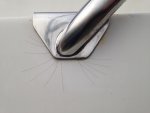
Gel coat repair ideas please.

Firstly do not start doing anything until you have considered the following. Colour matching. If you want the repair to be invisible you'll need to match the current gelcoat to the new gelcoat, which may be easy if the boat is new and you can get the RAL colour, but if you can't then you'll be into the art of colour matching which could be difficult. If you can't match the colour you will end up with a repair that could look even worse and may want to get it done professionally which I would imagine would not be that costly; for a professional it's quite a straight forward repar. If you decide to tackle it yourself there are some good videos on you tube. The basic idea is to enlarge and deepen the cracks with a stanly knife or similar. Once you commit to this there is no going back but the process is not that difficult. Leave gelcoat proud and go through the grits ending with 1200+ then finish with some cutting paste and polish.
 
I had star cracks like that, and after not taking advice and not fixing them I took advice and fixed them. Basically I was told that the substrate will also be cracked, which it was, and I had to strip the gel and grind back 2-4mm until the cracks disappeared, then apply a layer of mat/resin, followed by gel type finish. In my case I was going to reapply perfection, so colour match wasn't a problem. Mine was impact damage. There would be no point in trying to repair over underlying cracks, you must grind back until they disappear. If you are sure it's only the gel coat go ahead with cosmetic work.
 
That is a common problem caused by a combination of inadequate reinforcement under the stanchion base and stress on the stanchion from people pulling at it. wile you can do cosmetic repairs to hide the cracks, the only long term solution is to remove the base, grind back to sound GRP, repair and re gel the surface. Exactly what you need to do will be determined by what you find underneath.
 
I think whatever I do will have to be cosmetic as the stanchion is integral to the rail which goes right around the boat.

OK, understand. The cracks are on the vertical surface of the hull. Is this only on one stanchion, or are others similarly affected? If it's only one or two, I'd get a professional GRP repair guy to sort the problem - it shouldn't take long and you'd get a good colour match. Then you just have to stop people hauling on the rail!
 
Chances are they will reappear in a couple of years unless you deal with the underlying problems. Star cracks form for two reasons. First in the middle of panels where something has dropped on the panel or at changes of plane where there is flex or poor wetting out of the laminate. Second, like yours around fittings where it is the stress of the fitting that has damaged the underlying laminate. You can see the cracks going under the fitting suggesting they are not just cosmetic. Of course your fitting goes through the boat, but I guess it only has a single bolt and side screws through the toe rail. Not the most secure of attachment methods.
 
The professional who fixed some gelcoat cracks for me said that the problem is due to the fact that gelcoat is brittle, and the underlying layup is slightly flexible, the result on my boat is cracks where the wide side deck joins the coachroof, The thicker the gelcoat, the worse the cracks tend to be, and my kit car has a fairly thin fibreglass bonnet with a very thick gelcoat, and some very bad cracks as a result.
 
It would be helpful to know what boat the OP has. Older boats (30 years plus) have gel coat that was applied by brush and would have a thickness of 1 to 3mm thick. Newer boats have the gel coat sprayed on and is only about 0.5mm thick. So gentle sanding can easily sand through the gel coat on newer boats, so be warned.
 
Top