Gas turbine power units

Funnily enough watched a documentary within last two weeks about GT powered American boat in unlimited class.
his problem was corrosion/erosion on blades, with rebuild running to telephone numbers in dollars.
Proximity of intakes to salt water spray - not best idea.
 
To change the subject slightly, why has nobody developed a gas turbine generator for use in the home where the waste heat could be used for central heating? I thought about this when my CH boiler failed and I replaced it with a new condensing boiler. It would have been nice to have my own generator, particularly in a village plagued by power cuts.
 
Model aircraft jets

It may surprise people to know that gas turbines can now be made small enough to fit into aircraft models in the range of about 6ft span and length. The engines may weigh less than 1kg, although of course they are jets rather than power units. See, for example, here. I wouldn't like to say anything about operating life, though.
 
Odd thoughts, Unless you have high percentage of power cuts,the cost of a GT and the bits to convert heat to warm the house on top of normal CH would be un-recoverable. I lived on generaters for some years, so this was frequent topic. In a warm climate, rather than yours.
A petrol or diesel genset would make far more sense, I fitted many as back up. On Sunday power was cut from 8 to 12 for `maintanence´ and every time it rained.
A

A
 
Re: Model aircraft jets

Yes, I was fascinated to see some of those. But their consumption is outragious. Bit different to my efforts with an ED racer in the 60s on control line stuff.
What about Rocket Man? Seems to have some small jets that work.
A
 
went to the factory in san diego on a familiarisation course, the units were the same whether destined for offshore or desert.
what has spray got to do with it, my vp 2030 sits in the engine comptment, no special air intake, just a hole with a bit of zinc grill over it. stop digging!
stu
 
the gas turbines that i refer to were pretty efficient in that we used heat recovery on the exhausts, two factories around here actually went down the self generation route did the same, one a chipboard factory, used the exhaust heat to dry the sawdust raw material, apparantly big savings were made. ive toyed with the idea of getting a simple diesel donkey genny, run it on waste oil, and collecting all the waste heat to warm domestic water etc
stu
 
The GT that Rover were planning to fit to the Rover 2000 model used a ceramic heat exchanger. This was the bit they could not make in the end and it all died, and they fitted that old 2 litre engine. Got a couple of tech papers on the project filled somewhere. From memory the exhaust came out of the slot between bonnet and windscreen, giving demisting and defrosting.

Brian
 
I remember as an apprentice HGV techie we had to learn about a British Leyland gas turbine for trucks at college, it was a twin shaft with a compressor turbine and a power turbine, and I seem to remember something about a variable nozzle to control the torque and reduce the turbine case heat when under part load, had two large heat exchangers on the sides and a single burner can at the top.
It was mated to a semi auto transmision

Fuel economy was said to be pretty much the same as a conventional diesel and it was touted that the time before expected overhaul was about 750,000 km, with little maintenance required

"Its the future lads" sez the lecturer reverently. It all came to nowt.
Studied it for weeks as well. Loads of informtion. Not seen one since.
 
I'm sure it's improved but all the small gas turine engines I worked with were the most unreliable part of the aircraft -in fact generally bloody awful bits of kit. The Microturbo APU on the Jaguar was also used as a propulsion for something, may even have been a missile. From what I saw of it as an APU it spent more time either on fire or dripping fuel everywhere than it ever did actually running.

One of the big problems with them, aside from the cost of building and running them, is that, when they fail, they tend to do so spectacularly. Shafts disintegrate at high speed, throwing bits everywhere in the worst case. Even a minor flame out could be a bit nasty if you're standing behind the car/boat at the time.....
 
Hi Grumpy I can't help thinking that your APU problems were a peculiarity of that particular APU. They are generally very reliable on commercial jets Boeings (though I remember the engineers hated to start the Fokker APU for fear of failure. (more work).

Re life and hot starts on GT. A GT is usually rated at % of RPM of the gas generator. ie 100% is max rated power. Because of the nature of the air compressors they need to reach 40% RPM before you get enough air flow to get a start. If you give it fuel at a lower speed the fuel burns Ok but tends to burn the turbine blades without giving much acceleration. Even with a good battery for starting the engine life is reckoned in cycles (no of starts) as the temp will be greater on start up than any high powered running. Certainly the better the batteries the better the engine start. So operators of small GT aircraft where possible use a generator or large ground cart rather than ships batteries.

In military service the power out of a GT is often limited purely by the life expectancy of the engine. So in an emergency you just pour more fule in a get more power until the internals melt. If you get home it almost certainly means have a new engine. They have recorders for temp excursions ie recording time for the over temp to determine mainrtenance requirements.

Of course a GT on continuous service will not run for ever but they certainly can have a long life compared to frequent starting engines.

olewill
 
You may well be right though even the Tornado seemed to have it's fair share of fun and games. I was always on fast jets so I suspect they were rated to the very maximum they could be for their size, rather like leisure-rated diesels or small turbo-charged engines. They military tended to under-use and over-maintain in those days as well.

I've seen quite a few Jags bump-started (flat-out down the runway on one engine and stand on the brakes at the end, desperately trying to steer and start the other engine at the same time).
 
Sounds like an exciting ride, but unfortunately not compatible with todays congested roads.
I love the idea of turbine power, the sound at start up always gives me goosebumps, and the whistle of jet engines is magical.
I also like the mechanic simplicity, smooth rotation instead of the mechanical thrashing of parts moving in opposed directions as in todays reciprocating engines.
It would be great if the technical hurdles could be overcome.
We have just ordered a Nortech 50 with two 2,000 hp gas turbines from the factory in Florida so looking forward to getting my hands on that!
 
The heat exchangers on the Rover Le Mans GT where made by Corning Glass (USA) and were honeycomb discs rotating at 20rpm. Half the disc covered by the intake, half by the exhaust. Improved the consumption by some 25%.
A
 
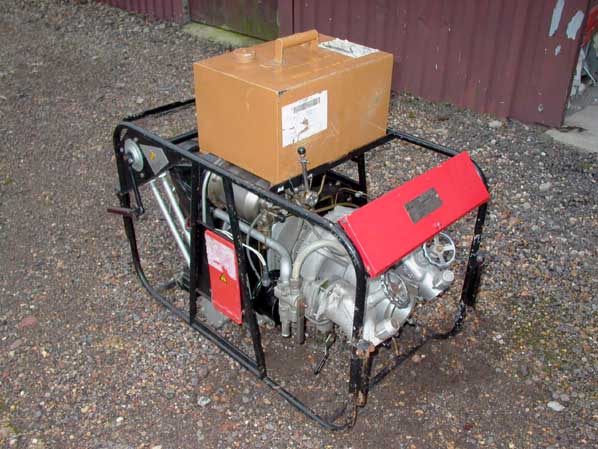
Like this Rover powered fire pump which required no battery as it was started by hand, with some difficulty?

rover1_sm.jpg
 
Top