Galling of stainless fasteners

zoidberg

Well-Known Member
Joined
12 Nov 2016
Messages
7,117
Visit site
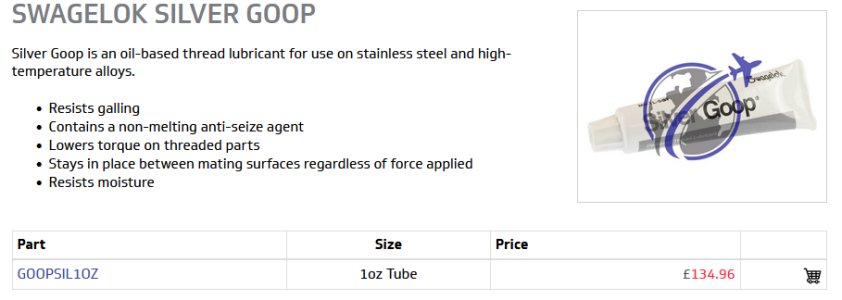
I am advised to lubricate the threads of machine screw fasteners and rigging screws, to prevent 'galling' - aka pressure welding.

Would crafty engineers here recommend suitable products and mention some that simply aren't....?

Also, rigging guru Brion Toss recommends filling the innards of certain demountable terminations - e.g. Sta-Lok - with a silicone gunk to prevent water entrapment and therefore oxygen exclusion. I haven't encountered this treatment. Any recommendations?
 
I am advised to lubricate the threads of machine screw fasteners and rigging screws, to prevent 'galling' - aka pressure welding.

Would crafty engineers here recommend suitable products and mention some that simply aren't....?

Also, rigging guru Brion Toss recommends filling the innards of certain demountable terminations - e.g. Sta-Lok - with a silicone gunk to prevent water entrapment and therefore oxygen exclusion. I haven't encountered this treatment. Any recommendations?
Use a nickel based anti seize on your ss threads.
On the basis of info gleaned from this forum, I squeezed a blob of silicone into my fittings prior to assembly.
Not fallen down yet (7y).
 
Not fallen down yet (7y).

I thought 7 years was the limit for insurance purposes :). You might be on borrowed time.

In these times of 'saving the planet' the arbitrary life ascribed to rigging really needs some justification. Stainless steel is not cheap to make - yet insurance companies (without any data they have published to support their contentions) demand that we scrap our rigging and buy new.

Jonathan

Apologies Mr Zoidberg - just a small element of thread drift.
 
I am advised to lubricate the threads of machine screw fasteners and rigging screws, to prevent 'galling' - aka pressure welding.

Would crafty engineers here recommend suitable products and mention some that simply aren't....?

Also, rigging guru Brion Toss recommends filling the innards of certain demountable terminations - e.g. Sta-Lok - with a silicone gunk to prevent water entrapment and therefore oxygen exclusion. I haven't encountered this treatment. Any recommendations?
I did a whole lot of Norseman 12mm fittings a while back and IIRR they recommended silicon in the assembly to avoid water ingress.
Vyv Cox would be the guru on this?

In the case, the problem was not the cable, but the original swages.
 
I thought oxygen was needed for stainless to work. I thought stainless underwater was not a good idea because lack of oxygen. I read a bit about stainless tangs in rudders failing if water got in. This is what I learnt from pbo magazines over 25 years ago. Was I misinformed? I probably have the magazines still. Skin fittings are never made of stainless so that leads to clues maybe.
 
A bit a internet searching shows many rudder problems because of stainless tangs. Stainless needs oxygen to work properly. I can understand standing rigging screws needing a bit of lubricant perhaps but I did not add any for 20 years on my first boat and all was well.
 
Galling was something I learned the hard way....when fitting my passerelle....I had ordered all my stainless fasteners and was working in the most awkward cramped conditions and I had to keep cutting out bolts that wouldn’t fully tighten...removing a single bolt could take hours....now I lubricant all stainless fittings without even thinking about it
 
A colleague of mine years ago was part of a multi-company team investigating galling. Their conclusion was that molybdenum disulphide additives were most effective. Shell developed such a grease but it was farmed out to another company, sorry do not know who.
 
I did a whole lot of Norseman 12mm fittings a while back and IIRR they recommended silicon in the assembly to avoid water ingress.
Vyv Cox would be the guru on this?

In the case, the problem was not the cable, but the original swages.
Yes, I use silicone in Norseman type fittings if I have any but I have also used Sikaflex. Anything that excludes water to reduce the galvanic corrosion effects on the cone.
 
I recently replaced all my 12mm rigging using self assembly stalok fittings. The fittings came pre-lubricated with tefgel.
Selden don't recommend using any sealant in the Stalok fitting incorporated into the bottom of their genoa furlers. Part of the thought is that you can't seal a 19 strand wire with silicon, etc. Water will still get in. Trying to seal it may just increase the amount of water trapped in there. I am not sure I agree. I chose not to seal the upper fittings as they would self drain under gravity. I used some high modulus silicon to seal the lower fittings as that was what I had in an already open tube.
The rigging was 10 years old with 37,000nm on it. I did hope to get another Atlantic crossing out of it, but after finding two broken strands on one of the aft lowers, I decided to bite the bullet and replace it before the trip back to the UK next year. I had already replaced the babystay due a broken strand in that last year. I chose to use compact strand and stalok fitting in that wire.
The only place we now have a hydraulic swaged fitting, is at the top of the forestay
 
Last edited:
I recently replaced all my 12mm rigging using self assembly stalok fittings. The fittings came pre-lubricated with tefgel.
Selden don't recommend using any sealant in the Stalok fitting incorporated into the bottom of their genoa furlers. Part of the thought is that you can't seal a 19 strand wire with silicon, etc. Water will still get in. Trying to seal it may just increase the amount of water trapped in there. I am not sure I agree. I chose not to seal the upper fittings as they would self drain under gravity. I used some high modulus silicon to seal the lower fittings as that was what I had in an already open tube.
The rigging was 10 years old with 37,000nm on it. I did hope to get another Atlantic crossing out of it, but after finding two broken strands on one of the aft lowers, I decided to bite the bullet and replace it before the trip back to the UK next year. I had already replaced the babystay due a broken strand in that last year. I chose to use compact strand and stalok fitting in that wire.
The only place we now have a hydraulic swaged fitting, is at the top of the forestay
Whenever I have made up these fittings I add sufficient sealant that it squirts out of the wire insert quite copiously. I would think it seals pretty well around the perimeter of the cable and I doubt that sufficient water would come down between individual wires to be a problem.
 
Whenever I have made up these fittings I add sufficient sealant that it squirts out of the wire insert quite copiously. I would think it seals pretty well around the perimeter of the cable and I doubt that sufficient water would come down between individual wires to be a problem.
Yep. Not my argument. It is Selden that don't recommend it. I sealed my lower fittings, the best I could
 
Lots of good advise.

The other rule is to tighten loaded fasteners very slowly so that the fitting does not heat up. Not just outside, but on the inside, at the thread surface. 15 seconds per revolution is one rule of thumb. Sounds crazy slow, but I didn't make it up.

Clean the threads. Even new blots can have grit in there.

Threads are not for pulling parts together. Use a clamp or other means if possible.

And, obviously, rigging screws should be bronze or have bronze inserts.
 
Top