Gaffer question, do I need some lubrication?

....... I did read somewhere that the throat halyard must be vertically inline with the head fitting on the gaff to avoid a levering effect on the saddle, .......

I used to sail gaffers in my youth and the top throat blocks were attached to the mast with a "stand-off". Similar to an eye bolt but the eye was about 6" off the mast. This keeps the top throat blocks clear of the mast and enables the throat halyard to pull vertically upwards from gaff. If a standard eye bolt is used then the throat is pulled into the mast adding friction and the top throat blocks rub on the mast causing considerable wear.
 
I used to sail gaffers in my youth and the top throat blocks were attached to the mast with a "stand-off". Similar to an eye bolt but the eye was about 6" off the mast.

Yep, aka a crane. Some boats get double duty from it by also using it in lieu of a chock / hound's cheek to rest the forestay on. Though it seems to me that's sorely tempting it to start pulling down through the wood...

I think what Ahoy is referring to is the idea that you don't want the throat cringle on the sail to be bent onto the gaff forward of where the throat halyard is attached. If you do, you have the gaff working as a lever with the throat halyard as the fulcrum. As the peak moves down the throat cringle will move up, and if the luff was already bowsed taut then you're going to strain something.

Pete
 
Last edited:
prr. No topping lift on my rig but one to bear in mind if I need to apply it on other boats. Will deploy one of my home stock of candles to the boat for dual use mast lube/romantic lighting use as required.

AHoy2
This may be the problem. Even a rig with some kind of boom crutch needs a topping lift. Larger rigs will have two, one leading down each side of the gaff. Windward one applied & the leeward slackend prior to hoisting.
 
This may be the problem. Even a rig with some kind of boom crutch needs a topping lift. Larger rigs will have two, one leading down each side of the gaff. Windward one applied & the leeward slackend prior to hoisting.

Agree - If the boat doesn't have a topping lift, then you will struggle to hoist the last bit of the sail as you're trying to lift the boom as well (this applies equally to bermudan boats unless they have a rigid kicker). You should top the boom up above its usual sailing position, hoist the throat fully and the peak almost fully, then let the boom fall into position, then finally adjust the peak halyard to get a nice sail shape. At least, that's how Kindred Spirit's mainsail worked best. I can also believe that failing to support the boom on a topping lift before lowering would cause gaff parrels or mast hoops / lacing to bind on the mast.

I would definitely recommend paired topping lifts, not just for "larger rigs". As well as allowing you to have only the windward one taut, so that the sail slides down the leeward one more easily, they also work as rudimentary lazy jacks by containing the sail to some extent, and guide the gaff down onto the boom instead of leaving it to swing free. Put a pair of single-sheave blocks at the hounds (or wherever the throat halyard upper block attaches) and have a line each side run up to the block, and down to near the end of the boom (not right at the end, ours was about two feet in on a 24' boat).

Pete
 
I have had a look back to early pictures of my boat and no sign of a topping lift as OE, I do agree with the comments made above though, so will check other Y23s when I have the chance. If anyone is interested my boat is the one featured in the reviews below and the rig is still mostly original per the reports, no topping lift to be seen.

http://www.fisherboatcompany.com/yarmth23_pbo_2000.pdf

http://www.fisherboatcompany.com/yarmouth23_ym_.pdf

http://www.fisherboatcompany.com/classic boat review y23 web.pdf

I plan on getting out for a sail tomorrow given the decent local forecast so will refresh my knowledge of the rig and apply the suggestions made by all.
 
I have had a look back to early pictures of my boat and no sign of a topping lift as OE, I do agree with the comments made above though, so will check other Y23s when I have the chance. If anyone is interested my boat is the one featured in the reviews below and the rig is still mostly original per the reports, no topping lift to be seen.

http://www.fisherboatcompany.com/yarmth23_pbo_2000.pdf

http://www.fisherboatcompany.com/yarmouth23_ym_.pdf

http://www.fisherboatcompany.com/classic boat review y23 web.pdf

I plan on getting out for a sail tomorrow given the decent local forecast so will refresh my knowledge of the rig and apply the suggestions made by all.

Hi. your rig has topping lifts, they are in the form of lazy jacks.... this is good as it also has a boom crutch with three boom positions.
 
Hi. your rig has topping lifts, they are in the form of lazy jacks.... this is good as it also has a boom crutch with three boom positions.

That was my original take with the lazy jacks, however, there is no way of sensibly using them in that role at present. More rig experimenting needed on my part I think. Thanks for checking.
 
Topping lift

That was my original take with the lazy jacks, however, there is no way of sensibly using them in that role at present. More rig experimenting needed on my part I think. Thanks for checking.
My Norfolk Smuggler has an identical rig and the lazy jacks serve as a topping lift
 
Well the promised good weather materialized so rigging checked per all the suggestions and then out for a pleasant three hour sail this afternoon in sunshine and a N F2 to 3 breeze (topsail weather if I'd had crew). I can report some benefit obtained, no tallow or lanolin available but a rub of candle wax on the mast has made a worthwhile improvement, treating the saddle leather should give the result I'm looking for. A bit of practice with gaff angles resulted in far better hoisting and lowering of the main so some lessons learned.

The lazy jacks are not intended to act as a topping lift as they are fixed lengths made off above at the lower mast ring (hounds), seems like a design compromise but not an issue now that I have addressed the friction and technique aspects.

Thanks all for the input.
 
Last edited:
On the subject of lubricating one's gaff jaws... I'm just starting season 2 of owning a gaff cutter. The previous owner used lard to lubricate the gaff jaws and since the boat came pre-supplied with a jar of lard I carried on using it. But now I've used all my lard and something in the back of my mind tells me that most gaffers use tallow, not lard. Is there any reason tallow might be better? Otherwise I will continue in the manner to which she has become accustomed.
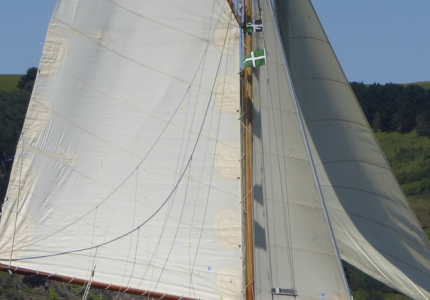
 
On the subject of lubricating one's gaff jaws... I'm just starting season 2 of owning a gaff cutter. The previous owner used lard to lubricate the gaff jaws and since the boat came pre-supplied with a jar of lard I carried on using it. But now I've used all my lard and something in the back of my mind tells me that most gaffers use tallow, not lard. Is there any reason tallow might be better? Otherwise I will continue in the manner to which she has become accustomed.
There should be no need for lubricant. Perhaps your Parrel Beads are too tight. If you keep the leather polished on the jaws it should rise and fall easily enough. Also how have you laced the main to the mast?
It should be laced as in the attached photo. IMG_7540.png
 
It is laced as in your photo. It has no parrel beads. Actually the gaff goes up and down very easily. But the main reason I have been putting lard on the jaws - apart from being under the impression that this is what one is 'supposed to do' - is that if I don't, and I'm sailing in the sort of conditions where the gaff moves from side to side a lot (off the wind, light wind, swell), I find that the rotation of the gaff transfers a slight rotation into the mast itself, which makes an unnerving creaking noise where it passes through the coachroof, and generally seems like a bad thing. I'm fairly sure my mast isn't supposed to rotate like they do on a catamaran! And putting plenty of lard on the leather of the jaws seems to prevent this.
 
Last edited:
It is laced as in your photo. It has no parrel beads. Actually the gaff goes up and down very easily. But the main reason I have been putting lard on the jaws - apart from being under the impression that this is what one is 'supposed to do' - is that if I don't, and I'm sailing in the sort of conditions where the gaff moves from side to side a lot (off the wind, light wind, swell), I find that the rotation of the gaff transfers a slight rotation into the mast itself, which makes an unnerving creaking noise where it passes through the coachroof, and generally seems like a bad thing. I'm fairly sure my mast isn't supposed to rotate like they do on a catamaran! And putting plenty of lard on the leather of the jaws seems to prevent this.
I use Vaseline on the leather of my gaff saddle and have been doing so for over 20 years. Reapply if the leather starts looking dry, you can't over do it. Your mast should not rotate. Mine has a tennon on the heel that engages in a mortice in the keel. My gaff saddle exerts very little pressure on the mast so vertually no torsion on the mast so am surprised yours has any effect on mast rotation even without a tennon on the heel.

Www.solocoastalsailing.co.uk
 
Top
