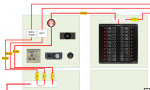
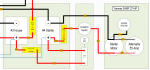
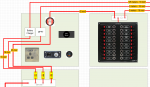
Fuse placements and sizing

Well, I am at a loss for words! Surely this is an April Fools Joke. I know it's not I've looked at the website.

On a dark and stormy night my nav lights go out. Oh gosh I wonder what fuse it could be? One circuit, labeled and you need a wee LED to tell you what the blown fuse is. I think most people could find and fix the fuse blindfolded.
Not only will the wee LED help to locate the relevant fuse but it actually confirms that it has blown and that your nav light failure is due to some other reason
 
Thank you all for the advice I have swapped the main switch panel feed to 25 mm2 and added a fuse for the link to the next switch panel

I wonder on the fuse sizing. I found this link, ISO Ampacity Calculator, that says that ampacity for my 16mm2 is 45 Amps, and 60 Amps for 25 mm2. These do seem low to me. However, on this basis, i plan to use a 60amp fuse to protect the 25 mm2 that goes to the switch panel busbar and a 40 amp fuse to protect the 16 mm2 that goes on to the next switch panel. I'll use a 40 amp fuse for the Battery charger but a 30 amp fuse for the MPPT charge controller due to the 5mm2 tails I have to use.

Does that sound ok?


1645045475325.png
 
Last edited:
Hmm, maybe I'm misunderstanding the "Current-carrying Conductors in the Bundle" option. I took that to mean strands.
ITYWF that a single 16 mm (ie not bundled with others) cable is rated at 110 amps and that 25mm is rated at 170 amps
The ratings are reduced if bundled with other cables

Why have you increased that one to 25mm ?
 
ITYWF that a single 16 mm (ie not bundled with others) cable is rated at 110 amps and that 25mm is rated at 170 amps
The ratings are reduced if bundled with other cables

Why have you increased that one to 25mm ?

Yes, I was coming to that conclusion, thanks. What do they mean by bundlled? There are number of cables that come together to pass through a bulk head or two. They'll be held together with Velcro at points but mainly loose. I guess the concern is heat build up?
 
Ok, so I have revised the fusing as thus.

Mega Fuses

1 : Cryrix CT 230A Battery Combiner225AAs specified by Victron
2 : Starter Motor (Yanmar 3HMF 27-HP)500A/160A/250A?Max continuos rating of the isolator switch / or 160A for the 35mm2 Ocenflex Tinned Cable / or 250A as suggested by Paul elsewhere?
3 : Main Positive Feed150ABased on the cable, busbars and frankly 150 amps is far too much anyway

1645094276372.png

Midi Fuses

1 : Switch Panels Feed90ABased on the 16mm2 connecting to the 2nd Switch Panel
2 : MPPT Charge Controller40ABased on the 5mm2 tails
3 : Battery Charger40AAs above to reduce fuse variety
1645093963727.png
 
Last edited:
Ok, so I have revised the fusing as thus.

Mega Fuses

1 : Cryrix CT 230A Battery Combiner225AAs specified by Victron
2 : Starter Motor (Yanmar 3HMF 27-HP)500A/160A/250A?Max continuos rating of the isolator switch / or 160A for the 35mm2 Ocenflex Tinned Cable / or 250A as suggested by Paul elsewhere?
3 : Main Positive Feed150ABased on the cable, busbars and frankly 150 amps is far too much anyway

1: No need for the 230a Cyrix, 120a is more than enough, unless you have other charging sources greater the 120a. Forget the start assist button and fit an isolator switch to parallel the load terminals of the domestic and engine isolator switches. That provides emergency start capability, as well as being able to isolate a faukty battery and run everything from the good battery.


2: 35mm Oceanflex cable is rated at 240a, fuse for that. A 500a fuse will not protect the cable and is unnecessary.

3: May as well use 90a here, same as the other panel feed.
Midi Fuses

1 : Switch Panels Feed90ABased on the 16mm2 connecting to the 2nd Switch Panel
2 : MPPT Charge Controller40ABased on the 5mm2 tails
3 : Battery Charger40AAs above to reduce fuse variety


They are all ok.
 
The fuses are there for when things aren't working as normal though.
Imagine a cable that runs through a cockpit locker, say, and one day in heavy weather the dinghy outboard that is stored in that locker crashes about and the cavitation plate cuts through the cable insulation and bridges between the +ve and - ve conductors.
If there is a fuse somewhere between the battery and the damaged point in the cable then that fuse will blow and all will be well( ish).
If, however the fuse is beyond that point then hundreds of amps will flow and either the copper cable will melt through before setting fire to anything else, or it won't and the crew will have a blaze to extinguish.
The closer all fuses are to the battery the less cable there is where that sort of thing can happen.
Cables running through a storage space like the cockpit locker should ideally be run in conduit or wire armoured. Just saying. Far easier not to have to deal with that kind of issue
 
1: No need for the 230a Cyrix, 120a is more than enough, unless you have other charging sources greater the 120a. Forget the start assist button and fit an isolator switch to parallel the load terminals of the domestic and engine isolator switches. That provides emergency start capability, as well as being able to isolate a faukty battery and run everything from the good battery.

Thanks Paul, the Cyrix CT 230A is already fitted, I'm just tidying it up.

So I'll look at swapping the start assist for a one/two/both/off isolator switch then. Thanks.

I really do appreciate your advice. I wish I could do something in return. In fact if anyone likes my drawings, I can send them Visio file or, if I have time, I can draw out other systems. It will look much better when I am finished, this one is work in progress.
 
Thanks Paul, the Cyrix CT 230A is already fitted, I'm just tidying it up.

So I'll look at swapping the start assist for a one/two/both/off isolator switch then. Thanks.

Not a 1/2/B, just a on/off battery switch. Connect to the load terminals of the two main isolators.

I really do appreciate your advice. I wish I could do something in return.

You're very welcome.
 
Not a 1/2/B, just a on/off battery switch. Connect to the load terminals of the two main isolators.

I understand what you are saying now, however my Isolator switches are several meters apart. So to achieve that, I would wire the Starter Isolator load as you describe but the domestic load would be from the either main domestic fuse (Mega Fuse 03) or battery terminal itself, probably the later would be easiest.
 

The cable numbered 009 appears to be thinner than the main starter motor cable 008 (35 mm2). How much thinner and will it be protected by the 250A fuse?

I'm not sure of its size but it is thinner. So you're right it will not be protected but we need the amps for the starter motor. I suspect it is wired that way around for precisely that reason.
 
I'm not sure of its size but it is thinner. So you're right it will not be protected but we need the amps for the starter motor. I suspect it is wired that way around for precisely that reason.
Heavy positive cables close to the (vibrating) engine block is an high risk area and a good reason for having these protected by fuses.
The connection between alternator and starter motor terminal (009) is just a convention with no other purpose, as far as I can see, than to save some copper.
You might want to consider running a separate positive cable from alternator to battery, so that you can fuse it according to its size.
If you do, you might also evaluate the benefit of another convention, namely that of connecting the alternator primarily to the starter battery. The 90A switch panel fuse may well be suitable, if you chose to connect to the house bank instead.
 
Isn't it better to fit fuses that will merely exceed the expected load by a reasonable margin, (I think about 20%)subject to the cabling being of a higher rating, than to raise the threshold that will be required to trip/blow a fuse just because the cable can handle it.?

I have started my engine many times through the 100amp shunt that comes with the battery monitor I am reasonably sure a 250 /or 300amp mega fuse is sufficient, indeed I think I received this advice on here in the past

I had a 150 fuse on my windlass so that is staying as is.

I am going with a 30 trip switch to feed the house, if this is not ok when everything is switched on (with some margin) I'll put in something stronger (I had an 80amp trip)

My cryix is the 120amp (I'll be using a 12b for paralleling. I am now wondering about the effect of this on a smart charger that feeds the twow banks(as it, in it's wisdom sees fit) It may be that I should disconnect one feed and let Cyrix be the only intelligent thing on board?

Why not take the alternator feed back towards the battery and a lower rated fuse just before the battery, or put a fuse at the point it meets the starter/cable?

(Still jealous of the clarity of the diagrams..?)
 
Top