Fuse for a USB/12v socket

richardabeattie

Well-Known Member
Joined
9 Jan 2004
Messages
1,386
Location
Wiltshire
Visit site
I am fitting one of these to charge my phone from the 5v USB socket and for other low load uses in the 12v socket.


"12V/24V Dual Recessed Power Socket - Twin USB (5V 2.1A) & Cigar Lighter"

I'd be grateful for advice on what sort and rating of fuse to put in the red wire.
 
I am fitting one of these to charge my phone from the 5v USB socket and for other low load uses in the 12v socket.


"12V/24V Dual Recessed Power Socket - Twin USB (5V 2.1A) & Cigar Lighter"

I'd be grateful for advice on what sort and rating of fuse to put in the red wire.

20amp as that is the max rating of the power socket. Smaller if you dont wish to provide the full 20A.

Whichever the wiring of the unit + and - must have a maximum safe capacity no less than the fuse value.

If its any length the wiring may have to be quite bit heavier to avoid volts drop at the higher loads.
 
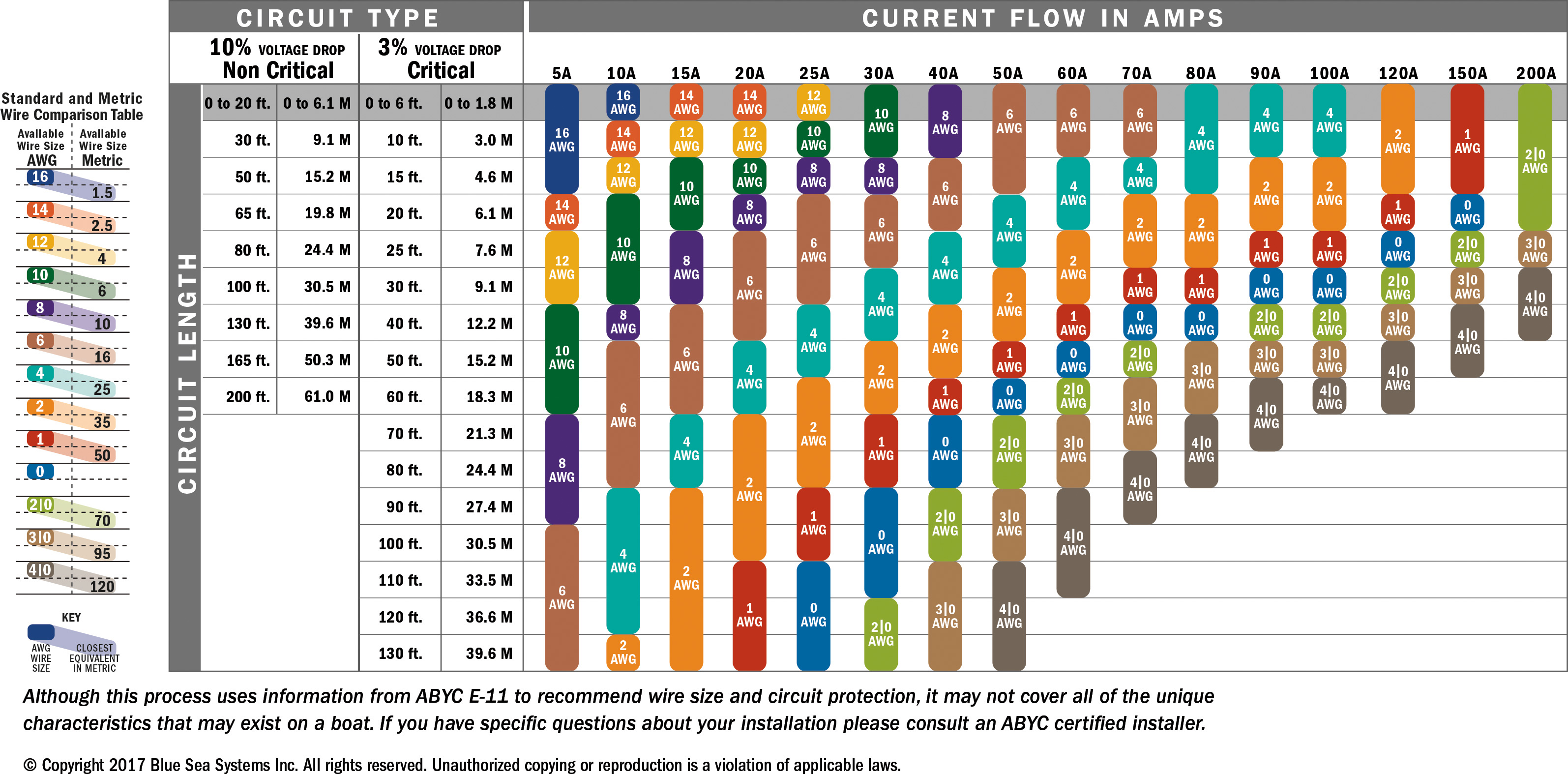
Yes, the key is to remember that fuses protect the wiring. I know for a long time I was unaware of this fact and thought that a fuse should be rated for the thing you are planing on using. There are simple online guides to wiring gauges and lengths against voltage drop and fuse ratings. These are what I used, after many questions on here and help from VicS and others, when I was rewiring my boat from scratch. Something like this:
DC_wire_selection_chartlg.jpg
 
Yes, the key is to remember that fuses protect the wiring. I know for a long time I was unaware of this fact and thought that a fuse should be rated for the thing you are planing on using. There are simple online guides to wiring gauges and lengths against voltage drop and fuse ratings. These are what I used, after many questions on here and help from VicS and others, when I was rewiring my boat from scratch. Something like this:

I've never found many UK suppliers who use AWG; it's much easier to use a sq mm table.
 
I've never found many UK suppliers who use AWG; it's much easier to use a sq mm table.

That was just an example table as it was the first that came up when I googled. I did find AWG was easy enough to use though and many of the suppliers as well as the online information used it as an option. There are other tables that tell you the sq mm comparison but I am tired of googling :)
 
Great diagram but what does Critical and Non Critical mean? I've worked it out that AWG stands for American Wire Gauge and that as the connection is only a foot or two long I need 14 gauge or 2 sq mm wire and a 20 amp fuse. Is that it?
 
critical and non-critical refer to the thing that the power supplies, and hence how much voltage drop you tolerate. A usb charger is non-critical whereas a VHF would be critical. As far as I am aware. I think you have it right otherwise. PS remember you need to take into account the entire wire length i.e. up the little red wire and back down the little black one :)
 
Last edited:
critical and non-critical refer to the thing that the power supplies, and hence how much voltage drop you tolerate. A usb charger is non-critical whereas a VHF would be critical. As far as I am aware. I think you have it right otherwise.

Critical and non-critical relate to the voltage drop in the cable. The longer the cable, the greater the voltage drop. "Critical" is max 3% voltage drop, "non-critical" is max 10% voltage drop. Some items of equipment need close to 12v to operate properly, so you'd go for the "critical" designation for that. Things like cabin lights will usually work on lower voltage, so could use the thinner gauge wire in the "non-critical" designation.

Note also that "circuit length" in these tables refers to the entire length of the positive and negative wires.
 

Thanks for posting that table. Looks very useful. I must make a note of it

I think I'm missing something here.
The one vital bit of info not supplied by the OP is what load ( current) he wants to be able to supply from the power socket. Unable to answer his question exactly without knowing that

I've never found many UK suppliers who use AWG; it's much easier to use a sq mm table.
Some do some dont some tell you both. A good table for conversion and other useful info like resistance per 1000 metres is
http://www.engineeringtoolbox.com/wire-gauges-d_419.html


Note also that "circuit length" in these tables refers to the entire length of the positive and negative wires.

Some are based to the total positve + negative length. Some use the just the length of the cable run. Its important to know which they require!
 
... There are simple online guides to wiring gauges and lengths against voltage drop and fuse ratings...
And that one would be really handy, if it used modern measurements. AWG has got to be the most antiquated system on the planet. FWIW, two of my 12V sockets are fused at 15A, the other a 16A breaker on the switch panel. In general, cigar lighter plugs are rarely rated over 10A.
 
Last edited:
From the description it sounds similar to the cheap and cheerful combined USB / cigar sockets I bought on eBay last year and fitted three of around the boat. I fused them at 10 amps because I couldn't envisage plugging in anything that needed more than 100 watts, and because both the fitting itself and the supplied wiring seemed a bit pikey and not to be trusted with serious current.

Pete
 
I think you need to fuse and wire it to the same rating as it would be done in a car, since the manufacturers of the toys that plug into the socket will assume that is what is available to them. In my car the cigarette lighter fuse is 20A. You don't want a fuse to blow when you are miles away from anywhere just to save 10p on thicker wire.
 
You don't want a fuse to blow when you are miles away from anywhere just to save 10p on thicker wire.

I might, if someone decides to plug in a 12v hairdrier or something else silly. The sockets in the cabins are meant for recharging phones and suchlike, not major power draws. I have a better-quality socket in the saloon, on short thick wires, fused at the full 20 amps if that's required. Also two deck sockets which are big bulky IP67 Bulgins, rated, fused and wired for 30 amps with dinghy inflaters in mind.

Pete
 
I've been wrestling with this conundrum as well. The sockets, as you say, may be rated at up to 20a but I wouldn't want to use them at that. I concluded that I should fuse them to suit the load that's likely to be applied. Charging phones, tablets, hand held VHF for example.
I might, if someone decides to plug in a 12v hairdrier or something else silly. The sockets in the cabins are meant for recharging phones and suchlike, not major power draws. I have a better-quality socket in the saloon, on short thick wires, fused at the full 20 amps if that's required. Also two deck sockets which are big bulky IP67 Bulgins, rated, fused and wired for 30 amps with dinghy inflaters in mind.

Pete
 
I've been wrestling with this conundrum as well. The sockets, as you say, may be rated at up to 20a but I wouldn't want to use them at that. I concluded that I should fuse them to suit the load that's likely to be applied. Charging phones, tablets, hand held VHF for example.
Surely you just fuse them within a reasonable safety limit of the wiring. If you do that then what can go wrong?
 
Top