Fuel Tank questions

I'm intrigued. Why is a "brass hand pump" a better solution than gravity?
With a sump at the bottom of the tank, which used to be standard, any dirt or water will automatically find its way into the sump, from which it is drawn off.

The worry is that any fitting at the bottom of a tank may develop a leak. If that happens with 200litres of diesel above it, how do you fix it? With fittings dipping into the tank from above, you can always remove and replace them unless the tank is absolutely brim-full. That's if the leak is a slow weep - if it really lets go you have a bilge full of diesel - and if you also have an auto bilge pump you may be hit with a fine for thousands for pollution (happened to a yacht in Southampton Water a few years ago, with only a few litres of spilled diesel).

The sump at the bottom is still a good idea, but rather than a tap it should have a dip tube reaching down into it, through which any water and crud can be sucked out.

Pete
 
The alternative is to have the two tanks permanently connected so that they are effectively one tank and you only need to draw from one. However the problem with this arrangement is ensuring that both tanks are full from one filler and fuel is drawn equally from both tanks. It is possible to have the new tank completely separate with its own filler and just a takeoff and pump to transfer fuel from that tank to the main tank. Simpler but does not give the advantage of independent supplies.
Yes, that is the simplest thing but I don't intend to have 2 fillers. Instead I will use a reversible pump and proceed by filling the main tank then transferring fuel to the aux tank. When the main tank is running out I will transfer fuel in the other direction using the same pump running in reverse.

I may get the aux tank made up with fittings to allow me to install independant feeds at a later date but it's not going to be easy to arrange an extra filler because my boat has narrow side decks in the cockpit region with long genoa tracks.

Boo2
 
Last edited:
Don't think I have ever seen an arrangement like that, but I think you are missing a trick by not taking advantage of the ability to have two independent supplies. Presumably you can source a reversible pump or you will have complicated piping and valves to use the same pump to transfer both ways.
 
The worry is that any fitting at the bottom of a tank may develop a leak...The sump at the bottom is still a good idea, but rather than a tap it should have a dip tube reaching down into it, through which any water and crud can be sucked out.

+1
And if NormanS is so fond of gravity, as I wrote before, a simple siphon tube with a tap at the end will utilise it nicely.
 
+1
And if NormanS is so fond of gravity, as I wrote before, a simple siphon tube with a tap at the end will utilise it nicely.

And you say that your syphon tube will stay full. So what's the difference between your"tap at the end", and my valve on the dirt sump? Mine seems much more straightforward. Both, IF they were to completely fail, would have the same result.
 
My tek tanks have inspection panels on the top and a tube that goes all the way to the bottom. This is so you can sample the tank, suck crud out and also pump the tank dry if necessary. The top has a butterfly valve and a stainless tube onto which I can attach a Pela or other pump.
 
My tek tanks have inspection panels on the top and a tube that goes all the way to the bottom. This is so you can sample the tank, suck crud out and also pump the tank dry if necessary. The top has a butterfly valve and a stainless tube onto which I can attach a Pela or other pump.
Where did you get the butterfly valve, can I ask ? Which of the Tek-Tanks fittings styles does it fit into ?

Thanks,

Boo2
 
Where did you get the butterfly valve, can I ask ? Which of the Tek-Tanks fittings styles does it fit into ?

Thanks,

Boo2

Sorry, I do not know the detail. All done by Tektanks and Rustler Yachts. Perhaps these will help.

36f3e91847de80aa4b09c41437a46c0c.jpg


8d9a34602a423d1710eb6bf94f027ffe.jpg
 
But I can lift mine up (or could...it's on my last boat).

I grant you the difference is small, but I have an aversion to holes at the bottom of fuel tanks.

I also replaced my tank which had a leak at the base so fitted a standard 90litre plastic tank(MUCH cheaper than custom made tank) with all fittings from the top of the tank. Could you get a standard plastic tank instead of a custom made tank? My original tank was very large, from memory about 150litres but the new tank with 90litres is more than enough for 20 hrs motoring.
 
But what type of fittings ?

Hi,

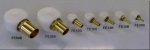
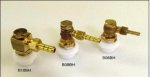
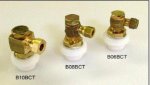
I still need to decide between the types of fittings though, the pix below are from Tek-tanks :

Can anyone explain to me what they are and what external things will attach to each type ?

Thanks,

Boo2
 

Attachments

  • elbow.jpg
    elbow.jpg
    19.3 KB · Views: 0
  • banjo.jpg
    banjo.jpg
    18.6 KB · Views: 0
  • banjo2.jpg
    banjo2.jpg
    17.4 KB · Views: 0
The ones with spigot tails (on the right) are for use with flexible hose. The others are compression fittings for use with metal (copper usually) either as complete tubes or tails on armoured flexible hoses.
 
The ones with spigot tails (on the right) are for use with flexible hose. The others are compression fittings for use with metal (copper usually) either as complete tubes or tails on armoured flexible hoses.

The ones on the left are also for hose. The difference between them and the ones on the right is that the former are fixed in position, the latter are on banjos so can swivel (while being assembled, not in use). The first kind are somewhat lower profile for a given hose size, which can be important depending on where the tank is being fitted.

Ones in the middle are for rigid tube, as you say.

Pete
 
Yes - I added the bit about them being on the right to clarify what spigot tails were - and confused rather than clarified! Anyway, the difference is now clear.
 
I wouldn't have any fittings on the sides of the tank unless they're right at the top edge - the potential for leaks is too great. The TekTanks fittings guide also suggests that fittings have to be on the top of the tank in order to comply with regulations.

In addition to the normal fuel feed, I'd suggest having a second draw-off pipe which goes right down to the very bottom of the tank. If you plumb this to a little brass hand pump, it's very useful for drawing off some fuel every now and then to check for water in the tank.
+1 to the "very-bottom" extra fitting, just got about a quarter of a pint of dirty black water out of the bottom of a plastic diesel tank on a 7 year old boat. Tank was made without inspection hatch - it has one now. None of the water had ever made it to the filter, as the normal fuel take-off was a good 50mm above the tank base.

The diesel itself looks OK, but I'll chuck in some bug-killer as a precaution when I put it back in the tank.

Incidentally, on my non-Tek-Tanks polyetheylene tank the circular single-centre-bolt access hatch http://www.tek-group.co.uk/acatalog/FLB - 640.jpg that I fitted leaked badly, probably tank too flexible. Had to make a multi-screw fitting up to replace it.
 
Thanks Tranona and Prv,

Can either of you tell me whether the dimensions for the hose type are the inside dia of the hose (I assume so) ? Ditto the copper pipe type banjos ?

And is it possible to get plugs for the type in the left hand picture FExxB ? I want to fit for the possibility of having an auxiliary tank but my preliminary quote has persuaded me to see how it goes with just the main tank for the time being.

Thanks again,

Boo2
 
They are inside pipe measurements - usually 8 or 10mm for fuel. Presumably you are using dip tubes for pick up and return. If you are replacing all the fuel lines worth considering having shielded piping with compression fittings on the end made up by local hydraulics shop such as Pirtek or Hyphose. Fit a shut off valve in the line that can be operated from outside the engine compartment if you don't already have one. You can have any extra holes included in the tank and fit a blanking plug or if you want to install the fitting attach a short hose with a blanking plug in the other end - securely clamped with a hose clamp.
 
Can either of you tell me whether the dimensions for the hose type are the inside dia of the hose (I assume so) ? Ditto the copper pipe type banjos ?
And is it possible to get plugs for the type in the left hand picture FExxB ?

Hose barb dimensions should be the ID of the hose, yes. Compression fittings I believe are the outside diameter of the tube, as that's what they clamp onto. In any case, if you fit 8mm tube, get 8mm compression fittings, 5/16ths get 5/16ths, etc. With hose the difference between metric and imperial is insignificant and you can interchange equivalent sizes, with compression fittings the tolerances are tighter and they ought to match.

The fittings on the left are just hose tails, same as on the right, but screwed into a hollowed-out block of plastic that's welded onto the tank, rather than screwed onto a banjo. There's no specific kind of plug for a hose tail; you could make a lashup with a short length of hose, another hose tail, and a stop-end cap, but personally I think I'd be looking to unscrew the hose tail from the plastic block and replace it with a male blanking plug. It looks like it's just screwed in there against a Dowty washer, but you could maybe check with Tek if you're unsure. I'm sure they would build it with blanking plugs if you asked, and you could replace with brass hose tails (cheap as chips) at a later date if required. Almost certainly they'll be BSP threads tapped into the plastic block.

Pete
 
I note that in the tank drawings provided by ExSolentBoy, there is a drain valve at the lowest point. It's referred to as "Diesel sampling valve". These look like excellent tanks, as the area of flat bottom is small, and acts as a dirt sump, and the fuel take-off is quite a bit above the bottom of the tank. The smaller the area of flat bottom, the smaller is the potential for a water / fuel interface, where the nasties breed.
 
Compression fittings I believe are the outside diameter of the tube, as that's what they clamp onto. In any case, if you fit 8mm tube, get 8mm compression fittings, 5/16ths get 5/16ths, etc.
My Nanni engine data sheet states 8mm for the fuel feed but it doesn't say what the fittings are, can I go ahead and buy compression fittings for the tank or will there be trouble if the engine has hose tail types ? Anyone know what the Nanni N.38 fuel feed fitting type is ?

Thanks to all who have replied,

Boo2
 
Top