fuel system woes

pandos

Well-Known Member
Joined
15 Oct 2004
Messages
3,202
Location
Ireland, (Crosshaven)
Visit site
I lost this season due to fuel system air leakage.

I did all of the normal things, that I have done on this boat many times previously and in addition to doing the same thing on dozens of pieces of machinery over the years but yet was unable to get it right.. my final thought was that it was a cracked pickup tube in the fuel tank allowing air and fluid to be sucked up, depending on the movement of the pickup pipe...

Having removed the pickup pipe it seems fine, so I am stumpted. There are two different threads on the banjo bolts used in the system and it may well be that some of these are mixed up and thereby damaging threads/seals.

I would like to rebuild the sytem with as few weaknesses as possible and add some gauges to show fuel pressure at the pump and vacuum to show if filters are getting blocked or if air is being drawn in ( I presume there is a happy medium which can be established where just fuel is being drawn through a clean filter)

I would also like to add a secondary supply, I have not really worked this out but I was thinking of a Valved tee in the suppply to the injection pump and feed this with a day-tank mounted above the engine which would be kept fed from a 12v inline pump, with a filter setup from a mitsubishi l200, simple spin on filter with built in bleeder pump.

Questions.
Has anyone used a replacement lift pump on an md21b, orbitrade make one for about €200.

There is a non return valve on the secondary filter housing to which is linked the return line from the highpressure pump.... what effect would removing this connection have ?, it seems to me to be a weakness...

attached is a pdf of the fuel system..any advice appreciated
 

Attachments

Last edited:
How do you really know it was air leakage?

Personally I would consider directing the return flow back to the tank or a swirl pot to extract any air from it.
Test the llift pump by measuring its output pressure.
Maybe add a clear filter after it so you can see any air and keep it out of the injector pump.
 
I did all of the normal things, that I have done on this boat many times previously and in addition to doing the same thing on dozens of pieces of machinery over the years but yet was unable to get it right.. my final thought was that it was a cracked pickup tube in the fuel tank allowing air and fluid to be sucked up, depending on the movement of the pickup pipe...

Having removed the pickup pipe it seems fine, so I am stumpted. There are two different threads on the banjo bolts used in the system and it may well be that some of these are mixed up and thereby damaging threads/seals.

I can understand your frustration. The most bewildering air leak I've ever had defied diagnosis for a long time. Like you, I tracked logically through the fuel system, including the pick-up pipe. The second time I did it, when replacing the bolt in the banjo fitting to the tank, the bolt didn't feel as if it was tightening properly. I applied more pressure, and the bolt broke off. It had been cracked for some time, allowing the banjo connection to relax and allow air to leak in. Keep looking, you'll find the problem eventually!

A vacuum gauge is a good addition; it can show you when the fuel filter is starting to get blocked. I fitted one to my last boat after suffering a diesel bug infestation.
 
How do you really know it was air leakage?

Personally I would consider directing the return flow back to the tank or a swirl pot to extract any air from it.
Test the llift pump by measuring its output pressure.
Maybe add a clear filter after it so you can see any air and keep it out of the injector pump.

Thanks for the replies,,

I saw air bubbles dancing in the filter on the engine,

Not sure how seeing air in the system can can help in keeping it out of the injector pump (except by turning the engine off)..

The pump produces plenty of pressure,

yes my inclination is to delete the connection from the filter to the return line and the one-way valve,. not sure what a swirl pot is, but if the engine is operating correctly the return fuel ought not be aerated,?

My problem with the pump is that I overtightened the connections, trying to eliminate the bubbles, but they were already tight...

I need to assess the viability of repairing the threads on the pump or fitting inserts to accept new banjo bolts, I ,may be able to solder internally threaded inserts.. (I'd rather keep the pump original than fit an after market one.)
 
I also had trouble with the fuel lift pump on my Bukh DV20. I had several years trying to track down fuel leaking out rather than air leaking in - my problem was over tightening of fastenings also. In my case - the body fastenings of the lift pump. I had bought a refurb kit for it and in my zeal to make it secure I distorted the flanges of the pump around the diaphragm. The fuel leak, of course, was near one of the banjos so It was difficult to tell where it was coming from. I managed to repair the flanges by grinding them carefully. Is it possible air is getting into your pump that way? It might be if the pump has to lift fuel from below the engine.
 
I also had trouble with the fuel lift pump on my Bukh DV20. I had several years trying to track down fuel leaking out rather than air leaking in - my problem was over tightening of fastenings also. In my case - the body fastenings of the lift pump. I had bought a refurb kit for it and in my zeal to make it secure I distorted the flanges of the pump around the diaphragm. The fuel leak, of course, was near one of the banjos so It was difficult to tell where it was coming from. I managed to repair the flanges by grinding them carefully. Is it possible air is getting into your pump that way? It might be if the pump has to lift fuel from below the engine.

Yes I suspect it is a banjo connection it seems I have at least two if not 3 different threads on the bolts between the fuel pumps and filter housings, I suspect I mixed up at least one of these thereby upsetting two connections,

I have found a replacement pump from a tractor source for relatively small money and also a source for fuel lines with pre made connections so when I get a chance to consider things I might replace the system I will try to find a pump or drill and tap one to accept the fittings from the cav filter housing/ the pump if these are identical...... they seem to be 1/2 UNF 20... whilst the lift pumps all seem to take m12 1.0 or even m10 1.0
 
Connect source of air pressure to the fuel supply pipe, block the return pipe, apply 5psi pressure ... hunt for the leaks/bubbles ... a leak going in the "inwards" direction can be hard to find .. but a leak in the "outwards" direction is much easier to locate.
 
Connect source of air pressure to the fuel supply pipe, block the return pipe, apply 5psi pressure ... hunt for the leaks/bubbles ... a leak going in the "inwards" direction can be hard to find .. but a leak in the "outwards" direction is much easier to locate.

the entire system is in bits now so hopefully once overhauled /rebuilt/replaced it will be perfect and will not require further diagnosis... good idea and Ill keep it in mind....
 
> lost this season due to fuel system air leakage.

Air doesn't normally leak from a fuel system but it can be sucked in through a microscopic hole, diesel leaks out and at that point the engine cuts out. To find the leaks I used kitchen roll wrapped arouud fllters, the fuel pump and and all connections, turn the engine over and you will find the leaks. If the fuel pipes are copper they are renowned for sucking in air, we had them and I changed to nomal fuel pipes.
 
> lost this season due to fuel system air leakage.

Air doesn't normally leak from a fuel system but it can be sucked in through a microscopic hole, diesel leaks out and at that point the engine cuts out. To find the leaks I used kitchen roll wrapped arouud fllters, the fuel pump and and all connections, turn the engine over and you will find the leaks. If the fuel pipes are copper they are renowned for sucking in air, we had them and I changed to nomal fuel pipes.
When I said air laekage I ment unwanted air getting in... I think most people understood that. I had no fuel leaking out. My fuel lines are a combination of steel and rubber... There could be a hole in any of these it will be a total replacement.. tractor suppliers seem to be good sources for materials...
 
> lost this season due to fuel system air leakage.

Air doesn't normally leak from a fuel system but it can be sucked in through a microscopic hole,

Doesn't have to be leaking out, it can leak in, air leaks into the system.

diesel leaks out and at that point the engine cuts out. To find the leaks I used kitchen roll wrapped arouud fllters, the fuel pump and and all connections, turn the engine over and you will find the leaks. If the fuel pipes are copper they are renowned for sucking in air, we had them and I changed to nomal fuel pipes.

If air is leaking in, how does kitchen role around the fitting pinpoint that ?

Olde saying....... Before engaging mouth, make sure brain is in gear. :)
 
You could bock off flow and return line at the tank and do a low pressure air test, using soapy water to look for bubbles. We had a vey small leak under a hose clamp that was causing a small air leak, no fuel was coming out. Only when hose was cut back could you see a very small crack in the hose.
 
You could bock off flow and return line at the tank and do a low pressure air test, using soapy water to look for bubbles. We had a vey small leak under a hose clamp that was causing a small air leak, no fuel was coming out. Only when hose was cut back could you see a very small crack in the hose.
see posts 7 and 8.

I am going to go for spin on filters with a twin filter set up and a vacuum gauge. What I really need now is to work out the best type of connections/pipe so that it is a robust system, there will be many joints with taps to allow changeing over.

8mm copper pipe and fittings seem ideal, But I am wondering if small gas valves will function with diesel, and also can i connect 8mm copper into the filter heads.


this will entirely depend on the filter heads I select
 
Vibration and work hardening of the copper pipe could be an issue and any valves/ fittings should not be brass.

I would use standard hydraulic fittings, tube with compression or coneex with crimped hose tails, easy to make up or have crimped locally.
 
Modern advice from fuel companies is not to use 'yellow metal' ie brass or copper in contact with the fuel.
 
What is the best alternative...304 ss... Nylon..?

I have just re piped my fuel system and used diesel fuel hose. I used plated steel fittings clamped with 2 ear clips. I included a sediment filter in the suction line.

diesel-tractor-generator-truck-glass-fuel-sediment-glass-bowl-assembly-l-r-1-2-inch-1072-p.jpg


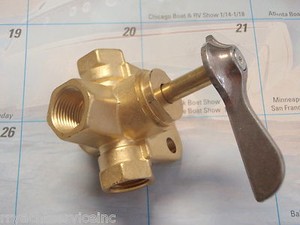
I used this valve in both 3 way and 4 way as filter and tank selection valves

s-l300.jpg
 
I think I found my problem... the lift pipe in the tank has an area of crevice corrosion that looks like it consists of at least a few pin holes by the looks of things it was at the surface of the fuel in the tank where it was left sit for 5 years in the yard... I need to put the compressor on this to see if it actually leaks air...

the fitting looks like bronze with a bit of pinking... but stiffer than copper. I am thinking of brazing the spot and then sweating a sleeve of pvc tube up over it sealed with a hose clip on the upper end so that even if there is further deterioration over the next 40 years, only fluid will be drawn from the bottom.

One of the things that puzzles me is that the feed to transfer from the reserve tank is 50mm whilst the tank filler hose is only 25mm.
 
Top