Fuel filler location ?

Boo2

Well-Known Member
Joined
13 Jan 2010
Messages
8,603
Visit site
Hi,

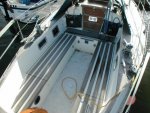
I bought a new fuel tank for my UFO 34 a while back but before getting it fitted I found the cockpit sole needed replacing. I've done that but it leaves me in a quandary because the old fuel filler location was in the middle of the cockpit sole which is the worst place possible from the point of view of contamination (see pic).

So my dilemma : where to site the new filler cap ?

The fuel tank sits directly below the cockpit sole, and, as you see from the pic, there is no space on the side decks beside the cockpit coaming to fit a new filler cap. I would rather not do that anyway because, as I understand it, there are regulations coming into play regarding the location of fuel fillers which require than any overspill stays inside the boat.

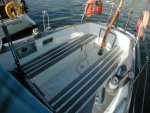
The stb cockpit seat does open but there is accommodation directly below. Abaft the stbd cockpit seat is the gas locker. The port cockpit seat opens to a locker (somewhat watertight to the rest of the hull). Abaft the port cockpit seat is the bilge pump (see second pic). The rear locker has space on either side that might work.

So, any ideas where to situate the best place to situate the new fuel filler ?

Thanks,

Boo2
DSCN9361.jpg


DSCN9362.jpg
 
Our filler is on the side deck, outside the cockpit, on our current boat, which suits us fine. On our 'new' project boat I was disappointed to find the filler is on the forward cockpit seat/bridgedeck, which seems to be a recipe for mess and irritation.

I was looking at the Boat Safety Scheme requirements a while back, and they require that the filler is placed so that a spillage doesn't flow to inside the hull, for fire safety reasons. (By contrast, quite a few other requirements are intended to ensure leaks escaping within the boat can't leak into the water for pollution avoidance reasons.) I know you don't need BSS compliance, but I was intersted that there was considered a safety issue about the location.
 
It seems to me typical of badly written legislation that leaks from a fuel filling can neither leak inside a boat nor outside, where are they supposed to go? It has to be one or t'other unless they can devise a system whereby any such leak is instantaneously vaporised - and then I suppose the idiots in the EA would fine you for air pollution.

There will always be occasional accidents when filling, I would much rather the filler was on the side deck and not in the cockpit, and unless a major error occurs you should be able to mop it up with paper towel etc.
 
Personally, I would look to either mount it on the teak behind the turning blocks or (preferably) on top of the transom. However, without knowing what the routing would be like for the pipework, that's only a guess.
 
The filler is there because it is the only place it can go (or if one is charitable the least worst place). The shape of the back end of the boat limits the choice of where you can put both the tank and the filler. Ideally it should be on the sidedeck or coamings outside the cockpit, but there is not as you have discovered physically any space for it. Practicality of use is low on the list of design priorities and you will find cockpit or bridge deck fillers common on boats where the only place for a fuel tank is under the cockpit. If there is enough clearance you may be able to recess the filler and cover it with an inspection hatch, but suspect there won't be. You can minimise the inconvenience of having diesel spill making the cockpit slippery by having a grating.

The only permanent solution is to relocate the tank to, say, under a quarter berth with easier vertical access onto a larger area of sidedeck. Or, as has been done in some similar type boats, build a tank in the middle of the boat as the base for a saloon table with a filler on the coachroof. Neither are simple solutions, even if there is space for the tank.
 
It seems to me typical of badly written legislation that leaks from a fuel filling can neither leak inside a boat nor outside, where are they supposed to go? It has to be one or t'other unless they can devise a system whereby any such leak is instantaneously vaporised - and then I suppose the idiots in the EA would fine you for air pollution.

There will always be occasional accidents when filling, I would much rather the filler was on the side deck and not in the cockpit, and unless a major error occurs you should be able to mop it up with paper towel etc.

The BSS scheme (as far as I could understand it) didn't require spills to go neither inside nor outside. The filler had to be positioned so the accidents spilled outside the boat (I guess on the basis that a potentially big flow of fuel wouldn't dangerously end up in the boat, and there would be people in attendance when filling to notice and spillage kit around at the fuel pontoon to deal with the resulting pollution), while internal leaks were to be contained inside the boat (the fuel is already there) so that there wouldn't be persistent unnoticed leaks causing pollution (the BSS is primarily aimed at inland waters).

Seems reasonable to me in principle (even if I don't necessarily agree with all the standard solutions offered to meeting the requirements)
.
 
I had to replace my fuel tank on my UFO 31, which also had the filler in the cockpit floor, [blooming nuisance]
I fitted a filler cap in the cockpit seat right in the quarter and connected with flexible hose. Then any spillage can be contained within the cockpit, usually with rags or in the event of a major spill, by blocking the cockpit drains.
I used a Tek Tank placed up under the cockpit sole where the old one was. All the connections can be made on tails before positioning the tank. I fixed the tank by lifting into position then making a timber cradle to secure it.
I've just had to remove the tank to make a new connection for the Webasto. This system made it easy by undoing a few screws. [once geriatric joints were got int position]
 
Personally, I would look to either mount it on the teak behind the turning blocks or (preferably) on top of the transom. However, without knowing what the routing would be like for the pipework, that's only a guess.
Yes, that's a logical place but I've earmarked those spaces for spi winches so unfortunately not possible.

The filler has been there for some 38 years
True, but the chance has come up to improve on the location and I think it's worth trying to find a better solution if possible.

I had to replace my fuel tank on my UFO 31, which also had the filler in the cockpit floor, [blooming nuisance]
I fitted a filler cap in the cockpit seat right in the quarter and connected with flexible hose.
That's an idea as well, but do you have teak on your cockpit seats ? I have teak strips on mine and I was concerned that drips of fuel every time would soon make it manky (-er than it already is). Other than that the port seat at the extreme aft end should give a good run for flexible fuel hose. I will have to seriously consider this idea...

Thanks to all for the replies,

Boo2
 
Following on from Tranonas summation , you might consider making a wee GRP ' blister' side moulding ?

This would be self tapped to the outside of the coaming and glassed from within, creating the ?80mm? of flat surface in which to set the filler point, away from the teak and above the salty deck or cockput sole, thence a flex tube to the tank ..
 
Can't you leave the filler where it is but just build a raised base for it so that a bit of water in the cockpit can't enter the tank? That's how mine is done.

I once had to refuel from jerry cans in some absolutely horrendous weather on passage, and the cockpit location worked well. A couple of us were able to huddle around the filler and make a decent spray/rain break whilst we filled the tank...probably not as easy with a side deck filler location.
 
My filler is on top of the cockpit coaming next to the genoa winch and a spill can go either way also its close to the spray hood so it is a real pain avoiding spillage. I am planning to fit it in the base of one of the cockpit coaming side pockets they are fairly large and sealed so any spill would be contained perhaps I will raise the fitting to keep it free of any water I could also fit the tank vent here.
 
Filler is 30 cm high 1.5 inch BSP with pipe cap

hidden inside welded deck box at front of coach roof.

Shaped and hinged aluminium hatch covers each half of divided deck box.

Hinges are welded onto deck box - half stainless steel and 1/2 aluminium welded to lids
 

Other threads that may be of interest

Top