Fuel consumption..

wazza

Well-Known Member
Joined
22 Sep 2004
Messages
785
Location
Sweden
Visit site
Is there any formular to work out fuel consumption??

If I know my HP and revs, can I know how much fuel I'd use on a passage??
I can appreciate I can't know how far that'll take me now, but during the passage it'd be easy to work out how far we'd get...
We have a 36HP Volvo Penta and it would be nice to know:)
 
Volvo may well have published a graph of fuel consumption/revs/power.

A very (very!) rough guide is:

petrol two strokes : 1 gall/hour per 10 hp
petrol four strokes : 1/2 gall/hour per 10 hp
diesel four strokes : 1/4 gall/hour per 10 hp

Of course sea state, weather and goodness knows what else will affect it, but that is a starting point.

One thing is for sure, motor well below displacement speed and you'll use a lot less fuel than if you try to motor near or worse above it. Estimated displacement speed = 1.2 * SQRT(water line length) I have seen various factors used, so it is not cast in stone (~1.1 to ~1.4)

Ultimately, if it is critical, top off the tank, go for a half hour motor then refill. Then carry double the fuel you need!
 
Thank you for the rough guide, that'll be a good start..
But I didn't understand the next part, about disp speed..1.2 x water line length(33ft) gives me 39.6, so that is what???
 
Thank you for the rough guide, that'll be a good start..
But I didn't understand the next part, about disp speed..1.2 x water line length(33ft) gives me 39.6, so that is what???

You forgot to square root the 33.

So 5.74456265 x 1.34 = 7.7knots

Why 1.34? because its the one that I was taught to be theoretically correct and it seems to hold true for displacement boats...

Once you start getting fin and skeg this does not hold so true, once you get to bulb keels and long rudders even less so.

There are lots of way to change the facts so the rule does not apply .
 
Ahhh yes, now that makes a lot more sense:)
I'm not so concerned how fast I go, it was more the fuel consumption/to revs and I have a start, thanks..
The formulae quoted are a diversion from your original question.
They are, in fact, an approximation of the point at which a displacement boat reaches its maximum speed.

The best approximation to ensure maximum fuel frugality is to never run your motor above its maximum torque rpm - usually supplied as a graph by the engine manufacturer.

If you cannot find these the figure will probably be about 60% on max rpm on a modern short-stroke diesel and about 35-40% on an older long-stroke.

If you want to find the point at which the least power input gives you the most speed, it will be the point at which skin drag is the same as wave-making drag.

I refer you A J Marchaj.
 
Last edited:
Most accurate way would be fill the tank note the engine hours, run it for several hours and then refill. Work out the consumption from how many litres it took to fill the tank divided by engine hours. This will give you litres per hour Running for half an hour would not really be long enough to be accurate or give an average of motoring conditions.
 
Think you will find the rule of thumb of 1 litre per 10hp used per hour is pretty accurate. Cruising speed on a correctly powered and propped boat uses in the range of 65-70% max power (Yanmar recommend 70%). So your 36 would be using .7*36 = 25hp. So you would expect average fuel consumption to be 2.5 litres an hour.

This subjecct comes up here regularly and you will find the empirical evidence (ie reports from people who monitor consumption closely) this is borne out in practice. On my own boat with a 29 hp Volvo 2030 I cruise at 2500 which is approx 21hp. I monitored consumption over a nearly 1000 mile motorsailing across the Med and averaged 2.2 litres per hour. So my 150 litre tank gives me a safe range of over 60 hours, which at 5.5 knots is over 330 miles. My old Yanmar 1GM averaged .75 litres an hour over the many years I had it.
 
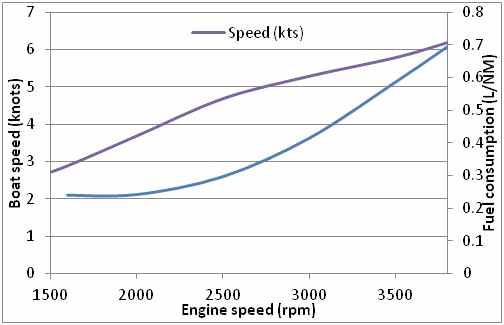
I recently re-engined my Maxi84 with aYanmar 13hp. I have done several runs of noting the engine revs versus boat speed and plotted a graph. It works out more or less a linear relationship as you would expect. I have then used the manufacturers data sheet graph of fuel consumption versus engine speed (knots divided by l/hr) to give me a litres per NM fuel consumption. At cruising revs (2500rpm, 4.5kts or so) the consumption is about 0.3l/NM. At max revs (3800rpm, 6.2kts) it is more like 0.7l/NM!
 
Think you will find the rule of thumb of 1 litre per 10hp used per hour is pretty accurate. .

The difficulty is relating bhp to engine revs and boat speed. But some engine makers and some magazine tests do this for you so you might like to have a google. Have a look at this which is for a Beta engine but unlikely to be much different to that for a Volvo. It certainly ties in with my experience of my own Volvo 2030.
 
Think you will find the rule of thumb of 1 litre per 10hp used per hour is pretty accurate. Cruising speed on a correctly powered and propped boat uses in the range of 65-70% max power (Yanmar recommend 70%). So your 36 would be using .7*36 = 25hp. So you would expect average fuel consumption to be 2.5 litres an hour.

This subjecct comes up here regularly and you will find the empirical evidence (ie reports from people who monitor consumption closely) this is borne out in practice. On my own boat with a 29 hp Volvo 2030 I cruise at 2500 which is approx 21hp. I monitored consumption over a nearly 1000 mile motorsailing across the Med and averaged 2.2 litres per hour. So my 150 litre tank gives me a safe range of over 60 hours, which at 5.5 knots is over 330 miles. My old Yanmar 1GM averaged .75 litres an hour over the many years I had it.

My 36' heavy displacment ketch also does about 2.5L or 1/2gall/hr cruising at just under 6kts and about 20bhp (4018 at 1800rpm) so I'm another in agreement with your figures.
 
It's all down to how much fuel you feel like using.

556e0cb4.jpg
 
Back home from my sailing trip.:D
Here is my performance graph:
fuel speed graph.jpg


Speed is more or less linear since for a fixed pitch propellor engine revs to speed should be linear. Fuel consumption increases dramatically at higher revs - I'll bow to other wisdom that it is a cube curve.
 
Doing your own measurements after using these guidelines should be your goal. Here's what I've done for the past 13 years: http://c34.org/bbs/index.php/topic,3841.0.html

Gallons or litres per mile is useful in confined waters. I find it useless as a measurement in tidal/current waters. The gallons or litres per hour are much more indicative of the actual use, since, for instance, if you're going up a river or along the coast against or with the current will make a tremendous difference in the miles covered. Do the transfer to (nautical or statue) miles based on your boat speed.

Yes, reducing revs with a tiny amount of decreased speed will save on fuel. My charts in the link above cover all kinds of use, and i have found that we cruise at 2450 to 2600 rpm on a 3000 WOT.

It all averages out in the end, and that's what you actual "use" will be anyway.

Good luck.
 
Top