Fuel consumption Volvo TMD40

Leighb

Well-Known Member
Joined
8 Aug 2007
Messages
7,066
Location
Suffolk
Visit site
I have been checking the fuel consumption on our engines and the Starboard seems to use significantly more. At the latest Full tank to Full tank it used about 17% more than the Port. That is on a mixture of slow speeds in rivers and faster coastal passages. Roughly 7 L/hr on Port and 8.25 L/Hr starboard.

What are likely causes, should I be concerned, could this be in any way be related to the high running temperatures of the starboard engine, which continues although all possible passageways have been cleaned.
 
One engine is working harder than the other. This may be becauseyou think you have balanced the engines by tacho, which could be out, or by ear and engine harmonics which I found isnt as reliable as you'd think since installing a sync guage and calibrating. I had a similar issue on KAD 42s and it was down to one engine having more boost and carrying the load more. Until that was rectified you could tell by coming slightly off the throttles on one engine. One way the drop in revs was more marked than the other, plus my tachos werent synced because one alternator pulley wasnt a Volvo original when I replaced an alternator (dumb mistake on my part) and as said harmonics isnt exactly reliable
 
Thanks for replies, yes I have only tried to match revs with the tachos, I hadn't considered that maybe the Stb engine might be actually running at higher rpm all the time. How best to check? What exactly is a sync gauge? The TMD40 is entirely mechanical no digital gizmos. Incidentally the Tacho is driven from a sender on the injection pump, not the alternator.
 
Thanks for replies, yes I have only tried to match revs with the tachos, I hadn't considered that maybe the Stb engine might be actually running at higher rpm all the time. How best to check? What exactly is a sync gauge? The TMD40 is entirely mechanical no digital gizmos. Incidentally the Tacho is driven from a sender on the injection pump, not the alternator.

The tacho's can be calibrated against a laser tachometer. On mine there is a calibration screw at the back of the tacho's. Unfortunately synchronising isn't always linear (at least mine are not) so I've set mine to be exact at 3k rpm
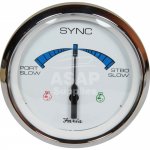
A sync gauge is handy then because it's accurate throughout the range basically tells you which engine is running slower. Here is an example
far33801_3.jpg
 
Before you spend time and effort just chech the engine rpm against a laser tacho. There could be many other reasons why one engine is working harder than the other e.g. prop fouling or damage, or other mechanical issues.
 
BTW, I have a neighbour in Conwy harbour who struggled for years with overheating problems with that engine on 280 outdrives. If you are on outdrives you may be interested in that he cured it by taking raw water from seacocks instead of the drives. I was dubious about the upper gearbox of the drives overheating when on the plane but he maintains the intakes scoop enough water on the plane to mitigate that issue. I'm not suggesting this is the fix but what worked for him and he researched it in dialogue with other owners and empirically one engine at a time with trials over 2 seasons before committing to it. It worked for him and many like him.
 
I have been checking the fuel consumption on our engines and the Starboard seems to use significantly more. At the latest Full tank to Full tank it used about 17% more than the Port. That is on a mixture of slow speeds in rivers and faster coastal passages. Roughly 7 L/hr on Port and 8.25 L/Hr starboard.

Have same type of curious fuel consumption on my Princess 35 with pair of 41B and its the starboard engine that appears to use more fuel.
Again a mixed use of slow upriver stuff and coastal.
Basically have no idea.........but you are not alone.
Both my engines run at same temp, so its nothing to do with that. !
Effect is obvious on fuel gauge after 20 hours running or so
 
Last edited:
Thanks for further replies. I will get a laser tacho, however there are a huge number out there with prices ranging from £11-99 to £250!! Any recommendations? Fortunately the crankshaft pulleys are reasonably easy to access to attach the reflective tape, but a reasonable range would avoid the need to have ones hand in a narrow space close to rotating parts.
 
I was shown a good tip by local volvo guys to determine engine performance
this should help assuming that gearboxes, props size and design are the same both sides, shafts turn by hand easily, hull and props pretty clean.

First off get an infra red hand held laser thermometer to verify the temperature your engines are running at. (£20 amazon jobbie) They should be within a 1 or 2 degrees of each other. When the engines are properly warmed up (don't forget the calorifier close the valves to it if possible to get everything the same for the test), point it at the thermostat housing to read true engine temps. If you have cleaned out all the cooling system properly they will be the same. If the dashboard temp gauges don't agree, its probably just a gauge/sender issue.

Once you are happy your engines are more or less the same temp, calibrate the rev counters - again a £20 laser hand held amazon jobbie should do the trick. Pistol style ones are better as you can see what the rpm is whilst looking at the engine.

Now take the boat for a proper long run. Check the the engine temps again, Then using the infra red temperature gauge again, measure the temperature of the tube that runs from the compressor side of the turbo into the charge air cooler (air heat exchanger) - measure at the same point on both engines and do this at different engine/boat speeds from slow, up to cruise and if possible max rpm. (I tend to measure close to the charge air cooler end for consistency)

If both engines are doing the same amount of work, (and burning fuel at the same rate) then the temperature of the air coming out of the turbo charger will be the same (few degrees either way) and so will the temperature of the tube tube carrying the compressed air.
If you get a significant difference - say 10 degs or more the engine with the lower compressed air temp is weaker and the other engine will be compensating and burning more fuel, to maintain the same rpm.

The causes could be:
bunged up charge air cooler inhibiting air flow - give them a clean out
poor fuel supply - blocked filters, something in the pipes - can both engines get to max RPM under load?
tired injectors with poor spray pattern - do you get much smoke at any point?
tired turbo charger - rust/decay in the exhaust side of the turbo (how old are they?), insufficient boost pressure - less compressed air - lower air temp.

I had my turbos replaced last year and the volvo guy did all of this, plus measure boost pressure and a few other bits and pieces.
With old turbos the compressed air temp difference was 40 degrees and the cooler engine was well down on boost pressure. After a proper fettling and two new turbos compressed air temp difference is plus/minus 1 degree! Fuel consumption is now identical.

( Turbos: if ones gone the other won't be far behind - if you just change one the problem will change sides)
 
Last edited:
Thanks for comprehensive reply.

My engines are TMD40s, not TAMD so no intercooler, but I assume you would measure the temp where the Turbo feeds into the inlet manifold?
Injectors have been checked recently, little smoke except on startup.
The port (lower fuel consumption) turbo was replaced as we knew it was seized when we purchased. The starboard was said to be OK, but could of course be a bit worn. However as I understand it, you are saying that the less efficient engine would be burning less fuel, not more?
We have had one run at WOT, and the Port reached 3600rpm, starboard only 3400. This might of course be gauge error. I am going to get a Laser Tacho to check the gauges.
Certainly some food for thought and some checking to do.

Thanks again for all replies.
 
Thanks for comprehensive reply.

My engines are TMD40s, not TAMD so no intercooler, but I assume you would measure the temp where the Turbo feeds into the inlet manifold?
Injectors have been checked recently, little smoke except on startup.
The port (lower fuel consumption) turbo was replaced as we knew it was seized when we purchased. The starboard was said to be OK, but could of course be a bit worn. However as I understand it, you are saying that the less efficient engine would be burning less fuel, not more?
We have had one run at WOT, and the Port reached 3600rpm, starboard only 3400. This might of course be gauge error. I am going to get a Laser Tacho to check the gauges.
Certainly some food for thought and some checking to do.

Thanks again for all replies.

forgot about the lack of intercooler - try measuring the compressed air temp at the turbo end. The inlet manifold is a big lump of metal bolted tight to the engine so will probably just get to engine temp and not vary much with load.
Was it a brand new turbo or a recon/rebuild ?
When you give the boat full throttle do both engines increase speed at the same rate or does one accelerate rpm faster than the other?
 
Often its just engine condition generally. I have twin TMD41A in an aquastar 33. Last year I had about 15% heavier consumption on the port engine and it was blowing oil out of the breather. It also failed to make max revs on full throttle. Arrr... thought I.... Piston blow by probably. Stripped it, found the bores hardly worn but heavily glazed. Pistons bearings et al were good but the rings were heavily worn.... Honed bores, fitted new rings (gaps only about .002 bigger than new when fitted) Recon turbos on both engines and injectors an orf we go.... Now both engines use within 5% of one another (flow meter readings) with the recon starbd engine being best. Both reach max revs and no oily breather anymore.. No doubt if I treated the port engine to the same the consumption would be the same but it aint worth stripping as its going very well otherwise. I doubt if anyone with twin engines gets identical performance from both unless they are relatively new but of course most older boats dont have fuel flow meters so they are blissfully unaware.......
 
Interesting one this.
Outwith all that’s been mentioned (my Favourite of which would be the injectors, but you say these are good) and usually no two engines are the same...is it at all possible that the props have at some point been miss matched or in different condition ?
 
Top