French Canals - Mast thoughts

Thanks all - the message loud and clear is that the mast must be VERY secure, and the ends protected as well as possible. Shipping down is now just too expensive to consider.

To be honest, I am more apprehensive about meeting the Peniches. I met someone the otherday, who said (in the canals) just slow down to a crawl and stay in the middle, the Peniche will invariable stop, - then you can squeeze past each other. The trouble is I have no idea how wide the canal is! (or deep at the edge) but I suspect I should not be too worried - probably more worried because SWMBO will be totalled!

Peniches DON'T stop and more than likely will hog the middle because they are constrained by draught especially if laden. My advice would be to steer clear and stay on your side. When we came up the canals last year we struck bottom on the sides a few times, but then we draw 1.7 metres. Slowing to a crawl is likely to make you more vulnerable to being drawn in towards the passing peniche. Remember that the canal has to be wide enough to accommodate two passing peniches so there should be plenty of room for you. Watch out for the blue boards though, which may require you to pass on the opposite side. All should become clear when you take your CEVNI exam.
 
Peniches DON'T stop and more than likely will hog the middle because they are constrained by draught especially if laden. My advice would be to steer clear and stay on your side. When we came up the canals last year we struck bottom on the sides a few times, but then we draw 1.7 metres. Slowing to a crawl is likely to make you more vulnerable to being drawn in towards the passing peniche. Remember that the canal has to be wide enough to accommodate two passing peniches so there should be plenty of room for you. Watch out for the blue boards though, which may require you to pass on the opposite side. All should become clear when you take your CEVNI exam.

Its the width that I have not got a clue about! only experiance here is the Kennet and Avon - in a tug! Done the CEVNI - and yes - look out for the blue board with the scintilating white light........
 
canal width

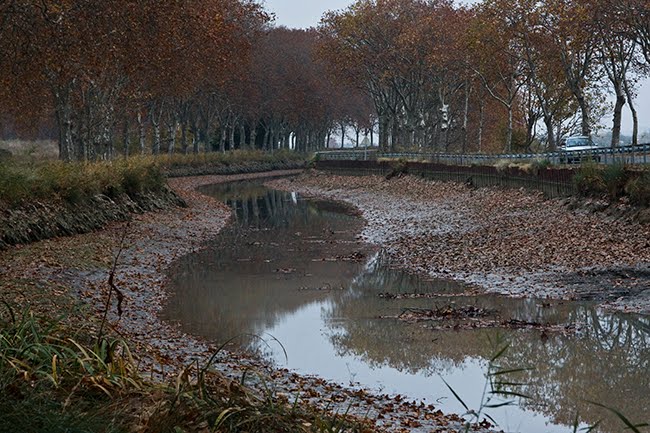
In March I am publishing a pic of a part of the Can du Centre which has been drained, but you can't wait until then.
I estimate the deep bit in the centre is less than 10 metres wide, and from there it shoals until it is barely 50cm at the edges.
When two laden barges cross each other, they usually slow down to a crawl and "feel" their way past each other, often with their port sides rubbing all the way If possible they arrange to pass close to a lock where the depth of the canal is wider.
The chief problem when crossing a barge is interaction. Ahead of the barge there is a wall of water and a high pressure area which will push you to one side. After you have gone over the bow wave, you will drop down fast and this is the dangerous bit. To be pushed to one side AND to drop by over half a metre is fraught. You may end up bumping on the bottom.
Try not to lose steerage way.
You will be sucked into the barge's quarter and are quite likely to bump there (known in French as a coup de fesse) Have a good fender aft on the port side.
But be reassured. We went up the Canal de St Quentin during the post-harvest rush and did not have to pass a single barge under way Luck of the draw..
 
20091120_drained.jpg

Canal du Midi, Ventenac (not my pic - from http://erika-hannah-bonvoyage.blogspot.com)
 
In March I am publishing a pic of a part of the Can du Centre which has been drained, but you can't wait until then.
I estimate the deep bit in the centre is less than 10 metres wide, and from there it shoals until it is barely 50cm at the edges.
.

I hope they fill it up again by mid April when we will be in transit!

So fix mast firmly, create impregnable fendering on port side - and w'ere away! Bill, thanks for thise observations, disconcerting though they may be, I won't tell SWMBO until after the first one!
 
If you can get the boat to sit parallel to the lock wall it makes life much easier as has been stated on here.We achieved thi by positioning a v.large ball fender at either bow and smaller ball fenders at the stern quarters.These coupled with tyres amidships kept the ship steady (28 foot Kelt 850 with 1.6m draught) so that I could hold her against the ecluse wall with a single line amidships whilst SWMBO manned a boat hook as necessary.We got into a very smooth routine and thoroughly enjoyed the trip.(I spliced a loop into a length of thin rope and used it to hold the tiller steady in the locks which is v.important.

We protected our topsides thus:

We got some of those blue plastic trarps with eyelets at the edges.We cut them into strips slightly less wide than our freeboard and fixed them to our perforated toe rail with cable ties from just short of the bow to the stern.(They lasted all the way from Honfleur to Sete.)The fenders sat outside of that and we used 2 pieces of decking we had were given by the Grandcamp Maisy H.M. as planks.(Remember to chase a channel for the ropes holding the plank to sit in)

We demasted in Honfleur (in 2004 there was a group of locals called the Cirque Nautique de Honfleur who helped arrange evrything) and built our A Frames and struts there.(There is a timber yard about a mile south of Honfleur - just follow the road by the side of the Seine who will deliver given some notice) We used mild steel nuts and bolts bought in the hardware store on the right as you walk south out of Honfleur)

The 60 or so miles from Honfleur to Rouen can get very lumpy indeed due to wash from the ocean going ships going to and from Rouen so you need to lash everything v.secure).

Don't worry you will soon get the hang of it and enjoy it.Me and SWMBO would go again like a shot!

Cheers and Bon Voyage.
 
Thanks Zumerset

I have the following plan which will make the boat look like the CSS Merrimack (Virginia)
http://en.wikipedia.org/wiki/File:CSSVirginia1862.2.ws.jpg

1. Tarpaulins down the top sides (thanks)
2. large number of medium size sausage fenders on each size
3. 4 scaffold planks - one set midships, and one set on the stern quarter protecting from the "Coupe de Fesse" - per Bills post
4. 2 large baloon fenders in the bow section.
5. Single line from midship cleat - motor slow ahead in locks ****

**** will this be asking for trouble with muck in through the water cooling intake?
 
You will be very lucky to get away with a single line on uphill locks, especially if you are trying to protect your mast. There's lots of turbulence from the incoming water, dramatic in some cases. We always put Jill ashore before the lock, or at the low wall and steps as you enter the locks on the Midi. We used a 30 metre bow line in a bight, which she dropped over the bollard at the head of the lock. The free end came back to me via a snatchblock to a genoa winch. The stern line was of fixed length in most cases.

The low wall was the cause of most of the damage that I did to the topsides. Engine controls are on starboard side but the walls are to port, only about 80cm above the water, so out of my sight for a long time. Ouch!

Despite what the guides say, we found that most eclusiers will not take your warps, apparently some liability issues have come up and they were advised not to.

I think that much of our strainer blockage resulted from motoring hard astern after running aground while dropping her off ahead of the lock. It was early in the season, so lots of last autumn's leaves lying on the bottom. The overheat alarm came on regularly in locks and I developed great speed in unblocking the strainer and skin fitting. I gave up counting in the end but estimate that I may have unblocked close to 100 times in the total canal passage. Have increased size of skin fitting and changed strainer since then.
 
We used fore and aft ropes in the midi but from the Saine to the Rhone we used just one rope from the aft cleat, around the bollard and back to the genoa winch. The main reason is you can't get to 2 bollards very easily for fore and aft securing and in some cases, you will need to move to a higher bollard as the lock fills. As said before, put the boat in drive and steer to keep the boat parallel to the wall.
There are a few locks south of Eperney on the Marne route that fill to the top of the lock wall so rubber fenders fail to protect the hull at this point. I cut some 3" fence posts into 18" lengths and hung them vertically (4 each side) and lowered the bottom end to about 5" below water level when in the lock. It just lets the hull rest against the wall without scratching while stationary. Just pull them up and leave on deck after leaving the lock.
 
We used fore and aft ropes in the midi but from the Saine to the Rhone we used just one rope from the aft cleat, around the bollard and back to the genoa winch. The main reason is you can't get to 2 bollards very easily for fore and aft securing and in some cases, you will need to move to a higher bollard as the lock fills. As said before, put the boat in drive and steer to keep the boat parallel to the wall.
There are a few locks south of Eperney on the Marne route that fill to the top of the lock wall so rubber fenders fail to protect the hull at this point. I cut some 3" fence posts into 18" lengths and hung them vertically (4 each side) and lowered the bottom end to about 5" below water level when in the lock. It just lets the hull rest against the wall without scratching while stationary. Just pull them up and leave on deck after leaving the lock.

I'm not sure that the canal latereal de loire and canal de centre have these locks that fill to the brim. Any one know about this as it clearly call for another layer of defence! I was thinking of some quire (coconut) matting strips over the side, which when saturated would float below the surface.
 
I'm glad I elected to go the scenic route round Spain, when I went down to the Med.

One of Europe's great cruising areas of the Biaxas more than makes up for the extra time and distance.

Charles, I think I too would prefer the outside route, however SWMBO is of more nervous disposition, and I have to break her gently into cruising - firstly to get her used to being away from home, her dog and grand children. So the cunning plan was to have a gentle first section......when we meet the first peniche.... I am hoping it will work!

It does mean that I won't have her as a continuous crew so will rely on mates coming out, which of course means getting to places on deadlines... which is not the point of cruising, and probably speeding up the passage to the Ionian, so that I can leave the boat from time to time in an affordable place.

Roll on....
 
I'm not sure that the canal latereal de loire and canal de centre have these locks that fill to the brim. Any one know about this as it clearly call for another layer of defence! I was thinking of some quire (coconut) matting strips over the side, which when saturated would float below the surface.

I would not bother about leaving your engine running in 'ahead' in the locks as per the peniches - we never did.

Yes there are quite a few locks that fill up to the brim on that route.These are best dealt with by lowering car tyres below the water line prior to entry and raising them after leaving.

As for passing ropes to the eclusier - in the big locks on the Seine between Rouen and Paris the eclusier is in a tower above you (and on the Saone and the Rhone).On the Seine we made fast to the ladders that run down the side of the lock with our midships line by passing a loop over a rung and hanging on then quickly swapping to a higher rung.We started off using 2 ropes but soon found that provided we were quick one of us could shift the rope without mishap.This avoided the long climb to the top of the lock to pass slips over the bollards (which can be a long way apart).This works very well especially if you can avoid going through the lock at the same time as the peniches which throw up a lot of wash.If you have sorted out the fendering so that the boat lies parallel to the lock wall then a single line amidships will hold her tight to the wall.One would think that she would range a bit with the turbulence but as the distance from your midships cleat (or a block shackled to the toerail) to the rung of the ladder is about 6 feet or so and is pulled taut you will move a foot or so at most.A means of keeping the rudder amidships makes things so much easier.

The big locks on the Rhone have floating bollards to tie off to and are easy to use.

As for raw water inlet blockages - the Kelt had an external strainer fitted over the inlet which looks a bit like a potato masher with a stop cock inside the hull.As a belt and braces manoeuvre we fitted an additional - separate - filter with a glass top.The problem with this was that some times the water is so dirty that you cannot see through to the water outside the hull.Having said that we must have been very lucky as we never had a raw water blockage!

There are many houses that back onto the rivers and canals and the people who live in them often dispose of their garden rubbish into them.We picked up half of someone's hedge in the Seine this way but were able to clear it before the current caused us to collide with anything.Forunately we had our anchor handy if push had come to shove.

For me Honfleur to Paris was the most challenging.If your SWMBO is a bit nervous it might be as well to have a third party on board for that bit.Crew changes should not be too much of a problem as the railway follows the Seine most of the way.
 
Last edited:
Canal du Midi. Mast down at Royan, followed by 50 miles up the Gironde, wide and exposed estuary. It is important to make the supports substantial and tie the mast down.

DSC00809.jpg


IMG_2056-1.jpg


Mast re-stepped at Cap d'Agde. Our mast touched the wall in a couple of locks but only lightly so no damage. We soon learnt that we should have removed everything, including the tricolour. First photo is at Bordeaux on our first day, note no bucket over the furling gear and shroud ends. Later we bought one to protect the ends from these touches, evident in the second photo at Agde.

In one way we found having the mast aboard was helpful. Crew could reach the long bow warp with a boathook from the lock when it was hung on the spreaders. This was far easier than me trying to throw it to her.


is yours a deep fin vyv?
 
Let's not get carried away

Whilst 'being prepared' is one thing, I think over-cooking the potential for problems - and their degree of difficulty - is another. Going through the waterways is, for most people, most of the time, a very enjoyable experience. There are complaints from time to time about problems (not being able to boil a kettle and make a cup of tea between staircase locks springs to mind . . )(sorry couldn't resist that one), but others complain it's all too boring. The truth is dead centre between those two poles.
If you are reasonably sensible and know how to handle a boat, you shouldn't have any trouble beyond the kind of interesting 'learning experiences' that go hand in hand with sailing.
And you'll have a really great time!
 
Concur with Grehan

GREHAN. Got it right this time???
I concur with all he says. Relax. Don't scamper about. It's enjoyable. Remember the air-line pilot's job description "99% boredom and 1% mind-numbing panic" only you wont get bored.

NB Use of motor tyres as fenders in locks is illegal and, though there is nobody to tell you off in automatic locks, you can easily run into problems if you come across somebody difficult. So do not rely absolutely on tyres. Have an alternative.

Lock-keepers do not normally mess about with mooring ropes etc, but some do.

If there is a barge in the lock waiting to come out,(un sortant) do not wait close up to the lock otherwise you might learn about your ancestry when he does come out. On the other hand watch out for German charter boats nipping in ahead of you. If you arrive at a lock after the closure, pleasure boats should moor as far back as they can to allow any barges coming up to moor ahead. We usually moor close up to start with because of Germans, and move back after an interval long enough to be sure nobody else has left the last lock

Keep watch on Ch 10. Barges always announce their whereabouts to each other. If you are coming to a bendy bit, do the same. Sometimes they just give a series of clicks on the mike. This indicates "Beware! there is a barge about."
 
Top