
Fortress anchor - why did you buy one?

I think you might find that the thick toe plate of the Rocna is not much different (in either volume and thus weight) to the steel ballast in an Excel or lead ballast in a Spade.

Rocna:

AvMva4e.jpg


Excel:

z8jNEXq.jpg


Spade:

9cOptGo.jpg
 
Last edited:
The images kindly provided by Noelex clearly show the double thickness of steel in the toe of the Rocna, which extends right back to the mid on where the shank joins the fluke. The fluke is a 'single' thickness of steel and front portion is twice the thickness. This weight is not as well concentrated as the steel in the toe of the Excel but to consider the extra steel under the fluke plate does not weigh the toe really stretches physics. It certainly moves the centre of gravity and centre of effort of the anchor which allows the Rocna to perform differently to the unweighted Mantus and allows a different design facet to the Bugel. It might be described as a strengthening plate - but you don't need that amount of steel and/or you could use HT steel (which Smith knows plenty about). Both the Bugel and Mantus use a single thickness of steel (the Bugel plate is quite beefy and Mantus much thinner - and obviously bending of the toe was not considered a problem) and thus have no extra weight in the toe.

If you make some crude calculations the Rocna thickened toe is slightly larger than that in the Excel, obviously the steel extends further back on the Rocna but the effects are more similar than different (for reasons that will only confuse in this thread). But testing shows the significant impact of the Rocna toe plate, (forgetting strength) it would not work without it and would simply be an 'also ran'. The weight, in the toe, converts it from having the hold of a Delta to twice that hold, of similar weight.

Thank you Noelex for the images.

Jonathan
 
Last edited:
The images kindly provided by Noelex clearly show the double thickness of steel in the toe of the Rocna, which extends right back to the mid on where the shank joins the fluke. The fluke is a 'single' thickness of steel and front portion is twice the thickness. This weight is not as well concentrated as the steel in the toe of the Excel but to consider the extra steel under the fluke plate does not weigh the toe really stretches physics. It certainly moves the centre of gravity and centre of effort of the anchor which allows the Rocna to perform differently to the unweighted Mantus and allows a different design facet to the Bugel. It might be described as a strengthening plate - but you don't need that amount of steel and/or you could use HT steel (which Smith knows plenty about). Both the Bugel and Mantus use a single thickness of steel (the Bugel plate is quite beefy and Mantus much thinner - and obviously bending of the toe was not considered a problem) and thus have no extra weight in the toe.

If you make some crude calculations the Rocna thickened toe is slightly larger than that in the Excel, obviously the steel extends further back on the Rocna but the effects are more similar than different (for reasons that will only confuse in this thread). But testing shows the significant impact of the Rocna toe plate, (forgetting strength) it would not work without it and would simply be an 'also ran'. The weight, in the toe, converts it from having the hold of a Delta to twice that hold, of similar weight.

Thank you Noelex for the images.

Jonathan

Jonathan, I would like some advice from you and didn’t want to start a new thread so I hope you don’t mind me high jacking this thread. I’m thinking of putting a float to mark my anchor, this would be particularly useful with a Rocna as the retrieval technique is different (drive straight over your anchor before you retrieve your chain). My question is, would this detract from its legendary holding power? I am in the Med so little in the way of tide
 
Bouba,

Attach a small float, tennis ball sized, to a metre of dyneema with a loop spliced into the end (where the buoy is) and attach to the top of the roll bar. If you ever need to retrieve the anchor dive and attach a decent piece of line to the splice and haul in from deck. If you have a long line that floats on the surface you will incur the wrath of any other yacht nearby as it is inevitable that someone will foul their prop or think the buoy is something to which they can secure (mistaking it for some sort of courtesy mooring). The dyneema needs to be strong enough to take the tension and short/long enough not to be a hazard to fin keels with bulbs.

We don't 'mark' our anchor, unless I want to take a photo to illustrate some point or other and I have used a float to determine how deep our anchor is set, I use a marked line, every 1".

I'd advise against having a buoy floating on the surface for reasons mentioned, unless you anchor as we do in largely splendid isolation. If you do have a floating buoy you really in a recognised anchorage you really need to mark it at night, with the sort of light fishermen might use, but really its not a practice I'm keen on.

Jonathan
 
I have a fortress that came with my boat. In the 5 times or so I've tried to use it. It have never set. I bet it I dropped a rocna off the rear roller it would be fine.
 
Bouba,

Attach a small float, tennis ball sized, to a metre of dyneema with a loop spliced into the end (where the buoy is) and attach to the top of the roll bar. If you ever need to retrieve the anchor dive and attach a decent piece of line to the splice and haul in from deck. If you have a long line that floats on the surface you will incur the wrath of any other yacht nearby as it is inevitable that someone will foul their prop or think the buoy is something to which they can secure (mistaking it for some sort of courtesy mooring). The dyneema needs to be strong enough to take the tension and short/long enough not to be a hazard to fin keels with bulbs.

We don't 'mark' our anchor, unless I want to take a photo to illustrate some point or other and I have used a float to determine how deep our anchor is set, I use a marked line, every 1".

I'd advise against having a buoy floating on the surface for reasons mentioned, unless you anchor as we do in largely splendid isolation. If you do have a floating buoy you really in a recognised anchorage you really need to mark it at night, with the sort of light fishermen might use, but really its not a practice I'm keen on.

Jonathan

Thanks Jonathan, All the anchorages here in the South of France are extremely busy in the summer. I'm actually a motorboater and very rarely anchor in more than four metres and the sea is usually crystal clear. I will follow your advice
 
I use a fishfinder to show me where the kelp is, - and avoid it. I doubt if any anchor will perform satisfactorily in kelp, although a fisherman might just.

Unfortunately I didn’t and still don’t have a fish finder, nor did I have the luxury of choice of finding a nice patch clear of kelp given where I was, the prevailing weather and other boats already sheltering from the deteriorating conditions...

Anchoring in kelp is always a bit of a lottery. Are you in, or hooked onto a thick stem that’s going to let go at half past dark o’clock and prevent your anchor from biting?
 
One of the many problems with kelp is that it grows on rock, or stones. Finding sand within the fronds is real gambling. Our kelp beds are well defined, and just like those I recall in Scotland - and to be avoided unless there is nothing else - but we'ed rather sail a few more miles and find somewhere better (and almost anywhere is better).

Jonathan
 
I have a FX23 bought on this forum for very low price and looking as though never used. I kept it on my old 33'boat in the UK as a kedge for a year but never had reason to use it. Now I'm in Greece with a 44' boat it is the right size! Boat came with a 25kg Delta as bower and 15kg Bugel as kedge but I brought the Fortress with me. Last year it sat on the aft deck of my centre cockpit boat attached to 15m of 8mm chain and 50m of anchorplait although never used as a kedge. A couple of my favourite anchorages are soft mud and busy and the Delta struggled even in 25kn of wind when the bottom had been churned up. Switching to the Fortress was amazing. Bit and stayed rock solid immediately. I've also used it a few times with a shore line on but a strongish crosswind. Rowed it out at 90 degrees in the dinghy then pulled tight from the bow and held me perfectly still. Once in a stronger forecast I put it out as a V from the bow but the wind never really materialised.

Earlier this year I was in the US and bought a rail bracket from West Marine so it now hangs off the rail across the stern and outside so more out of the way. Unfortunately the bracket can't take it with mud palms on so now it has the palm on one side and not the other! On subject of mud palms mine came with them but no bolts to fix. Contacted Fortress to ask how much to buy and they immediately sent a new set of palms and bolts FOC. Amazing!

Once I can work out a sensible way to get it to Greece I plan to replace the Delta with NG, probably Knox, and will then get rid of the Bugel as well.
 
Pasarell,

Somewhere on the Fortress website they have some suggestions for brackets for storing the anchor. I think there is a company in California that makes a couple of designs that they feature and one of the designs uses a brackets into which the mud palm slots. Its for rail or stanchion mounting - I don't recall which nor do I recall where on the website.

I'm not suggesting you buy one of the brackets but they are pretty simple, I'm taxing my memory :), it was simply a bent plate into which the mud palm fitted, slotted. It would not take much mental effort to have a look, make up a simple sketch and have one made, wherever is local.

having a mud palm on one side needs you to be able to see the anchor in the water - to ensure the mud palm side is down - not much use in the dark - so check the website, or send them an email and ask for their recommendation - and I'm sure they will give you the website of the manufacturer. One of the other brackets depends on slotting the ends of the stock in to, I think, rings - but there is more than one option.

We simply keep our Fortress assembled and shackle attached in a bow locker against the locker wall. It fits fairly flush and is easy to retrieve (but we do have a decent bow locker).

Jonathan
 
OK alot of points covered here. Why did I buy it.--I read the US coast guard use it, It was light,and could be store easily in the anchor well. Its a FX11. Has it been put to the test.-- Sure thing, Firstly on a Hunter Delta in an on shore gale when engine failed and rudder broke off below hull. It held however the line frayed and broke and the boat ended up on shore. When tide went out I located the anchor and it took some time to dig down and get it out. Secondly I had the same anchor on my Kelt 8.50 ,3 tons when the impeller which was not 2 years old separated from the core and I was forced to shut down the engine. Head sail blew out and resulted in getting a tow by RNLI. The FX 11 held in 52knots of wind and both myself and the RNLI chap could not break it out ,so we put a bouy on it and I came back and retrieve it. So thumbs up from me.
 
OK alot of points covered here. Why did I buy it.--I read the US coast guard use it, It was light,and could be store easily in the anchor well. Its a FX11. Has it been put to the test.-- Sure thing, Firstly on a Hunter Delta in an on shore gale when engine failed and rudder broke off below hull. It held however the line frayed and broke and the boat ended up on shore. When tide went out I located the anchor and it took some time to dig down and get it out. Secondly I had the same anchor on my Kelt 8.50 ,3 tons when the impeller which was not 2 years old separated from the core and I was forced to shut down the engine. Head sail blew out and resulted in getting a tow by RNLI. The FX 11 held in 52knots of wind and both myself and the RNLI chap could not break it out ,so we put a bouy on it and I came back and retrieve it. So thumbs up from me.

Interesting comment - it will warm the heart of Fortress.

I am of the belief, gut feel, that Fortress over size their anchor recommendations because retrieval of good small anchors can be an issue. Bigger anchors do not dive so deeply and are easier to break out.

Jonathan
 
We got a Fortress second hand but never used.
Have used it once, cleaned in fresh water and kept on the stern for 4 months (plus 6 months inside) - disappointed to find the securing bolts were rusted solid after that time. Poor quality.

Nice and light weight, but an absolute pain to store as such an awkward shape and so many (some unnecessary) sharp edges. A menace to teak decks and gel coat.
Think will return to using our spare Rocna as kedge / stern anchor. Heavier but a doddle to manage with only one sharp bit and a handy handle for lifting with.
 
We had a similar problem with the bolts, corrosion between the alloy and stainless. There was nothing wrong with the quality of the stainless, just incompatible. I initially used Duralac and have since replaced with alloy bolts, you can get them from decent bike shops. Good alloy bolts, 7075, will be stronger than the stainless ones. I'm assuming Fortress do not use 7075 because of cost but why they do not suggest using Duralac or grease I'm not sure. Many leave their Fortress assembled and its a bit of an issue if/when you come to disassemble.

Jonathan.
 
the US coast guard use it,

regardless of anchor type (or official organization) I wonder why this should be considered an endorsment: these SAR boats hardly ever anchor, and when they do they are usually supplemented by '00s of available horsepower with people on 24h duty, hardly comparable with what happens on the average sailboat.
Same with ships, whose anchoring dynamics are very different from small boats: who would ever use a "Hall" anchor, "because even ships use it" ?
 
Last edited:
regardless of anchor type (or official organization) I wonder why this should be considered an endorsment: these SAR boats hardly ever anchor, and when they do they are usually supplemented by '00s of available horsepower with people on 24h duty, hardly comparable with what happens on the average sailboat.
Same with ships, whose anchoring dynamics are very different from small boats: who would ever use a "Hall" anchor, "because even ships use it" ?

Whereas I sympathise with the view and I cannot argue with the logic - but the same could be said of the RNLI's choice of Delta and then their most recent change to Spade, for the new Shannon Class. Are either an endorsement. Any vessel with a decent sized crew will have a 24 hour watch if/when on anchor - so do we, ours are anchor alarms.

What is interesting is that the choice, in the case quoted, is of a leisure anchor over a 'Hall' type. So here was a 'commercial' ship choosing a leisure anchor - and these are big ships.

The choice was dictated by performance and weight (or lack of weight) - the same reasons mentioned by virtually everyone who has posted. No-one has highlit the good performance in thin mud - much championed by Fortress themselves. Its demountable qualities are not particularly important to members here.

On this basis - the endorsement and use of endorsement when weighing up options seems very sensible.

And though none of us use Hall anchors - our anchors do bear some similarity to oil rig anchors and in fact many of us use 'oil rig' anchors - namely Bruce, which was available as small as a few kgs or 1,000s of kgs.

Jonathan
 
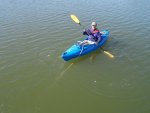
In this image I am taking a Fortress FX-16 with all-fiber rode (no chain, Covered Dyneema leader) out with a kayak. Piece of cake. In soft mud, the holding capacity is equivalent to a >60-pounds NG anchor with chain, maybe more. I used it to drag 35-pound NG anchors in testing, which it did easily.

While it is not my first choice for a primary anchor most places, there is no rival for some uses. Yes it is a funny shape, but that is a matter of finding the right place and not thinking "regular anchor storage." I have never found it to be an inconvenience. Typically, I've kept them vertically along locker walls--easy to get to and taking little space. This is my 4th boat with one.

I challenge you to suggest a conventional anchor that will hold tons in very soft mud that I can pickup will 2 fingers. Or rather one you would want to handle from a kayak. Much easier than a dinghy.

41. taking 2nd anchor out with kayak 3.jpg
 
Last edited:
Later I then wondered about a Danforth, genuine. Very popular in America as a primary leisure anchor but comes in very large sizes for commercial vessels.

An anchor being used on a, large, commercial vessel does not deny its applicability for use on a leisure vessel. The fact Fortress and Danforth are more popular on American vessels does not mean Americans don't know what they are doing as Britany anchors are common on French leisure vessel - but seldom seen in other parts of the world.

Jonathan
 
Top