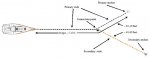
Fork or 'V' anchoring

From Reeds Seamanship 1890. 1st Mates exam FAQs

How would you moor with two anchors and 45 fathoms of chain?

Drop the working anchor first and pay out 90 fathoms of chain, then let fall the bower; throw all aback, heave in on one chain, and pay out the other until there are 45 fathoms of each out.

How would you pick them up again next day?

Pick up the lee one first

You want to get under weigh; you are hove dead short, wind on the bow, there is a rock right aft; what would you do?

Anybody wish to answer??
 
I don't think it's worth worrying too much about finding the perfect angle for a Vee. After all, suppose it was established that the perfect angle was 49.5°, how are you going to achieve that, in the real world?

I always say that anchoring is an inexact science....

* If everything is an approximation, there is no point in having a target.
* Anchoring is a fairly exact science. The problem is there are a LOT of variables and we don't always know the values. But that is not to say the physics and engineering are not well understood.
 
Best angle.

First, remember that anchors move during setting.

If the goal is to reducing yawing, obviously a fixed point is best and the angle should approach 180 degrees. The limiting factor is the tight rope effect, which increases the load on the anchor; this becomes a problem at 120 degrees (according to the trig). The narrower the angle, the greater the odds of single leg loading, yawing, and wiggling the anchor. Thus, about 90-120 degrees is a good target range if the bottom is fully reliable.

If the bottom is not reliable it is more complicated. A narrow angle reduces the load if the wind does not change, but it will and the load will be on one anchor, which will drag. Second, you will probably have one anchor that holds better than the other (matching anchors are for text books), perhaps a large Fortress. Thus, the Fortress should take most of the load and the NG should mostly serve to damp out direction changes (since Fortress does not love those). I would opt for a Y instead of a V, because I want the anchors a bit closer to each other (still ~ 15 M), so the NG does not need to drag as far to support the Fortress. However, the angle is still about 90 degrees. Sort of a hybrid between the hammerlock and a V, but where both are at long scope. Well-proven by local sailors for very soft mud in areas with changeable winds and tides (does not tangle rodes). This does not reduce yawing as much as a V, but it does stabilize the anchors.

(From "Rigging Modern Anchors," coming out Fall 2018)
49a. boat mone with V nomenclature.pub.jpg
 
Last edited:
If we plotted our anchor position by GPS, which we never do, I imagine we could lay a second anchor from the cat 'fairly' accurately and have a decent approximation at an ideal angle. The trouble would then be that we might want to deploy more chain, why carry it if you do not use it, and whatever angle we had carefully used - would then be invalid.

We look at the yaw of the catamaran in the specific location and tend to set wide 'V's in variable wind and less wide if we are more stable. But its a bit subjective.

We agree with you Norman - we steer clear of marinas and anything calling itself a marina (including piers) and prefer the isolation and known security. We similarly don't use courtesy mornings (as we simply don't know how 'good' they are).

Jonathan

edit

Crossed with Thinwater's post above. Not sure I like a 'Y' setting, especially as I want to reduce veering (because I think veering contributes to anchors dragging).

Close edit
 
Last edited:
Meanwhile at the pontoons (called a marina) boats, and even the pontoons were in trouble, heaving up and down, fenders popping etc. It was so bad that the police and coastguard were called, to do I'm not sure what.

Where would you rather be? ( Snug at home is not a valid answer).

Good point, Norman. There are areas where “marinas” are less safe than lying to ones own ground tackle, as you have indicated. This can also be true of moorings. There are also some great cruising grounds where it is unlikely you could reach a marina in time, even if you wanted to.

Then there is the risk of becoming caught out and trying to enter a marina when the conditions have already deteriorated.

In named storms there is a frequent belief that even in locations with excellent facilities there is greater safety leaving the marina, but in contrast to this view there are many people who do not consider anchoring safe in strong or even moderate wind.

Justified confidence in your ground tackle not only adds great peace of mind, making cruising less stressful, but prevents these types of issues.
 
....

Jonathan

edit

Crossed with Thinwater's post above. Not sure I like a 'Y' setting, especially as I want to reduce veering (because I think veering contributes to anchors dragging).

Close edit

The dimensions are arbitrary, depending on your goals. The length from the split to the bow can be quite short, just 1 meter, and it will still prevent tangles (important where there are tides). Also, even if there is yawing, the anchors will not wiggle, only the force will change.

What is important is to remember that the anchors are asymmetrical; one will drag before the other--make that work for you, not against you.
 
* If everything is an approximation, there is no point in having a target.
* Anchoring is a fairly exact science. The problem is there are a LOT of variables and we don't always know the values. But that is not to say the physics and engineering are not well understood.

How can it be an exact science when there are so many variables? What is your "target"? When I anchor, I just want to stay put. Maybe my Scottish English has different meanings from your American English. ;)

On another point, when I rig a Bahamian Moor, the join between the two rodes is well under the surface, well under the keel even, a bit like your "Y". If however, I want to lie to a "V", I always bring both rodes aboard, so that I can adjust lengths of either one if I want to. If I want to leave my boat unattended for a long time, I rig a Bahamian Moor. The boat can then swing round in circles , without tangling the rodes. If I'm lying to two anchors in a "V", it's probably because of severe weather, so I'll be around, and won't let the rodes get tangled. I prefer to be in control.
 
An exact science often has many variables, although they are not always easy to measure. Most sailors cannot and will not measure them, so rules of thumb substitute for calculation. But that does not mean the science cannot be exact. An exact science is one where the effect of the variables is understood. In this case, it is simply complex.

You make good examples for different rigging methods. A few more variables and situations to consider:
* A Bahamian moor is a poor choice if the holding is poor. It is not applicable in very soft mud or in very strong winds even with good holding. I am assuming the angle is > 120 degrees.
* Adjusting the rodes is not very practical if the wind changes while you are asleep, away from the boat (you noted this), or during a violent squall accompanied by a sharp direction change. The Y-rigging is relatively self-adjusting in soft mud. Nothing requires adjustment.
* The rodes will get tangled (wrapped around each other) if the boat rotates 360 degrees, which is common in tidal areas. Being on board won't change that. Complete two 360s (I've done more than a dozen in 24 hours) with two chain rodes and it will take hours to sort out the mess. Y-rigging avoids this. A Bahamian moor is typically rigged this way.

I suppose it is obvious that I frequent tidal areas with soft mud bottoms and strong squalls.
 
Last edited:
Every year for years now, I have been in the habit of leaving my boat anchored with a Bahamian Moor for four weeks in some of the more remote parts of Scotland, including Shetland, and more often the Outer Hebrides, because of other commitments. You are not talking to a novice.

It is many years now since I learned not to use two completely chain rodes for a "V". That was with a previous and somewhat larger boat that I have now. At the time, the chains were 16mm and 19mm, and each anchor weighed 140lbs. After several days of gale force winds, it quietened away completely overnight, and the boat did at least one 360°. I vowed never to do that again! My rodes are now one of all chain, and one of short heavy chain + nylon rope.

We'll just have to agree to disagree about "exact science". :D
 
Every year for years now, I have been in the habit of leaving my boat anchored with a Bahamian Moor for four weeks in some of the more remote parts of Scotland, including Shetland, and more often the Outer Hebrides, because of other commitments. You are not talking to a novice.

It is many years now since I learned not to use two completely chain rodes for a "V". That was with a previous and somewhat larger boat that I have now. At the time, the chains were 16mm and 19mm, and each anchor weighed 140lbs. After several days of gale force winds, it quietened away completely overnight, and the boat did at least one 360°. I vowed never to do that again! My rodes are now one of all chain, and one of short heavy chain + nylon rope.

We'll just have to agree to disagree about "exact science". :D

I didn't mean to imply you were not. Your comments were clear and concise. It sounds like we've even made some of the same mistakes. The clarifications and extensions were for other readers, since every boat and every sailing area require slightly different approaches.

As for "exact science," it's just semantics; there is no magic in it, but there is also no way you will every understand all of the details in the field. Ther's just too much going on. Hence, we evolve rules of thumb, just like engineering safety factors, to cover the unexpected. Some folks act like anchoring is a mystery solved only by staying in harbor or getting the biggest anchor they can carry. I think you've grown far past that!
 
It's suggested that 'violent veering' in strong gusts is a primary cause of anchors dragging. Perhaps it may be of value to consider what factors predispose to this veering, and what could be done to mitigate it.

It is often suggested that having a 'cutaway forefoot' on an otherwise long keel-form encourages the bows to blow off, as the centre of pressure ( above water ) on the hull and rig is far ahead of the centre of ( underwater ) lateral resistance. 'Big couple', as POTUS might say. One possible solution is rigging a 'riding sail', which has been discussed here in the past.

41544456304_9645c9c16a.jpg


There are many examples to be seen on Google Images.

Another approach might be consideration of anchoring by the stern.....


As for "From Reeds Seamanship 1890. 1st Mates exam FAQs... "You want to get under weigh; you are hove dead short, wind on the bow, there is a rock right aft; what would you do?" Anybody wish to answer??".......... One answer, in 1890, would seem to be 'clubhauling', and Captain Hayes' Manoeuvre used just that - but that's an unlikely manoeuvre in a AWB today. Could one adapt that principle for our use today?
 
Last edited:
As an example, boats with lifting rudders can move the COE forward by lifting. They can make it worse by lifting the centerboard and leaving the rudder down; they really yaw then.

A dinghy on the foredeck will make it worse.
 
The trouble I have with riding sails is that my boom, and hence topping lift, extend to the transom of the bridge deck. The riding sail need be tension further aft, than my bridge deck transom, and I have nothing load bearing on which to secure. My boom is also a considerable distance above the 'main' decks and it would be difficult to achieve a narrow, if that is what is needed, angle between the 2 sails. I am assuming one wants the riding sail well aft, so fixing the main halyard half way along the boom (obviously easily possible) would allow me to produce, almost, any angle for the riding sail - but the its effect would be reduced as its not sufficient far aft.

Catamarans can be subject to veering, they have minimalist underwater profile, high windage from the side and low weight (so they accelerate fast) and many larger yachts, like my example of our 38' cat being the equivalent for windage of a 45' Bav is simplistic, the Bav weighs twice as much and has a much larger underwater profile - so in terms of veering we will have greater propensity to veer than maybe a larger, 50' with its heavier displacement. Cats might therefore (and many light displacement yachts with fin keels) benefit from any techniques to mitigate veering - and anchoring in a 'V' is one of them.

It does not matter how good your ground tackle is - if you are veering violently (and your anchor is shallow set) there is a danger the anchor will unseat. Of course if your veering is more benign a good efficient anchor of the right size will simply set more deeply with each gust - and anchoring in a 'V' is less necessary (but good for peace of mind) - as it reduces veering.

I have not thought of a solution, yet.

Jonathan
 
People should not be overly concerned that in 25-30 knots the angle of the chain created by veering will unseat their anchor.

Anchors are very tolerant of side loading. Even when this force is at 90°, it takes a lot of force to cause an anchor to rotate. People imagine their anchor is swinging round with, for example, every change of tide. In reality, while the chain has minimal grip so the boat will swing around to the other side of swing circle, the anchor has loads of grip and will often just stay in place with these kind of forces. The anchor is frequently not pointing in the same direction as the chain.

Here is a typical example showing a Rocna. With greater force over a longer time the anchor will gradually rotate, but the process is slow. It needs a relatively high force to move the anchor even if the chain is at 90°.

Y9T8Hwh.jpg


Yawing does create an additional load on the anchor. The hull has a higher drag coefficient and a greater projected area once the airflow is presented at an angle. In addition, a yacht will develop some momentum that must be arrested.

However, all boats will yaw when anchored. This type of thread that is implying people should always be setting two anchors in 25-30 knots wind and should never (or perhaps almost never), even in lighter wind, use a scope of less than 5:1, is just creating undue worry about anchoring in minds of newcomers. Perhaps we can have discussion about yawing without these extreme views. I hope my contribution at least provides some balance.

In my view, providing you have adequate ground tackle, there is no need to complicate things every time you anchor in only 25-30 knots of wind. These type of steps may well be necessary with very small anchors and thin chain on a lightweight catamaran, but they are not needed for most boats.
 
Last edited:
Can we please have some clarity here. Apparently some boats yaw, and some veer.:confused:

A riding sail is easy for those of us with ketches. The luff of my riding sail has slides to go on the mast track. The two clews sheet to the corners of the taffrail. Of course, a ketch probably doesn't yaw/veer as much as a sloop anyway, by virtue of having more windage aft.
 
I agree that yawing or veering as I know it, doesn’t cause anchors to drag even in strong winds as we never have even though we veer a lot. But it feels as if it will despite snubbers as the boat speeds up and takes an extreme angle before juddering to a halt and starting again.

So some sort of reduction is always welcome and my ideal is tying back to sure even in a partial crosswind as the anchor angle is almost fixed but that is not always possible or safe. So riding sails remain appealing even and I’ve also tried big buckets in now and stern but the speed through the water is actually quite low so they just hang.
 
>We and several other boats around us were yawing through 90 degrees plus

Fit a riding sail on the backstay and tie the lines to a stanchion each side it cuts the swing to 25/30 degrees, what I found surprising was having seen hundreds of yachts at anchor we never saw another yacht with one. We got our riding sail here https://www.sailrite.com/ you can buy one, which we did, or it shows you how make one but you will need a walking foot metal sewing machine capable of sewing canvas. On the V anchor front it's what we used if the wind was forecast to increase a lot.
 
Last edited:
>We and several other boats around us were yawing through 90 degrees plus

Fit a riding sail on the backstay and tie the lines to a stanchion each side it cuts the swing to 25/30 degrees, what I found surprising was having seen hundreds of yachts at anchor we never saw another yacht with one. We got our riding sail here https://www.sailrite.com/

Looks like a good product. What wind strengths did you fly it in? If it is high enough to clear the bimini it would be a long way up our backstay. How much difference would this make to wind limits? I would not consider a fork moor until at least 30 knots , would a riding sail be good for that plus?
 
In my view, providing you have adequate ground tackle, there is no need to complicate things every time you anchor in only 25-30 knots of wind. These type of steps may well be necessary with very small anchors and thin chain on a lightweight catamaran, but they are not needed for most boats.

In my Andros example quoted earlier we had anchored on the Rocna for two full days of 35 - 40 knot meltemi winds, no question of a shift in direction, it wss coming straight down the Kafirias Strait. I put the Fortress out at, as it transpired, at around 60 degrees to the Rocna and the change in yaw angle and comfort level improved dramatically. There was no other reason for doing it, I have every confidence in my anchoring gear.

As said, our boat is relatively light by the standards of some here. At the moment the wind is blowing around 15 - 20 knots at most and we are yawing 75 degrees. Not uncomfortable but it would be at twice the wind speed.
 
It's suggested that 'violent veering' in strong gusts is a primary cause of anchors dragging. Perhaps it may be of value to consider what factors predispose to this veering, and what could be done to mitigate it.

It is often suggested that having a 'cutaway forefoot' on an otherwise long keel-form encourages the bows to blow off, as the centre of pressure ( above water ) on the hull and rig is far ahead of the centre of ( underwater ) lateral resistance. 'Big couple', as POTUS might say. One possible solution is rigging a 'riding sail', which has been discussed here in the past.

41544456304_9645c9c16a.jpg


There are many examples to be seen on Google Images.

Another approach might be consideration of anchoring by the stern.....


As for "From Reeds Seamanship 1890. 1st Mates exam FAQs... "You want to get under weigh; you are hove dead short, wind on the bow, there is a rock right aft; what would you do?" Anybody wish to answer??".......... One answer, in 1890, would seem to be 'clubhauling', and Captain Hayes' Manoeuvre used just that - but that's an unlikely manoeuvre in a AWB today. Could one adapt that principle for our use today?

I don't understand the scenario. If you are "hove dead short", and now there's a rock right aft, where was the rock before?
 
Top