Fork or 'V' anchoring

The problems were is deeper water (3 meters) where there was catenary. 5 feet, no problem either way. It was only in certain gusty conditions, when the chain would sink and then rise. In fact, this takes some depth to happen... obviously. Others have reported the same, being sling-shotted by chain.

It's rather obvious, if you think about the math. Nylon will only stretch 2-4 in light/moderate winds, but the chain length can change 5-10 feet with a harder stop at the end.

Sorry, missed me. I like all chain. Used it for many years. But it's not magical. Chain has one set of maths, rope a different set.

If I was regularly anchoring in such shallow water, I would only have a short length of chain, maybe 5metres, and the rest rope. There are two reasons for using chain on an anchor. One is to get the pull on the anchor as near horizontal as possible. You already get that by anchoring in extremely shallow water. The other reason for chain is to withstand chafe from the seabed.
 
If I was regularly anchoring in such shallow water, I would only have a short length of chain, maybe 5metres, and the rest rope. There are two reasons for using chain on an anchor. One is to get the pull on the anchor as near horizontal as possible. You already get that by anchoring in extremely shallow water. The other reason for chain is to withstand chafe from the seabed.

We're not talking about me. Also, don't assume I am commenting based upon the boat you think I own--my comments are based on a number of boats I have owned and many anchoring situations. Back to the OPs question. It's a good question.
---
If a boat is yawing it is because the CLR is behind the COE of windage. You can either try to adjust this imbalance or add resistance to slow the swing. Bridles and Vs act by moving the CLR way forward. Chain rode and hammerlock mooring are a combination of drag and moving the CLR. A riding sail or taking the reacher down moves the COE aft.

Any other options? The OP does not keep a dinghy on the bow. He can't lift his rudders or boards. He already uses a bridle, though he could let it out more.
 
Last edited:
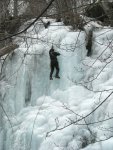
This reminds me of the debate among ice climbers about two ropes (UIAA half ropes) vs. a single rope (UIAA single rope). (Google this.) I've used both. A single rope is simpler and lighter. Two half ropes change things...

* If you chop one with a crampon or ice ax you have the other.
* The impact force is lower on a half rope.
* You have two ropes available for rappel.
* Twice as much to coil, but the coiling is easier.
* The belayer has to manage two ropes.
* Slack and rope management is better but more complex.

On rock I prefer a single rope. On ice, it depends.

two ropes
Leading%u00252Bin%u00252BWhite%u00252BOak%u0025252C%u00252Ball%u00252Bsewn%u00252Bup.jpg

single rope
Ice%u0025252C+Whiteoak+Canyon+2011+2.jpg

It is the same with anchoring. On good bottoms in average conditions, a single anchor. In severe conditions or with a poor bottom... it depends. But like ice climbing, using two does increase the complexity. Learning how to manage that complexity is part of it. If you are getting tangled up (ice or anchoring), you haven't learned it yet. That should not be the deciding factor. The situation should be.
 
Last edited:
We're not talking about me. Also, don't assume I am commenting based upon the boat you think I own--my comments are based on a number of boats I have owned and many anchoring situations. Back to the OPs question. It's a good question.
---
If a boat is yawing it is because the CLR is behind the COE of windage. You can either try to adjust this imbalance or add resistance to slow the swing. Bridles and Vs act by moving the CLR way forward. Chain and hammer lock are a combination of drag and moving the CLR. A riding sail or taking the reacher down moves the COE aft.

Any other options? The OP does not keep a dinghy on the bow. He can't lift his rudders or boards. He already uses a bridle, though he could let it out more.

The OP's question doesn't mention yawing. :rolleyes:
Please can you explain what you mean by "chain and hammer lock"? That's a new one for me.
 
Google "hammerlock mooring." It's a traditional method.

Well, every day's a schooldays. I have never seen the term used for that. I'm familiar with the concept, though I must say that it is a very inefficient use of an anchor. When I deploy an anchor, I want it to act as an anchor, not drag back and forward to stop yawing, which I can achieve much more efficiently by, for instance, rigging my riding sail, or using two anchors in a Vee.
 
Well, every day's a schooldays. I have never seen the term used for that. I'm familiar with the concept, though I must say that it is a very inefficient use of an anchor. When I deploy an anchor, I want it to act as an anchor, not drag back and forward to stop yawing, which I can achieve much more efficiently by, for instance, rigging my riding sail, or using two anchors in a Vee.

a. Normally a hammerlock does not drag back and forth. It takes drags only until it takes a light set at one extreme and then just stays there, since the force driving the yawing is small. This is a very common misconception. It is really more like a very assymetric V, where the function of the near anchor is to stabilize the far anchor.

b. It is far more effective than a riding sail. I have tested them both, side by side.

c. It is far easier that laying a second anchor. Just dangle it down.

d. It is easily convertible into a V by lifting it for a minute, lowering at the extreme of yaw, and then easing both rodes. Very easy.


So whether it is inefficient depends on your point of view and the situation. Others would say that a riding sail is inefficient, and in a storm when windage is a problem, are they wrong? Maybe. Maybe not.
 
Last edited:
Interestingly anchoring a 'V' is not uncommon in 'big' ships. I know one cruise ship captain, 2,000 passengers so quite big, who uses 2 anchors when they are anchored off 'tropical' islands to stop, reduce, the ship from yawing to make it easier for the tenders to ferry passengers. From memory HMNZS Canterbury deployed 2 anchors at Auckland Island a couple of years ago to stop yawing.

I was not aware of the term hammerlock till recently but deploying a second anchor is in one of HM navy books of seaman ship - though I've never heard of it being used.

To me a hammerlock is a funny chain joining device used by the lifting industry.

Jonathan
 
Interestingly anchoring a 'V' is not uncommon in 'big' ships. I know one cruise ship captain, 2,000 passengers so quite big, who uses 2 anchors when they are anchored off 'tropical' islands to stop, reduce, the ship from yawing to make it easier for the tenders to ferry passengers. From memory HMNZS Canterbury deployed 2 anchors at Auckland Island a couple of years ago to stop yawing.

I was not aware of the term hammerlock till recently but deploying a second anchor is in one of HM navy books of seaman ship - though I've never heard of it being used.

To me a hammerlock is a funny chain joining device used by the lifting industry.

Jonathan

There are at least five uses in American English for the word hammerlock, but only one hammerlock mooring.
* a wrestling move
* compressed air fitting
* a type of pipe union
* lifting coupling, as above
* anchoring method

Context makes the usage obvious.

Not a commonly used method, but not rare. I've used it a only few times, principally when the wind got swirly. It's really easy. I've also used it in testing, where I found it really works well. The other thing I learned in testing was that severe yawing can easily double the load on the anchor, while also wiggling the anchor.
 
We were anchored in a small cover when bullets at around 180 degrees shot down different valleys. The bullets were strong enough to lift water of the surface and to produce worrying snatch loads.

We decided to set a stern line. I misjudged the length of line needed to reach the tree and had to wait, holding the stern line, standing on the beach, as we extended the line from the cockpit. The load or tension necessary to hold the catamaran against the bullets was surprisingly low - I'd guess at 50 kg. It does not take much to stop yawing.

Its just, how do you do it? - and which for 'you' is the best method (and if you cannot approach shore due to depth restrictions, very common - then shore lines are out of the question).

An argument against anchoring in a 'V' is that it alters your yawing pattern - this does not make too much sense as yachts of different designs yaw differently anyway. All a 'V' does is convert the yawing patter from flighty to much more sedate (and there are still plenty of sedate yachts at anchor (who are sensitive to flighty yawers).

Jonathan
 
To. Reply to the OP .
My reply refer to us and we anchor every day in any condition for nine months each year and have done for the last nine years .
We have not found a need to run to a Marina or harbour although there have been time went the wind have touch over 50 kts and the boat is so wild standing wasn't possible that we wish we was in harbour.

We have used V anchoring many times over the years , if .
1 we know the wind is going to be mostly from one direction and over 30 kts .
2 if we going to be away for most of the day and its possible that the wind many pick up over 25 kts ( normally we don't leave the boat in them conditions )
3 in Croatia if a bora is forecaster .
It works for us and just like we all have insurance hoping we never going to need it the second anchor is just that.
I also feel it one anchor is dislodge the second anchor not only will hold us but it will get the anchor a chance to reset .

To the question about two anchor getting tangled, yes it doesn't some time happen if the the wind changes s it can some times ,
but I never had a problem to untangle them ,
My biggest fear is some one else dragging down on use when we have two anchors out which only every happens once and in that cast it was a F in big steel boat which we needed to get out of his way as he had no intention of lifting his anchor and moving after even after he already hit another boat , In that cast we buoy off one anchor and lifted the other and moved as fast as we could .

I no expert I only had 40 years, have I ever drag , well YES , but them we do anchor in condition that most with half a brain would be in a Marina, although I feel safely swinging on my hook then in a Marina with next door boat rocking wildly on mind or my fenders having their life taken out of them by the pontoon .

May I say over the years I enjoy reading Neeves and Noelex posting ,
I just wish I could get you both into a pub , pour a few beers into you both and then sit back and listen to you both talking anchoring :) if nothing it be interesting.

Before some of us get into heated argument here what we need to remember is we all commenting on our own experience , and we all have different boats with different tackle some just weekend anchor other like us liveaboard anchor a lot more so what right for one may not be right for another , as they say one man blow is another man enjoyable day sailing.

Just to end my posting the other week I was talking to a French guy who had a old CQR and he was tell me in three years he had never drag his CQR ,its the best thing ever , two days later he came over to ask if we was going into the Marina as there a good chance the wind would gust up to 20 kts , now I understood why he never drag anything over 15 kts was his limit on anchor .
 
Just to end my posting the other week I was talking to a French guy who had a old CQR and he was tell me in three years he had never drag his CQR ,its the best thing ever , two days later he came over to ask if we was going into the Marina as there a good chance the wind would gust up to 20 kts , now I understood why he never drag anything over 15 kts was his limit on anchor .


Vic,

Wise words :)

I'm not into knocking CQRs. They have stood the test of time and on that recent poll there were a significant number of people voting for them. We used a genuine CQR without issue when we were HK, including 30 days at anchor in the northern Philippines, San Fernando, when we lost our mast and never dragged but the anchor was a bit small for our cat here in Oz. Our Manson CQR copy has not been a success - but that is no evidence that its performance is in any way equal to a CQR and I would not confuse the 2. In reading these threads over the years many here swear by, genuine, CQRs and they appear to talk sense - so I won't knock their experiences - but the NG anchors we use now are so reliable and so forgiving - we won't, at current CQR prices, swap back - and maybe the new iteration of the CQR is not a match for the original.

But I did like the last paragraph that I quote, above, - which I fear is true of many who comment on their anchor, whether a CQR, or say a Supreme. Many will head for a marina and if I had a very young wife (as opposed to a young wife) and young children I would also follow suit - I see no need to scare them (no matter how safe my ground tackle) - so I don't knock the practice of running to the marina.

In fact I applaud the people who retreat to marinas as it leaves anchorage a bit more quiet and they fund the facilities we need, notably fuel and the occasional chandler.

Having said that - head south from Sydney and you would find difficulty finding a marina - which is why few head to Tasmania and thus provides us a major attraction.

Jonathan
 
May I say over the years I enjoy reading Neeves and Noelex posting ,
Thanks

Just to end my posting the other week I was talking to a French guy who had a old CQR and he was tell me in three years he had never drag his CQR ,its the best thing ever , two days later he came over to ask if we was going into the Marina as there a good chance the wind would gust up to 20 kts , now I understood why he never drag anything over 15 kts was his limit on anchor .

Yes, this is a problem. Even amongst a small number of experienced cruisers, we have occasionally noticed a reluctance to anchor in strong or even moderate conditions.

The other problem sometimes seen is a reluctance to use some anchorages that are actually perfectly OK. It is not unusual to hear “fantastic spot, but the holding is poor or it is not sheltered enough for overnight”. This is sometimes true, but often the caution results from poor anchoring gear.

I think this is a pity. Modern anchoring gear, both new generation anchors and powerful electric windlasses, have really revolutionised anchoring. Personally, I feel quite safe in places and wind strengths where 20-30 years ago I would never have dreamed of anchoring. Not everyone has taken advantage of this change.

Modern yachts have autonomy with lots of water and electricity, larger storage capacity, better refrigeration, modern communication equipment, etc to stay anchored in remote areas for long periods. It is a shame to be heading back to a marina in conditions that should be perfectly safe. Even worse is to be concerned and worried unnecessarily.

To get back to the theme of the thread, this is partially why I think it is wrong to consider it necessary to set out two anchors in only 25-30 knots of wind. I think I would lie awake many nights and with every gust worry if I should have set that second anchor.
 
Last edited:
Noelex - I agree with most of your post - but there are an awful to of people who do use 2 anchors. You use an anchor that is almost 2 times the size recommended for a yacht of your, previous, size. Not everyone wants to do this, for whatever reason. We use, arguably undersize anchors without issue. When the winds are FORECAST to be, or actually are 30 knots we think it is prudent to deploy another anchor on THAT occasion. 30 knots in an anchorage would be unusual for most. The need to continuously cart around an anchor almost twice the size necessary for normal conditions might seem seem perverse when normal conditions are much less than 30 knots.

The windage of our yacht is almost identical to a 45' Bavaria, and your yacht was how long? and we use 8kg anchors (and sometimes 2 anchors) and 6mm chain and you were using a 50kg anchor and 10mm? chain (whose holding capacity has never been defined).

There are as many ways to cook a rabbit as to anchor - it depends on your preferences.

Anchors are a compromise and usage is personal choice - there is no right way but there are different right ways.

It is beneficial to explore practices, for me - and hopefully everyone.

I accept I can become dogmatic when someone suggests I am wrong (despite 20 years of doing what we do - in marine areas considered by many to be pretty character forming).

Jonathan
 
I've never had a boat that naturally yawed much (unless I didn't use a bridle). I believe you have a furled reacher on a sprit. That was very bad in my testing. It might be the primary problem.

Sorry Thinwater, I missed this.

Yes we do have a furled screecher 45^2m on a sprit (and it is Mylar and does not furl very thinly). We also have a furled 150% genoa on the crossbeam, just forward of the bow roller.

We recently anchored in 30 knots gusting 35 for a few days and had our extended bridle of 20m and found veering markedly reduced but we did not have the screacher on board. I attributed the reduction in veering to the longer bridle and I can completely ignored the absence of the screacher.

I need to retry with and without the screecher

Jonathan
 
I wonder if long snubbers actually increase the tendency to yaw? I can see how long snubbers reduce snatching, but yawing, I'm not so sure.
I have a riding sail on my mizzen, which greatly reduces yawing. I only use it occasionally, if and when I think it will help.

And I missed this one as well, apologies Norman. I have been a bit tied up :(

When we used a short bridle, 10m, the arms might stretch 1m, now that we use a longer bridle the arms stretch a bit less, in similar wind, so say a total stretch of 0.75m - but that is now spread over 20m (or at the extreme 30m). The movement is now much more gentle - the recovery by the bridle to the stretch reduces the acceleration. The longer bridle is thus more comfortable (and the bridle less stressed).

The bridle angle becomes more narrow and the two arms share the tension more evenly and each arm is stretching less, because they are sharing of tension.

I had thought this was the factor causing less veering but see above and Thinwater's comment on our furled screecher. Now I don't know - but think the better sharing of tension offers stability. (Academic for most as a bridle on many yachts is simply not feasible - you really need a bit of beam - but a longer single snubber should offer a more gentle take up and release of tension.)

I'd like to try a riding sail - its well proven - but have not thought how to rig one. All reports of riding sails seem positive - but they seem to have gone out of fashion, I have never seen one in Oz.

I'd fully agree if we had a guarantee of only 30 knots (at the masthead) we would not lay a second anchor. We do not get those guarantees and I don't particularly want to lay the second anchor, certainly not from a dinghy, and not very enthusiastic from the bow under engine when the forecast 30 knots becomes an actual 40 knots. Call it being a wimp, or laziness - its not difficult to lay a second anchor.

Jonathan
 
There has been mention of angles - what is the experience.

When deploying from a dinghy it becomes a bit of a lottery, the angle. I try to get the second anchors so that its rode is about the same length as the first and I'm aiming for 45 degrees, because I can deploy more rode, or more snubber + rode, and reduce the angle. Normally we would end up with 30 degrees - but this more by chance than design.

I've never tried to test to see what is best, for us.

What is the ideal?

Jonathan
 
There has been mention of angles - what is the experience.

When deploying from a dinghy it becomes a bit of a lottery, the angle. I try to get the second anchors so that its rode is about the same length as the first and I'm aiming for 45 degrees, because I can deploy more rode, or more snubber + rode, and reduce the angle. Normally we would end up with 30 degrees - but this more by chance than design.

I've never tried to test to see what is best, for us.

What is the ideal?

Jonathan

Is the goal to reduce yawing or to share the load (including wind shifts)? I think these give different answers.
 
I don't think it's worth worrying too much about finding the perfect angle for a Vee. After all, suppose it was established that the perfect angle was 49.5°, how are you going to achieve that, in the real world?

I always say that anchoring is an inexact science, and unless I'm anchored in shallow water over clean sand, I can never see my anchor(s) in operation, so realistically I don't know how good a grip I've got until I try to heave it up. In our waters, diving down for a look is not an option.

Several on here have mentioned about people seeking shelter in marinas if stronger winds are expected. Increasingly, pontoons are appearing in places on the West Coast of Scotland. Some of these claim to be "Marinas" when they patently are not. Understandably, people who through no fault of their own, don't know the difference, read the word Marina, and assume shelter in all conditions. It just ain't so.

A couple of years back, forecasts were predicting a severe gale, in a week's time. Yes, we had a full week's warning, so plenty of time to choose a good sheltered spot. We chose one of the hidden corners, among the many branches and islands in Loch Maddy, in the outer Hebrides. It so happens that pontoons have been installed at Lochmaddy village, close by. They (wrongly) call themselves "Lochmaddy Marina", so understably some yachts headed there for the forecast blow.

This was quite a bad summer gale - the one when the oil rig, the Ocean Winner was being towed west of the Outer Hebrides, the tug couldn't cope, and the oil rig fetched up ashore. Quite why, in the light of the forecast, the tug chose to go west-about, may come out in the MAIB report. Anyway, back to yachts: we were fine where we were, lying to a single anchor, the only boat in a wee loch, plenty of swinging room, plenty of chain out, absolutely no sea, 50-60 knots of wind. Our only problem was that our wind generator must have shed a blade, and proceeded to destroy itself dramatically, but that's another story.

Meanwhile at the pontoons (called a marina) boats, and even the pontoons were in trouble, heaving up and down, fenders popping etc. It was so bad that the police and coastguard were called, to do I'm not sure what.

Where would you rather be? ( Snug at home is not a valid answer).
 
Top