forestay repair in situ

steve1963

Well-Known Member
Joined
22 Sep 2014
Messages
282
Visit site
I have a plastimo furler, in which one of the small screws connecting the extrusions has come loose and is standing proud. This is preventing the hoisting/lowering of the sail. I need to fix this urgently. I had the idea of climbing the mast and then hanging in a harness or bosuns chair, at the same level as the loose screw, and then, with a strop around the forestay, pulling myself toward the forestay, until I can reach the problem. However, I have a feeling that this may be more difficult than it sounds.

An alternative would be to undo the stay at the deck level, bring it toward the mast and then work on it from the mast (I have a mast ladder). However, this presents its own problems

Anyone got any ideas/experience?
 
My boat was out of the water for the winter. The boat next to mine had almost exactly the same problem, although in their case the screw had come out altogether and dropped down the bolt rope track. They had a Plastimo 609S.

It was fixed using the method you propose, I happened to be working on my boat at the same time and watched them do it. It was done by the boat yard staff so they are quite familiar with working up masts. However, it did not seem unduly difficult. Certainly the mast climbing and reaching the forestay went fine. Extracting the stuck screw was difficult but I think it would have been on the ground.

They said there was no evidence of loctite being used which he reckoned was the cause. I happened to install a Plastimo 609 on my boat 4 years ago and I clearly remember that the manual did not call for loctite on the screws, but instead said to use silicone sealant. I think loctite would be better.
 
If you are going to undo the stay just go bows to a quay and slide the whole furler off the stay and deal with it without any need to climb. When I had to remove my forestay to replace a fitting this is what the riggers did. The mast was secured by means of the spinnaker and genoa halyards both secured forwards and winched tight. Whilst you have the furler off check all the screws, and any that you can loosen should be refitted with a drop of loctite to keep them secure.

Sorry I forgot, We only slid mine off because we could remove the sta-lock fitting at the bottom, if you have a swage it cannot be done my way. In my case we needed to shorten the wire slightly, hence the fitting had to come off.
 
Last edited:
And. Go to the top of the forestay, attach a short loop around it from your harness and then get lowered to where you need to be so that there's no holding on to do.
 
If you are going to go up the mast anyway, and you're not in a great hurry, why not disconnect and lower the whole furler, then take it ashore and give it an overhaul? Then you can remove, clean and refit all the screws using Loctite 243 or similar, and also examine the bearings and replace if necessary. That way done you can look forward to many years of trouble-free service.
 
If you are going to go up the mast anyway, and you're not in a great hurry, why not disconnect and lower the whole furler, then take it ashore and give it an overhaul? Then you can remove, clean and refit all the screws using Loctite 243 or similar, and also examine the bearings and replace if necessary. That way done you can look forward to many years of trouble-free service.

That would be my choice. My furler was fitted with the boat on the water. Rigger in Dunkerque assembled everything on the pontoon then hauled the forestay up the mast, which was held on genoa and spinnaker halyards. Far easier than trying to fix your forestay from a chair, especially as you have mast steps.
 
I would go up with a climbing harness.
I would be reluctant to take the forestay and furler off if it could be avoided, as they are very vulnerable to damage in any situation other than where they are intended to be.

Alternatively, I have seen people use an extension ladder. The key to this is some wooden board to go on the deck, a) to avoid point loads on the deck and b) to stop the feet of the ladder moving. The top ofthe ladder is held at the mast by a halyard and a down haul and lashed to the mast while working.

Small boat halyards tend to stretch too much to replace the forestay with a bloke aloft.
Big boats you'd be OK. Where the crossover is, is not something I'd want to find by experiment.
 
I would go up with a climbing harness.
I would be reluctant to take the forestay and furler off if it could be avoided, as they are very vulnerable to damage in any situation other than where they are intended to be.

Alternatively, I have seen people use an extension ladder. The key to this is some wooden board to go on the deck, a) to avoid point loads on the deck and b) to stop the feet of the ladder moving. The top ofthe ladder is held at the mast by a halyard and a down haul and lashed to the mast while working.

Small boat halyards tend to stretch too much to replace the forestay with a bloke aloft.
Big boats you'd be OK. Where the crossover is, is not something I'd want to find by experiment.

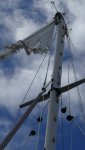
I had to do that with the sail up, the screws came loose while sailing (awful job by the rigger) so it was impossible to lower the sail, the set screw heads also damaged the genoa luff.
I unfurled the sail and while hanging with a climbing harness I pulled myself towards the stay by means of a rope looped around it.
I did it a few other times, once to shred this sail into pieces with a knife as it was all jammed up there.

unnamed.jpg
 
Top