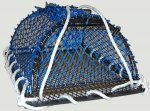
Folding lobster pot

Shuggy

Well-Known Member
Joined
10 Mar 2006
Messages
1,181
Location
Argyll
Visit site
I’m struggling to find a decent folding lobster pot. Not one of the cylindrical squashy ones, but a decent folding one. I used to have one from Fyne Fishing but he is not taking orders. After several years and several lobsters it disintegrated.

Any pointers to online sellers please?

Thanks.
 
This is no use to you at all - but this, or a variant, is what we use. It folds flat - ish and sits in a transom locker. It weighs a hefty 26kg - so you are not going to buy it mail order nor carry it home as part of your luggage. It appears to be simply made from steel rod and a few custom parts for the hinges - anyone who can weld could knock one up (much more cheaply than the price shown here). I don't remember (and I would) that ours cost that much.

I have a little bow roller on the transom of our dinghy to allow ease of retrieval.

It meets licensing requirements in Tasmania.

It is brilliant.
 
Thanks - that’s helpful. I like the look of that. Another question (sorry): do the entrances subsequently have net cylinders attached so the catch can’t get back out again? I may get one welded in mild steel as a prototype for a stainless one. Cheers.
 
If going stainless route might want an anode to stop corrosion, the net entrance is to stop them escaping, have a google of parlour pots, their design principle may be helpful, also possibly look at fitting an escape hatch so juveniles can get back out... hope that helps a bit.
 
I’m struggling to find a decent folding lobster pot. Not one of the cylindrical squashy ones, but a decent folding one. I used to have one from Fyne Fishing but he is not taking orders. After several years and several lobsters it disintegrated.

Any pointers to online sellers please?

Thanks.

Have a look at stainless steel weld mesh with a suitable mesh size.

https://www.multimesh.co.uk/stainless-weldmesh/
 
Thanks for the posts - all good. I’m also toying with making a rod framed one with net. I’ll post results here in due course!
 
Ours has a plastic entry at the top its simply a cylinder about 150mm long with a flange that sits on the top of the cage (to retain the cylinder). The cray fall in but cannot climb out it is too slippery. At the bottom of the cage there are slots to allow juveniles (or undersize cray) to get out. You could easily make a plastic entrance from water/sewage pipe, available in your local builders merchant (they might have something with a flange - or simply cut a flange and stick on with Sika, or appropriate adhesive.

Discarded supermarket trolleys would be a good idea. Don't weld. Simply join up and make the joins as hinges and then you can fold flat (they take up a lot of room).

I'd send a picture but our pot is on the cat. Ours is 2 parts, a steel welded tray for the base and steel welded inverted tray for the top - the smaller, top, tray fits into the bigger one. It sort of like a truncated square pyramid when assembled The sides are simply net. When assembled there are a 'U' frames at the sides that turn, its crudely hinged, and locks into the opposing tray. When ours is folded its about 750mm x 750mm square with the top tray nesting into the bottom and the trays are about 300mm high with about 600mm between trays. The U frames keep it 'assembled' and it is very sturdy. It has rings for the rope.

Ours is made heavy - the alternative are - rocks.

Tasmania is famous for its cray and there is a big commercial industry. The commercial fishers know the reefs out in the ocean and lay their pots in a long line, very well marked. They have windlass to haul in the line of pots. We tend to fish along the shoreline, where the commercial fishers don't want or need to access.

First time we dropped our pot we collected 13 cray of legal size. Well beyond legal allowed 'hold'.

Brush up on your cray recipes! It is very easy to become tired of crayfish :)

Because we are working from a, small, dinghy we have to watch the weather and sometimes need leave the pot unattended for a couple of days for while to allow the swells to ease - we still catch cray - even after its been rough. As we travel down the coast we trawl and catch baracoutta - evil looking fish full of bones. We chop them up and use as bait. Someone here suggested Kit e Kat - simply open with an old fashioned beer can opener (the ones that cut a triangular hole) and simply drop in the pot - sort of sustained release.

I wear a LJ, carry a hand held VHF - just be careful - when you are retrieving a full heavy pot you are not watching the seas. We don't have enough room in our dinghy for 2 people and manhandle a cray pot - so Josephine sits well off the shore, I venture in.

Jonathan
 
Last edited:
Ours has a plastic entry at the top its simply a cylinder about 150mm long with a flange that sits on the top of the cage (to retain the cylinder). The cray fall in but cannot climb out it is too slippery. At the bottom of the cage there are slots to allow juveniles (or undersize cray) to get out. You could easily make a plastic entrance from water/sewage pipe, available in your local builders merchant (they might have something with a flange - or simply cut a flange and stick on with Sika, or appropriate adhesive.

Discarded supermarket trolleys would be a good idea. Don't weld. Simply join up and make the joins as hinges and then you can fold flat (they take up a lot of room).

I'd send a picture but our pot is on the cat. Ours is 2 parts, a steel welded tray for the base and steel welded inverted tray for the top - the smaller, top, tray fits into the bigger one. It sort of like a truncated square pyramid when assembled The sides are simply net. When assembled there are a 'U' frames at the sides that turn, its crudely hinged, and locks into the opposing tray. When ours is folded its about 750mm x 750mm square with the top tray nesting into the bottom and the trays are about 300mm high with about 600mm between trays. The U frames keep it 'assembled' and it is very sturdy. It has rings for the rope.

Ours is made heavy - the alternative are - rocks.

Tasmania is famous for its cray and there is a big commercial industry. The commercial fishers know the reefs out in the ocean and lay their pots in a long line, very well marked. They have windlass to haul in the line of pots. We tend to fish along the shoreline, where the commercial fishers don't want or need to access.

First time we dropped our pot we collected 13 cray of legal size. Well beyond legal allowed 'hold'.

Brush up on your cray recipes! It is very easy to become tired of crayfish :)

Because we are working from a, small, dinghy we have to watch the weather and sometimes need leave the pot unattended for a couple of days for while to allow the swells to ease - we still catch cray - even after its been rough. As we travel down the coast we trawl and catch baracoutta - evil looking fish full of bones. We chop them up and use as bait. Someone here suggested Kit e Kat - simply open with an old fashioned beer can opener (the ones that cut a triangular hole) and simply drop in the pot - sort of sustained release.

I wear a LJ, carry a hand held VHF - just be careful - when you are retrieving a full heavy pot you are not watching the seas. We don't have enough room in our dinghy for 2 people and manhandle a cray pot - so Josephine sits well off the shore, I venture in.

Jonathan

Civilized country :)

Here in France if you lay a non-commercial lobster pot you must be sure to wake up very early in the morning and check if you have caught something, any lazy time spent for breakfast or morning coffee and one is almost sure to find the pot having been emptied by someone else... :D


I These were popular on sale
casier2.jpg
 
I've just discovered a whole new world of folding pots by googling 'casier pliant a l'homard' - I'll see if anyone will send one over to the UK. Much less hassle than making one!

In the shops they were sold with two concrete weights bolted inside, better ask them to sell and ship it "sans les blocs de béton" :)

Depending upon what you need, there are different shapes, google casier homard, casier crabe, araignee, also "nasse a poisson"
https://comptoir-maritime-lecabestan.fr/668544-nasse-a-poissons-pliante.html


addition:
If you or friends happen to cross the Channel, some of those (and a lot, lot of other fishing gear) are sold at "Comptoir de la mer" chain shops, the leisure arm of the fishing cooperatives, they are present in most French ports.
 
Last edited:
Top