Flopper stopper

richardh10

Well-Known Member
Joined
7 Jul 2007
Messages
521
Location
on the move
Visit site
I've decided its time to make one of these as I'm presently rolling around gnashing my teeth.
I'm thinking a bit of marine ply covered with fibre glass, but what size? For storage purposes it's going to have to be hinged, so what is the best way of doing that? Boat is 38ft and 12 tonne. Any input welcome as I've no idea what I'm doing

Thanks
 
If a second snubber led to a midships cleat and adjusted to angle the boat into the swell won’t work then the storable and “free” snubber that I’ve used moderately effectively is my parachute drogue held open by two battens bolted in the middle to form a cross that can store as just one batten on top of the other. Then I hang it from the end of the boomed out boom using an existing warp with rubber snubber led through a block at the boom end so I can adjust and cleat it. The drogue is kept under water throughout the entire roll and weighted by my dinghy anchor.

What it does do is completely stop the resonant roll starting as it quickly damps it away with the combination of the drogue resistance and rubber snubber. What it doesn’t do is stop the roll towards the side it’s set on - I’d need another identical set up with spinnaker pole on the other side to do that and it cures so much of the problem it’s not worth the faff to me and I’d have to buy another parachute drogue. I have a 1.5m wide parachute for a 45 foot boat.
 
Hi, I rejected the traditional triangular design. It takes a long time to work when it starts going upwards as it has to get flat again.
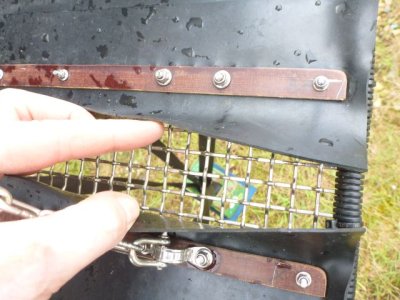
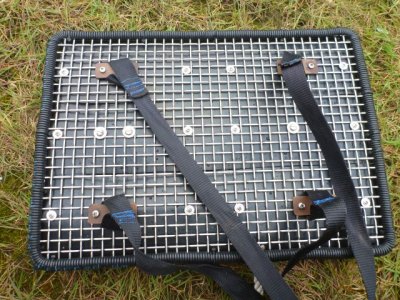
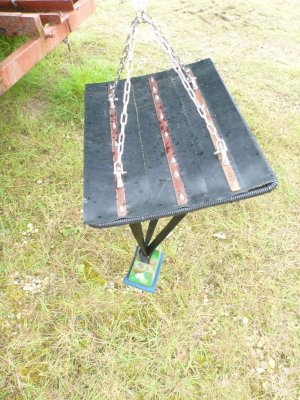
I have used a metal mesh with strips of rubber acting as one-way valves and a weight hanging below it. It starts slowing the roll of the boat a lot sooner.
 

Attachments

  • P1220225 low.jpg
    P1220225 low.jpg
    200.9 KB · Views: 31
  • P1220226 low.jpg
    P1220226 low.jpg
    88.7 KB · Views: 26
  • P1220228 low.jpg
    P1220228 low.jpg
    137.1 KB · Views: 27
I've decided its time to make one of these as I'm presently rolling around gnashing my teeth.
I'm thinking a bit of marine ply covered with fibre glass, but what size? For storage purposes it's going to have to be hinged, so what is the best way of doing that? Boat is 38ft and 12 tonne. Any input welcome as I've no idea what I'm doing

Thanks
Polyester GRP has poor adhesion to plywood. I would just epoxy resin it.

Here is one Make a DIY flopper stopper - Practical Boat Owner
 
. . . For storage purposes it's going to have to be hinged, so what is the best way of doing that? . . .

This website has some discussion (including relevant comments from others at the bottom of the page) and short videos of both a rubber flap type like Egbod's at Post #4 above, and a commercially produced hinged metal type that could perhaps form something of a model for one with the hinging you need for storage.
How can we Design a Better Flopper Stopper? - MV Starr

In wood I imagine it could either be a simple single hinge axis and suspended as shown in the second video example, or perhaps a hinge axis either side of a central batten from which the whole device could be (partly?) suspended and weighted). This would allow it to open wider and presumably give greater
resistance.
 
I lashed one up from an Avon floorboard and a hank of spare chain.
The main things I took away from the experiment were:
- you need much more weight than you think
- getting the thing completely level, with the ropes exactly the right lengths, is crucial, otherwise it just slips off sideways.
- the amount of chafe and wear it will experience is astonishing. It's in constant motion.
- you may dampen your roll but create a symphony of new squeaks and creaks as the rope you use to suspend it rubs on cleats, shackles, etc.
 
If a second snubber led to a midships cleat and adjusted to angle the boat into the swell won’t work then the storable and “free” snubber that I’ve used moderately effectively is my parachute drogue held open by two battens bolted in the middle to form a cross that can store as just one batten on top of the other. Then I hang it from the end of the boomed out boom using an existing warp with rubber snubber led through a block at the boom end so I can adjust and cleat it. The drogue is kept under water throughout the entire roll and weighted by my dinghy anchor.

What it does do is completely stop the resonant roll starting as it quickly damps it away with the combination of the drogue resistance and rubber snubber. What it doesn’t do is stop the roll towards the side it’s set on - I’d need another identical set up with spinnaker pole on the other side to do that and it cures so much of the problem it’s not worth the faff to me and I’d have to buy another parachute drogue. I have a 1.5m wide parachute for a 45 foot boat.
Builders bag? Cheap or free.

Seems like this general procedure might put quite a lot of strain on the gear though, at gooseneck etc
 
Having built three before conceding defeat (2 x triangular and 1 crate & flap affair) I would direct you to Sea Change's post.
A flopper-stoppet large enough to make much/any difference is heavy and too large to easily store, difficult and time consuming to rig/recover and causes irritating noises and bumps.
Deploying a second anchor is more successful, but even more time consuming, but you can often improve matters more easily by taking a strop from your main anchor chain to a midship cleat or cockpit winch thereby adjusting how you lie to the swell.
Alternatively - and with experience our approach - shrug your shoulders, drag a berth cushion and blanket onto the saloon floor and spend the night there; it'll roll far less and works while on passage too.
 
Last edited:
Seems like this general procedure might put quite a lot of strain on the gear though, at gooseneck etc
Builders bag makes sense but I already have a parachute drogue and its strong with lot’s of strong points at the rim and the base to attach things.

I think the forces are far smaller than a main sheet in gusty weather and all in the downward direction like a main sheet or vang but at the end instead of the always slightly concerning part way along of those two fittings. If I ever did use a spinnaker pole to do the other side I might worry a bit about the fitting at the mast end but again those are designed for strong forces.
 
A friend used a proprietary one on a bigish boat. It failed to provide enough anti-roll force. The conclusion was it was not worth the bother as to get a big enough device would mean having something too big and awkward to store. A shame as rolling is a proper PITA.

Even catamarans roll, though they don’t do a death roll. Maybe they are the best compromise.
 
Get a ketch! We hoist the mizzen bar tight. With the fully battened loose footed sail, you can set it so it doesn't move. I rig a block and tackle to triangulate the sheet. The dampening changes are natural roll frequency to put us out of phase with the swell. We don't have to do it often, maybe twice a year but it makes a huge difference
 
Get a ketch! We hoist the mizzen bar tight. With the fully battened loose footed sail, you can set it so it doesn't move. I rig a block and tackle to triangulate the sheet. The dampening changes are natural roll frequency to put us out of phase with the swell. We don't have to do it often, maybe twice a year but it makes a huge difference
Geem. Are you trying to post more than me? You'll have to try harder.
 
Without the need for a second mast, a small riding sail set on the backstay and cleated tight to midships can keep the swell on the bow and reduce rolling. A discarded storm jib with piston hanks from a small yacht can usually be purchased cheaply, works well and is easy to stow.
 
Top