Floating containers - ever seen one?

I must “declare an interest” as I manage container ships by way of a day job. None of “mine” have yet dropped a box OB; the general idea is to deliver the cargo in good nick. But things can go wrong. I have seen ships that have lost containers from deck stacks.

A regular ISO container is made to be weather tight, not water tight, so water will seep in and it will sink. There are two important exceptions to this. One is the proverbial container full of consumer durables packed in expanded polystyrene foam and the other is the refrigerated container which by its nature (its a big fridge!) has lots of insulation and is air tight. When loaded these are usually very heavy and will sink anyway but an empty one will float for ages.

ISO containers are built to be very strong in the corners, because that is where the lashing loads are taken, and fairly strong in the floor, because that is what the contents are lashed to, but much less strong in terms of resistance to impact in the sides and the roof. I would expect a corner to do real damage.

I don’t know of any reliable figures for numbers of boxes either washed overboard or lost due to the loss of the ship. The numbers are all educated guesses. If you lose a container full of cargo you will tell your P&I Club of course but if you lose an empty, why bother?
 
Last edited:
My question would be is how dangerous is a floating container? Unlike a power boat or a Vendee Globe racer, I wonder if a container would do much damage even it hit directly at 7-10kn
If one looks at the Crash Test video - https://youtu.be/bRhcXBtmPQs they found it quite hard to make a hole in the boat to start the test which I find quite reassuring

In reality, you are most likely to make a glancing collision. Would this really hole the boat?

TudorSailor

Before my ownership the boat was hit by another moving vessel at about 3 knots, large hole above the waterline, thankfully. Hitting the corner of a metal container should have the same force. I am not reassured.
 
What, apart from air that would be removed by a valve, can go in a shipping container that is more buoyant than the weight of the container ? Polystyrene in packaging is much reduced now. I doubt any container is buoyant when full of water, if I’m wrong it’s certainly not many.

Balls.:D
 
If the max load of a container is 22 tonnes & the volume about 38 M3 ( not sure how accurate these figures are- someone will correct this- then minimum positive buoyancy when they first hit the water will be 16 M3. i would imagine that a well packed container would still have 16M3 of spare space for 16M3 of water regardless of polystyrene etc. The packaging wil absorb water around the products. Fridges will allow water into the spaces & in the works for instance.
So the container will eventually sink.
The question is how long will it take for 16M3 of water to drip into it.
Well if you have ever laid in your berth with water dripping on your head through that leaky fitting-- not long:encouragement:
 
My question would be is how dangerous is a floating container? Unlike a power boat or a Vendee Globe racer, I wonder if a container would do much damage even it hit directly at 7-10kn
If one looks at the Crash Test video - https://youtu.be/bRhcXBtmPQs they found it quite hard to make a hole in the boat to start the test which I find quite reassuring

In reality, you are most likely to make a glancing collision. Would this really hole the boat?

TudorSailor

Somebody did some tests on a Dehler 31 once.

https://www.youtube.com/watch?v=rvxhQO4pw2E
 
This is what happens when a steel mooring hits a GRP boat.

ns-storm-port.jpg


Think what a container would do.
 
What, apart from air that would be removed by a valve, can go in a shipping container that is more buoyant than the weight of the container ? Polystyrene in packaging is much reduced now. I doubt any container is buoyant when full of water, if I’m wrong it’s certainly not many.

But other forms of packaging may be as buoyant, or even more so. Many things I've received recently have been packed with a sort of giant bubble-wrap - it's hard to think of anything much more buoyant! And polystyrene foam is still very common for a lot of consumer electrical or electronic goods; for example I recently bought several ceiling fans and they all (three types from 2 different suppliers) had substantial polystyrene packaging. There does seem to be a move towards a sort of shredded cardboard, which would probably absorb water fairly quickly - but then again, the boxes themselves tend to be pretty well sealed and would last some time. I think there's plenty of bouyancy in enough containers to make hitting one a distinct possibility.

That said, floating wood is at least as big a hazard. I was once in a plywood boat that nearly sank because of a panel being stove in by floating debris - I was a boy at the time, and my father's boat was in company with us. Another friend's yacht sank in the North Sea after hitting a plank or log. Both happened in the early to mid 60s, before shipping containers were much of a factor.
 
Guess ive been lucky and never seen one in a fair bit of ocean sailing.
Seems like the chances are quite slim of a dink happening. Mebbe around that of getting hit on the head by a coconut whilst on holiday. In cleethorpes.....
 
The Dehler crash test was great but they hit straight on. The real risk is the corner of a shipping container hitting just aft of the bows. Whats more its an unsinkable Dehler. My dear Navigator did her RYA Day Skipper in a Bavaria and said she found it alarming that the sides flexed when she leaned against the galley or heads sides, (she affirmed our choice of Westerly built like the proverbial) and I think doing that test with faster but lighter built Bavaria might cause more damage
 
I saw one off the Lizard about five years ago. CG were putting out a Nav warning, but for a different location, as no-one had seen it for 3 days. All that could be seen was a small pyramid shape of the corner, proud of the water by less than a meter.
 
Last season we spotted a massive looking (30m long) rusty steel pontoon-like structure with multiple jagged edges, which as far as I could tell was partially supported by half sunken floats.

It was N of Cherboug just before the W-E shipping lane. Stopped and called the French CG, who took the details. No idea what it originally was.
 
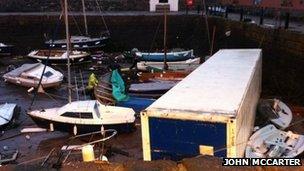
Saw this one in the back of our harbour. Did a heck of a lot of damage crashing through the dinghy park before it got there.

_64783055_img_3971.jpg
 
thats on average 85 days so expect 1 container every 400,000 square miles.
https://www.marinetraffic.com/ has 160,000 vessels tracked in the last 24 hours.
All of a sudden, it looks like there should be collisions with containers quite frequently.
Not sure I concur with your maths...

So if there is 1 40ft container in 400,000 square miles that means there is a rectangle 40ft x 8ft in the 400,000 sq.mi.

400,000 square miles is equivalent to a rectangle 1 mile wide and 400,000 miles long.

Thats 400,000 x 5280 = 2112 million feet long and 5280 feet wide.

If you were to cover that width with a grid 8 feet wide you can fit 660 x 8 foot wide rectangles into that width and nearly 53 million 40 foot long rectangles into the distance. a 400k sq.mi area covered in a grid 40ft x 8ft would have 34848 million 40 x 8ft rectangles. Your container in theory occupies just one of those.

Your 160,000 vessels of unknown size in that 400,000 sq.mi area at any one time. Some will be bigger than one 40 x 8ft rectangle. Others will be smaller. I don't know what the average is but lets say 80ft x 16ft (so 4 rectangles) would be average. So 640,000 of your rectangles are covered by a boat. 1 by a container. And 34,847,359,999 are uncovered. If we assume your odds of hitting a container happen every time you move into a new rectangle, that you can never hit another boat, and that another boat can not be in the same rectangle as a container then you have a 1 in 34,847,360,000 chance that your next rectangle move will result in a collision. A collision for a ship is probably low risk. But for a yacht travelling at 6kts is serious. 6kts means covering 36456feet per hour. So you transition through 911 rectangles per hour (assuming you move along the long length of the rectangle). So any any hour of sailing you have a 911 in 34,847,360,000 chance of hitting a container. so 1 in 38 million chance per hour of sailing. If we estimate the average boat sails say 8 hours on Sat and 8 hrs on Sunday, 2 weekends a month, for 6 months of the year (192 hrs a year), and the average sailor sails for 40 years. So ~ 8000 hours in a life time. I *think* that gets you to a 1 in 5000 chance that you enter the same "rectangle" as a container in your lifetime if you kept sailing in that some 400,000 square miles and the container never sank or was replaced by another.

I realise thats all rather arbitrary and there is a lot of guess work in there, and it has been a while since I did any probability maths so I may have it wrong too. There will likely be other factors at play:

- are more lost in oceans than coastal?
- are more lost in winter?
- how many are lost attached to hulls that are lost vs how many are loose containers?
- tide dynamics - you tend to sail with currents if you can - the box will move with currents too...
- if a ship hits it - does it the sink?
- a container is >8ft tall. if you sail in 'shallow' waters it would likely get stuck on something at some point.
 
Not sure I concur with your maths...

So if there is 1 40ft container in 400,000 square miles that means there is a rectangle 40ft x 8ft in the 400,000 sq.mi.

400,000 square miles is equivalent to a rectangle 1 mile wide and 400,000 miles long.

Thats 400,000 x 5280 = 2112 million feet long and 5280 feet wide.

If you were to cover that width with a grid 8 feet wide you can fit 660 x 8 foot wide rectangles into that width and nearly 53 million 40 foot long rectangles into the distance. a 400k sq.mi area covered in a grid 40ft x 8ft would have 34848 million 40 x 8ft rectangles. Your container in theory occupies just one of those.

Your 160,000 vessels of unknown size in that 400,000 sq.mi area at any one time. Some will be bigger than one 40 x 8ft rectangle. Others will be smaller. I don't know what the average is but lets say 80ft x 16ft (so 4 rectangles) would be average. So 640,000 of your rectangles are covered by a boat. 1 by a container. And 34,847,359,999 are uncovered. If we assume your odds of hitting a container happen every time you move into a new rectangle, that you can never hit another boat, and that another boat can not be in the same rectangle as a container then you have a 1 in 34,847,360,000 chance that your next rectangle move will result in a collision. A collision for a ship is probably low risk. But for a yacht travelling at 6kts is serious. 6kts means covering 36456feet per hour. So you transition through 911 rectangles per hour (assuming you move along the long length of the rectangle). So any any hour of sailing you have a 911 in 34,847,360,000 chance of hitting a container. so 1 in 38 million chance per hour of sailing. If we estimate the average boat sails say 8 hours on Sat and 8 hrs on Sunday, 2 weekends a month, for 6 months of the year (192 hrs a year), and the average sailor sails for 40 years. So ~ 8000 hours in a life time. I *think* that gets you to a 1 in 5000 chance that you enter the same "rectangle" as a container in your lifetime if you kept sailing in that some 400,000 square miles and the container never sank or was replaced by another.

I realise thats all rather arbitrary and there is a lot of guess work in there, and it has been a while since I did any probability maths so I may have it wrong too. There will likely be other factors at play:

- are more lost in oceans than coastal?
- are more lost in winter?
- how many are lost attached to hulls that are lost vs how many are loose containers?
- tide dynamics - you tend to sail with currents if you can - the box will move with currents too...
- if a ship hits it - does it the sink?
- a container is >8ft tall. if you sail in 'shallow' waters it would likely get stuck on something at some point.

The statistics of encountering an object distributed over an area when following a particular track across that area are tricky. The inverse problem (if you encounter X objects along a track Y long, what is the areal distribution of X) is highly relevant to marine biology, especially whales and other cetaceans. Lets put it this way - the mathematics are suifficiently problematic that whale populations are still regarded as being dificult to estimate, hence the differences between whaling and non-whaling nations! Whaling nations prefer optimistic asssessments, conservationists prefer pessimistic ones.

Many of the problems arise from the question "If you don't see any X along the tracks is that a) because they weren't there or b) you failed to spot them. Clearly for objects at or even below the surface of the water, b) is quite likely - but how likely?

I don't know the relevant mathematics, but I do know that it is an interesting research topic for those so inclined!
 
Top