Floating containers - ever seen one?

RolyGate

Member
Joined
7 Jun 2007
Messages
27
Location
UK Kent, or living aboard elsewhere
www.pelaginox.com
Just updating my opinion on this: not a threat as they all sink, and mostly fast. Some might float for a bit if they contain timber or flatscreen TVs with a lot of polystyrene packaging; but they all go down in the end.

Anyone ever seen one or heard of one?

Thanks in advance.
 
Just updating my opinion on this: not a threat as they all sink, and mostly fast. Some might float for a bit if they contain timber or flatscreen TVs with a lot of polystyrene packaging; but they all go down in the end.

Anyone ever seen one or heard of one?

Thanks in advance.

Where do you get your information from?
These people seem to think otherwise... https://www.billiebox.co.uk/facts-about-shipping-containers/
3. It’s estimated that there are 1,582 shipping containers lost at sea (includes catastrophic events) every year. That’s almost 4 container every day! Lost containers can be damaged by waves and sink (a 20ft can take up to 57 days and a 40ft will take three times as long, to sink). The ones that don’t sink, often float just below the surface which can cause a lot of damage to other sailing vessels.

I remember calculating how fast one would sink and was surprised just how long it would take. Its not the air that needs to get out, but the amount of water that needs to get in through some very small holes that takes the time.
 
(Quoting): 3. It’s estimated that there are 1,582 shipping containers lost at sea (includes catastrophic events) every year. That’s almost 4 container every day! Lost containers can be damaged by waves and sink (a 20ft can take up to 57 days and a 40ft will take three times as long, to sink). The ones that don’t sink, often float just below the surface which can cause a lot of damage to other sailing vessels.

There may not be a contradiction. What proportion of those four per day (that's one for every 35 million square miles, although obviously not evenly spread) takes 57 days to sink?

And by what physical process can a container "float just below the surface"? Unless they have a certificate of exemption from Archimedes' Law, things which don't float keep on sinking unless they have a bulk modulus (compressibility) which is less than that of the fluid surrounding them. That will not be the case for containers.
 
Any container packed with impermeable material less dense than water, will float if the buoyancy of the material is greater than the weight of the actual container. I've seen a lot of strange things floating, but so far, not a container, although I have seen one washed up on the shore on the Monachs, and obviously it floated to there. It's quite scary to think of something like that, floating about.
 
I saw one off selsey bill a few years ago while out paddle boarding, it appeared to be about a foot or so below the surface. Certainly a hazard to any boat.
 
There may not be a contradiction. What proportion of those four per day (that's one for every 35 million square miles, although obviously not evenly spread) takes 57 days to sink?

And by what physical process can a container "float just below the surface"? Unless they have a certificate of exemption from Archimedes' Law, things which don't float keep on sinking unless they have a bulk modulus (compressibility) which is less than that of the fluid surrounding them. That will not be the case for containers.

I would expect many of the floaters to be just below the surface, in fact just under half of them... You (and your buddy Archi) are right for flat calm conditions, but add a few waves and things arent so simple. On rough water what is "the surface" as a point to be above or below, and does the floater need to be completely submerged or just the majority of it submerged to be "below"

But seriously....
Of those that do float whilst completely waterlogged, there are few that would offer better than an ice berg.

And back to some thumb in the wind maths...
40' vs 20', I guess the vast majority are 40' which "can take 3 times as long" so 170 days. Wild, unsubstantiated guess that its an even distribution (of floating times) thats on average 85 days so expect 1 container every 400,000 square miles.
https://www.marinetraffic.com/ has 160,000 vessels tracked in the last 24 hours.
All of a sudden, it looks like there should be collisions with containers quite frequently.
Obviously the chances of anyone on this forum being that unlucky is remote.....
 
Current (well, a couple of days old) Nav Warnings about sunken ship "Grande America" in Biscay, a number of containers still floating after a few days.
Screenshot_2019-03-14-12-01-19.png.
There is also the rescue boat floating somewhere. The crew were rescued by HMS Argyll, they should have taken a moment to shell all those floating debris :)

Today's nav warnings give one more container position.
 
Just updating my opinion on this: not a threat as they all sink, and mostly fast. Some might float for a bit if they contain timber or flatscreen TVs with a lot of polystyrene packaging; but they all go down in the end.

Anyone ever seen one or heard of one?

Thanks in advance.

I was always of the opinion that floating containers were a bit of a myth after an MAIB investigator told me he'd never seen a verifiable account of it happening.

Since then I've seen a photo of one, and one of the furled sails podcasts had a flotsam expert who convincingly argued that containers full of electronics packed with polystyrene float.

So I'm now convinced they exist.

Having said that you don't often see them washed up on beaches around the Uk, so maybe not *that* common.

EDIT: I *think* this is the right episode: http://furledsails.com/article.php3?article=695
 
Last edited:
I would expect many of the floaters to be just below the surface, in fact just under half of them... You (and your buddy Archi) are right for flat calm conditions, but add a few waves and things arent so simple. On rough water what is "the surface" as a point to be above or below, and does the floater need to be completely submerged or just the majority of it submerged to be "below"

Are you sure about that, for it's not immediately intuitive, at least to me!
 
Yes. On passage from the Azores to Falmouth, surfing down a big wave, glanced to the left and was horrified to see the corner of a container, probably just 12 inches, showing on a parallel course abut eight feet from the boat. Almost impossible to see in the top of the wave but my god we would have felt it if it had hit us!
 
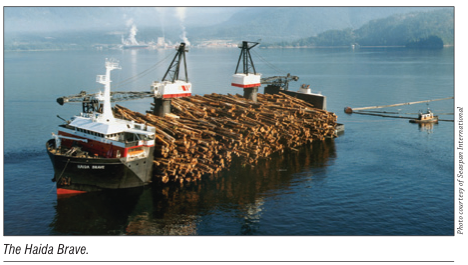
What I worry about is floating logs.

Hoa easy would it be for several from this ship

Screen-Shot-2013-08-20-at-11.34.25-AM.png
 
Are you sure about that, for it's not immediately intuitive, at least to me!

I would have thought that anything with a very slight positive buoyancy would spend a big part of its time just below the surface, in waves.

Think about it - as a trough passes the object, a lot of it will be above the surface - it will want to sink because it cannot support that mass above the water. Gravity is strong so there will be a strong downward force on it.

However, when it is below the surface, the upward force due to buoyancy will be weaker - because it is only very slightly buoyant.

End result is that when a big chunk of the container above water, it will go down quite fast and therefore (relatively) deep - maybe a meter or so. Then it will take a lot longer to get back up to the surface because the buoyant force is very small.

It will spend more time below the surface, and a smaller proportion of its time with a part above the surface. Giving the impression of floating just below the surface.
 
Last summer in Kuşadası Bay in choppy conditions I noticed a seagull apparently walking on water. On investigation I discovered he was standing on a sodden pallet floating just below the surface. It was in an area where power boats frequently open up doing 30 or more knots. I managed to get it on board and deposited it in the Marina.
 
I would have thought that anything with a very slight positive buoyancy would spend a big part of its time just below the surface, in waves.

Think about it - as a trough passes the object, a lot of it will be above the surface - it will want to sink because it cannot support that mass above the water. Gravity is strong so there will be a strong downward force on it.

However, when it is below the surface, the upward force due to buoyancy will be weaker - because it is only very slightly buoyant.

End result is that when a big chunk of the container above water, it will go down quite fast and therefore (relatively) deep - maybe a meter or so. Then it will take a lot longer to get back up to the surface because the buoyant force is very small.

It will spend more time below the surface, and a smaller proportion of its time with a part above the surface. Giving the impression of floating just below the surface.

Good explanation, makes absolute sense, Cheers!
 
Last edited:
I passed close to one mid-channel on a calm day a few years ago. It was just below the surface. It gave me a hell of a shock - I reported it to the coastguard but whether anything ever happened about it, I've no idea.
 
Things with really marginal buoyancy can, so I am told, float 'just below the surface' because the water gets a little denser as you go deeper, due to the top layer being warmed by the sun, or other layering effects, like fresh water on top of salt where a river meets the sea.

Containers are pretty well sealed (the bottom less so?), so as the air slowly escapes, they will be marginally buoyant for a significant time.

But I also think the sea is rarely flat enough to easily distinguish between floating 10cm below the surface and floating with 10cm of freeboard, for something 40ft long.
 
Obviously the containers with buoyant stuff inside are basically floating on the surface, but washed across by waves as they're offshore making them to all intents just underwater - and invisible to eyeball or any forward looking yacht sonar I know of.

I really do think containers ought to have at least a salt block system to aid them sinking quickly if washed overboard - tough luck if the salt jobs require regular replacement.

Maybe some sort of regulation re buoyant cargo too.

Losing cargo is the worst comment on a ship captains' record, more penalties should be introduced for masters and owners.

Re wood washed over the side, one of our Sea Harrier Test Pilots used the F95 recce' camera to photograph a ship approaching Shoreham in a gale, with very large wooden planks washing over the side; any one of those would easily take out a yacht.

That pilot also operated a charter fishing boat, so was aware of the danger he was seeing.

I have the pics but putting them here is a faff.
 
Last edited:
The short answer is several! Funniest one , in the channel. Early eighties onboard a warship summoned by channel control to a “ hazard to navigation “ arriving on scene to see a forty foot box floating with about a foot freeboard. Skippers plan is to engage GPMG and sink it ! Several box’s of 7.62 later and drifting in the tide for an hour resulting in no change in freeboard. Plan B yours truly is dispatched to open and investigate container! Fags Millions of them B&H actually ? I rip charged the box into three and it sank like a brick spewing cartons of B&H down channel, the Skipper issuing dire warnings to all and sundry that no salvage was permitted! That was not the last box I sank at sea ?

John
 
Top