Flexiteek (or simmilar) rubbing strake?

Avocet

Well-Known Member
Joined
3 Jun 2001
Messages
30,541
Location
Cumbria
Visit site
I have a damaged rubbing strake and partly from a wish to reduce maintenance costs, as well as partly from a bit of an environmental conscience, I'm wondering about trying to use something synthetic to replace it. It's a right angle section about an inch-and-a-half deep and an inch-and-a-quarter wide. Both "legs" are half an inch thick. I'd need about 30' per side and would have to bend it round the curve of the length of the boat. Could such a thing be made from synthetic teak? Is it quite bendy and can it be had in long lengths (or joined)? Can it be varnished? Glued? Is it cheaper (or otherwise!) than the real thing?
 
Yes indeed. You can buy synthetic teak rubbing strakes of various dimensions. Dekking have a range for example. You may have to hand craft end caps. No finishing is required, they look like and stay like weathered teak without the mould and splinters.
 
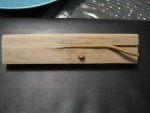
Thanks for that. I can't see any of their sections that are wide enough across the top though. The hull-to-deck joint is pretty wide (and unsightly) so I'd need something to cover it (even if I had to fabricate it from two separate rectangular sections. A picture is worth a thousand words...

Rubbing%20strake%20sketch_zps7t5n2wrm.jpg
 
How extensive is the damage? I've just repaired a section of mine (different design to yours) and it was a real pain in the arris, but still easier than replacing both sides.

I guess it was a pain mainly because my woodwork skills are limited and it took me ages to work out how to effect a good repair. Looks good now, though.
 
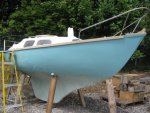
It's pretty well mashed, to be honest! The boat is on a swinging mooring which complicates the process of working on it somewhat. I've bunged several small screws through it to hold it for the season and I think I'm going to have to live with it until winter now, but it got me thinking (with this and my other thread about touching up varnish) whether there's a better way altogether. I made these ones up about 15 years ago using three sections of teak on each side, scarf jointed together. If I was doing the job again, I'd use an 8 : 1 scarf instead of a 6 : 1, but it's still asking quite a lot of the joints to bend the resulting piece round the curve of the boat (even though Avocet's not very beamy)! This impact hasn't damaged the fibreglass so it probably wasn't very hard, but the joints are under constant tension having been cold-bent around the hull. The other problem with real teak is that it's fine amidships, where the top of the hull is vertical, but it doesn't sit so well near the bow where the sides aren't vertical so it needs to twist as well as bend. So what with one thing and other, I was just idly kicking the idea of something synthetic around which, if it was easier to form round curves and twists, didn't need varnishing and saved a few teak trees, could be a winner!
 
I'm just in the process of finishing off a flexiteek (?) rubbing strake and capping rail on my Hurley 18. It is strange stuff to work with but all your normal woodworking tools should do the job. My hull/deck joint is similar to yours - having routed out the back of the capping rail it sits perfectly over it and looks great. I'll try and get some photos later.
 
I'm just in the process of finishing off a flexiteek (?) rubbing strake and capping rail on my Hurley 18. It is strange stuff to work with but all your normal woodworking tools should do the job. My hull/deck joint is similar to yours - having routed out the back of the capping rail it sits perfectly over it and looks great. I'll try and get some photos later.

I'd certainly be very interested to see those, please! Was it pretty easy to bend? Does the edge nearest the inside of the curve start buckling and forming ripples when you bend it?
 
Check if any of the Wilks traditional range is suitable. https://www.wilks.co.uk/marine/traditional-range.html


Ta, but it doesn't look like it. They have a few angle sections but there's an 80m minimum order on the ones that look closest (and they're not very close anyway). There's a stock one that I MIGHT be able to machine down but it's £26 / metre which is going to work out at the best part of £500 for the boat!
 
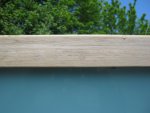
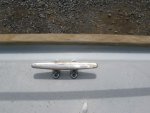
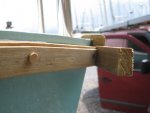
IMG_0943.jpgIMG_0944.JPGIMG_0945.jpgIMG_0947.JPGIMG_0949.jpgIMG_0950.jpg

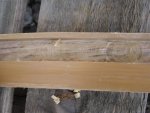
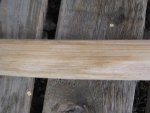
Rather pleased with the result. I haven't finished the transom yet where you can see the 'plank' stuck, screwed and dowelled on. The routed capping section sticks on with a special glue with sika in the groove. This leaves the small step seen on the 'plank' which is welded with a special heat gun leaving the finish (after a bit of sanding/trimming) seen in pic 2
 
That's superb! Thanks for posting those! What's it like to bend? (particularly the top piece that's being bent against it's deepest section). Avocet is a very similar hull shape, so there's not much of a curve to it. Also, do they give any figures for thermal expansion? I know some plastics can grow quite substantially when the sun gets on them. No idea if this stuff will though. I take it the special glue is the same colour and can be sanded back? (Can't see any trace of it on your photos)!
 
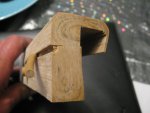
I didn't have any problems at all with bending in any direction, one of the great advantages of it but also a slight disadvantage when trying to use the router on it. The glue is actually clear but the finish in pic 2 is created by welding a narrow bead of the same material into the recess seen in pic 4. I'm told that the thermal effects are minimal and what I've seen so far would seem to agree with that. I might get chance to finish the transom this afternoon - if so will take some sequential pics to demonstrate the process. The works shown in the pics ie preparing the material, routing the capping and fitting both sides took my wife and I about 16/18hrs with probably another 2/3 to finish it off. Much quicker than timber and no scarf joints etc to worry about.
 
Fantastic! Was this actual "Flexiteak" or a similar product and were you able to get it in continuous lengths long enough for your boat or did you have to join it anywhere along its length?
 
Last edited:
I didn't have any problems at all with bending in any direction, one of the great advantages of it but also a slight disadvantage when trying to use the router on it. The glue is actually clear but the finish in pic 2 is created by welding a narrow bead of the same material into the recess seen in pic 4. I'm told that the thermal effects are minimal and what I've seen so far would seem to agree with that. I might get chance to finish the transom this afternoon - if so will take some sequential pics to demonstrate the process. The works shown in the pics ie preparing the material, routing the capping and fitting both sides took my wife and I about 16/18hrs with probably another 2/3 to finish it off. Much quicker than timber and no scarf joints etc to worry about.

Which supplier did you use to purchase the Flexiteek strip?
 
I must say, I'm enthused with the idea of doing this. "fit-and-forget" rubbing strakes that don't trash the rain forest! Did you get a continuous length long enough or did you have to join lengths?
 
Sorry it has taken so long to get these pics up. Been rushing about to get afloat which we now are - at last!!
IMG_1011.JPGIMG_1010.JPGIMG_1009.jpg

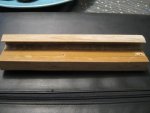
Pictures are in the wrong order but pic 3 shows the finished result and the process with the weld strip/recess to the right of the photo. There is a dowel on the extreme left.

Pic 2 shows the 2 sections glued together and the rebates that I routed out.

Pic 1 is the back of the 'assembly' - the darker brown is how it arrives, the grain affect is created by sanding.

Hope this helps, very pleased so far.
 
Top