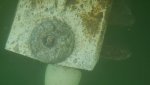
Fizzing anode :-(

msimms

Well-Known Member
Joined
11 Sep 2002
Messages
430
Location
Boat: Chichester Marina
Visit site
Hi,

Noticed what looked like a growth on port leg additional anode. On closer inspection noticed it was also giving off bubbles.
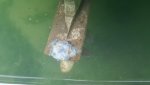
first sight port.jpg
First sight

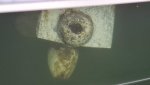
cleaned port.jpg

Cleaned off.

Link to a video of it 'fizzing': FIZZ

The video was shot with shore power disconnected and batteries isolated. Volvo 290DP legs with stainless props. The ring anodes are virtually non existent, couldn't see the bar anodes but they are doubled up and usually show very little wastage. There is also an anode mounted on the hull between the legs. I couldn't see that one either but like the bar anodes it doesn't waste that much. I think the continuity from anode to leg was okay, reading about 1.7 ohms.

All anodes are aluminum.

Berthed in Chichester Marina.

Wondered if anyone had seen similar before?

Cheers

Mark
 

Attachments

  • cleaned port.jpg
    cleaned port.jpg
    44.3 KB · Views: 9
Sea water anodes should be zinc

I disagree. However if Aluminium is fizzing zinc would be a lot lot worse off. Check for wires in the bilge. Typical offenders are bilge pumps and float switches. Look for any loose wires. Disconnected split chargers are another culprit. Check the earth strap that sits behind the engine rhs if KAD and connects to shield. That is electrolysis and not galvanic.
 
I would also say should be zinc.
Why would you put an aluminium anode on an aluminium leg ?

Different aluminium as I understand it - recommended by one outdrive manufacturer - Mercruiser I think. Work in both salt and fresh - we have used them on outdrive and shaft drive boats for years as we do river and sea. First switched from zinc when we were permanently salt water.
.
 
Aluminium anodes may be used in salt water or fresh water. Handy if like me you intend to take the boat between fresh and salt water.
I have been using them some years.
They do protect an aluminium outdrive.
 
Hard to tell from the video but are the bubbles only coming from the anode? Some appeared to be coming from the surface of the leg.
 
Aluminium Anodes have been scientifically demonstrated and proved to be superior time and again but vendors just cannot break past the lore of zinc. People say zinc is working why fix what aint broke. Well apart from zinc being fine Aluminium performs better and lasts longer and doesnt form that crust which renders zinc inert and you thinking there's still plenty meat on the bone. Dont take my word, google is your friend.
 
When you say "shore power disconnected and batteries isolated" does that mean shore power unplugged or just the breaker opened? Is the breaker single pole or double pole? Battery isolation usually just means turning off the main switch which operates only on the positive cable with the negative still connected. Is your battery neg connected to AC neutral?

There has to be an electrical input somewhere, it's highly unlikely that fizzing like that would take place without it.
 
If you have split diode charging system from the alternator it may be you have a problem with the diode , disconnect the red cable on the alternator as that could possibly be going to ground .
id also be checking your sea cocks and skin fittings

so it’s a twin engine but only one fizzing , has to be an issue on that engine somewhere .
 
Hi,

Thanks all for your comments – addressed below.

I changed to aluminium from zinc a number of years back (eight?) and they seem the better option, lasting longer whilst providing better protection. Had noticeable corrosion on aluminium props when the boat was fitted with zinc. Happy that aluminium is the correct choice for boat and its location (quite a lot of freshwater coming in to Chi marina).

I did fit the additional anodes to the leg (the fizzing one) about three years ago when moving to stainless props, the bar anodes have been doubled up too.

As far as I can see the bubbles were coming from the anode only and nowhere else on the leg. There was a bit of debris floating around.

It is twin engine, KAD43 and 290 legs and only one side ‘fizzes’.

The video was taken with the shore power physically removed and the three battery switches - one for each engine start battery and the third, service, were off. So only +ve isolated. Not everything is isolated, bilge pumps would still have power and I think the Eberspacher too.

Reasonably certain that –ve and AC earth are connected together but not to AC neutral.

The resistance reading (1.7 ohm) was from a cheap meter and matched the other side.

Bilges are dry.

This weekend I’ll have a thorough check around the engine for damaged/loose cabling and check skin fittings (which are bonded). If I can’t find anything untoward I’ll start isolating the batteries (and alternator) until the bubbles stop. I find it hard to imagine that this can occur with no power in the equation.

Thanks all for your help.

Cheers

Mark
 
Hi,

Thanks all for your comments – addressed below.

I changed to aluminium from zinc a number of years back (eight?) and they seem the better option, lasting longer whilst providing better protection. Had noticeable corrosion on aluminium props when the boat was fitted with zinc. Happy that aluminium is the correct choice for boat and its location (quite a lot of freshwater coming in to Chi marina).

I did fit the additional anodes to the leg (the fizzing one) about three years ago when moving to stainless props, the bar anodes have been doubled up too.

As far as I can see the bubbles were coming from the anode only and nowhere else on the leg. There was a bit of debris floating around.

It is twin engine, KAD43 and 290 legs and only one side ‘fizzes’.

The video was taken with the shore power physically removed and the three battery switches - one for each engine start battery and the third, service, were off. So only +ve isolated. Not everything is isolated, bilge pumps would still have power and I think the Eberspacher too.

Reasonably certain that –ve and AC earth are connected together but not to AC neutral.

The resistance reading (1.7 ohm) was from a cheap meter and matched the other side.

Bilges are dry.

This weekend I’ll have a thorough check around the engine for damaged/loose cabling and check skin fittings (which are bonded). If I can’t find anything untoward I’ll start isolating the batteries (and alternator) until the bubbles stop. I find it hard to imagine that this can occur with no power in the equation.

Thanks all for your help.

Cheers

Mark

I can remember a certain forum member do some diy electrical on his bilge pump and wired the positive feed to a group of wires that lead to a skin fitting , hence the boat sank .
I had in previous months serviced both drives and was twitchy wondering what might have occurred hence I was present when the boat was salvaged to see the fault .
 
I can remember a certain forum member do some diy electrical on his bilge pump and wired the positive feed to a group of wires that lead to a skin fitting , hence the boat sank .
I had in previous months serviced both drives and was twitchy wondering what might have occurred hence I was present when the boat was salvaged to see the fault .

I'll certainly include them in the investigation. There's only two and both were replaced last year. They looked fine but were twenty years old so thought I'd had my money's worth out of them.
 
Before checking the resistance, measure the lead resistance or if using a flying lead/ extension lead include that as well. This reading then becomes your zero. It is not unknown for cheap meters to have a significant lead resistance
 
Could it be stray current from your neighbour boat on that side

I did wonder but as it occurs with my shore power disconnected I ruled it out.

Don't we need to share an earth for that to happen? I do have a galvanic isolator fitted to counter that for when hooked up to shore power . I'll put my meter across the isolator at the weekend to confirm it's still good.
 
Top