Fitting an inner forestay

pcatterall

Well-Known Member
Joined
2 Aug 2004
Messages
5,506
Location
Home East Lancashire boat Spain
Visit site
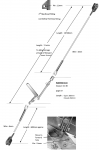
I have a 'spare' 6mm forestay which had been used when our Neptunian ketch had a bowsprit. It is no longer used but I would like to bring it back into service even just for a small additional jib or storm sail. There is a good deck fitting ( just a U bolt) at a useful position just behind the anchor windlass I want to use a Highfield lever so we can deploy the inner sail quickly as needed. I am happy to shorten the stay and use Staylok type fittings for the fitting to the Highfield lever. I want to take the right gear out to Spain ( roll on!) and seek advice about just what bits I will need and the best place to obtain What parts do I need to corectley connect the lever to the U bolt. I did use the stay with the fork fitted directly to the U bolt but am pretty sure that that is not really the way to do it!
 
Thanks for the 3 replies.
The forestay is fixed 3 feet from the top of the mast.
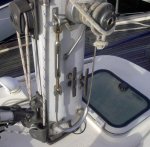
The U bolt goes through the deck then a wooden pad onto a beefy angled bracket with additional bolts through the anchor compartment bulkhead.
The stay may be used for a storm jib or a small working jib ( possibly with a boom).
 
Thanks for the 3 replies.
The forestay is fixed 3 feet from the top of the mast.
The U bolt goes through the deck then a wooden pad onto a beefy angled bracket with additional bolts through the anchor compartment bulkhead.
The stay may be used for a storm jib or a small working jib ( possibly with a boom).
This is just what I'm also planning on. The reading I've done so far, indicates that a storm jib should have a strongly backed fitting for the tack, on third the way aft from the stem to the mast. A high cut clue and pendant on the sail's tack. I have also thought I would like a self-tending club-footed working jib but I don't know if it would have it's tack at that same point. I feel it would probably be attached at the stem, perhaps just aft the forestay. In my case it couldn't be on the main forestay. I have a free standing roller furling genoa and the forestay is forward on the stem of that.
 
The Highfield lever setup guarantees that your stay and lever are significantly longer than the shrouds, and wll be difficult to stow neatly alongside a shroud or to the base of the mast. I prefer a shorter stay that will tie down to a shroud or mast base the 99%+ of time it is not in use, with a block and tackle used to tension it down when (probably very rarely) needed. The block and tackle stows away and has other uses, particularly MOB or lifting other heavy stuff.
 
I would go for the high field lever arrangement despite jwilson comment. I don't think you could get enough tension with tackle.
I would also not go for self tacking jib. I think it very desirable to be able to manually back the jib eg to get the boat out of irons or aid in a tack or to heave to. Might be a life saver in really bad weather. ol'will
 
The Highfield lever setup guarantees that your stay and lever are significantly longer than the shrouds, and wll be difficult to stow neatly alongside a shroud or to the base of the mast. I prefer a shorter stay that will tie down to a shroud or mast base the 99%+ of time it is not in use, with a block and tackle used to tension it down when (probably very rarely) needed. The block and tackle stows away and has other uses, particularly MOB or lifting other heavy stuff.

The usual way is to size the stay and Highfield lever to its parked spot, in our case on the toe rail and then the bottom strop, attached to stem fitting, is long enough to couple to it when brought forward.
 
Im thinking about a better arrangement for my storm jib as I currently hoist a wire stay and block on my spare jib halyard. Tension isn't a problem even without a black and tackle. Im pondering over a dyneema stay permanently attached to the mast that I can tension with a block and tackle and the fore stay tensioner I have on my split backstay. The reason for Dyneema is that I could easily wrap it around a shroud for stowage when not in use. I'm a long way from committing as what I have works albeit in a bit of a Heath Robinson way.
 
I would use one of these as the connection to the U bolt
Baby Stay Fitting / Slip Hook with Ring buy now | SVB
Probably the 8mm (this is what I wished I had used). Can be fitted to a fork terminal.
Much easier to hook and lock into place than trying to get a pin in as the deck is bouncing around.
The best tensioning system I've seen (for me) was on a friend's boat.
At the lower end of the stay he uses friction rings to create a 2-1 advantage with a length of dyneema.
This rope runs through a clutch immediately behind the deck attachment point, the end of the rope can be led to a winch on the mast and adequate tension applied. With the clutch it doesn't tie up a mast winch which is probably needed to raise the new hank on sail.
There is also less time spent in the boats pointy end bouncing around and the stay can be sized to store next to the shrouds.

I use colligo line terminators to give a very strong 8-1 ratio block. It works but not well as you have to pull on each strand in turn to get tension.

Dan
 
I would go for the high field lever arrangement despite jwilson comment. I don't think you could get enough tension with tackle.
I would also not go for self tacking jib. I think it very desirable to be able to manually back the jib eg to get the boat out of irons or aid in a tack or to heave to. Might be a life saver in really bad weather. ol'will
Good thoughts. There is a time and place for everything so having a self-tacker isn't exclusive of normal sheeting. I am wondering if a storm jib has a different angle on the luff. Does a storm jib stay need to attach to the same (nearly same) point on the mast as the main forestay? Or, can it/should it be lower?
Im thinking about a better arrangement for my storm jib as I currently hoist a wire stay and block on my spare jib halyard. Tension isn't a problem even without a black and tackle. Im pondering over a dyneema stay permanently attached to the mast that I can tension with a block and tackle and the fore stay tensioner I have on my split backstay. The reason for Dyneema is that I could easily wrap it around a shroud for stowage when not in use. I'm a long way from committing as what I have works albeit in a bit of a Heath Robinson way.
My thoughts are that my storm jib would be hoisted with a halyard so, the halyard, when not in use is fastened at the mast.
If there's not a wire luff, then Graham 376 above has the option I would use. The strop can have whatever purchase and lead suits your situation.
I'm wondering about effects on the mast. Does a storm jib need to come off the mast at (very near) the same point as the main forestay?
 
I would use one of these as the connection to the U bolt
Baby Stay Fitting / Slip Hook with Ring buy now | SVB
Probably the 8mm (this is what I wished I had used). Can be fitted to a fork terminal.
Much easier to hook and lock into place than trying to get a pin in as the deck is bouncing around.
The best tensioning system I've seen (for me) was on a friend's boat.
At the lower end of the stay he uses friction rings to create a 2-1 advantage with a length of dyneema.
This rope runs through a clutch immediately behind the deck attachment point, the end of the rope can be led to a winch on the mast and adequate tension applied. With the clutch it doesn't tie up a mast winch which is probably needed to raise the new hank on sail.
There is also less time spent in the boats pointy end bouncing around and the stay can be sized to store next to the shrouds.

I use colligo line terminators to give a very strong 8-1 ratio block. It works but not well as you have to pull on each strand in turn to get tension.

Dan
Those Colligo terminators look to be new versions of old, old technology. Who recommends them, where, when and why?
 
I have an interest, and have explored rigger-opinion far and near. This page from Selden may give pause for thought. It did in my case.....

https://support.seldenmast.com/files/excerpts/595-808-E-35-35.pdf
I'm not able to find a mast tang that will accommodate two forestays. The best my search has turned up is a backstay tang that has a smaller hole for ...possibly the topping lift block.
Can two forestays be attached without drilling extra holes in the mast?
 
The location of the new inner forestay onto the mast is a question of distance down and stiffness of the mast. The back stay and possibly cap shrouds that have to react against the pull from the inner forestay. (which will be great). In some cases there may be a case for fitting running back stays to the same level, to keep the mast straight and counter the load.
So it is not possible for me or anyone who is not a rigging engineer with much experience to gi ve the answer as to how far down from the main forestay you can attach a storm type inner forstay for a storm jib. I would imagine that a small percentatge (10%) of distance down from forestay to intermediate shrouds would be OK. Perhaps more on a really robust mast. I think it needs to be separated by some distance.
Midway (50%) between main forestay and intermediate shrouds spreaders and or inner forestay would be worst case without aft support.
olewill Not answering your question.
 
We also have a removable inner forestay with a Highfield lever arrangement attached to a U bolt on the deck (and the underside of this is tension down to the anchor locker bulkhead).
The outer forestay has a roller furling genoa; the inner forestay is used for a high cut yankee working jib. It could also be used for the storm jib, although we have never had to use this in anger.
We usually leave the inner forestay in place, unless we know that we will be short tacking with the roller genoa.
If only anticipating maybe one or two tacks on a passage, we simply roll up the genoa as we tack, and then let it out again on the new tack.
It is nice to have the security and peace of mind of the extra forestay.
 
Top