Fitting a standpipe, with no internal access

Ian_Edwards

Well-Known Member
Joined
9 Feb 2002
Messages
2,221
Location
Aberdeen Scotland
Visit site
I want to fit a stand pipe to a Vetus Atank390, 1400 long x 800 deep x 400wide. Wall thickness 5-7mm.
The tank looks like it is a rotation moulded, and the spec' says synthetic, whatever that means, it looks like some form of polythene to me.
I have no internal access to the tank, at least at the end I want to fit the standpipe.
The standpipe is for a diesel heater, so it doesn't need to go to the bottom of the tank , 700mm would work well, 650mm would do, and the output need to fit a standard 5mm ID rubber hose.
I'm having difficulty finding a standpipe that will fit the bill.
Length seems to be a problem, as does the wall thickness (most seem to be for thin steel tanks), and of course the lack of internal access.
It really needs to be SS steel of some form.

Has anyone successfully fitted a standpipe, to a Vetus tank, where internal access isn't practical?
 
I want to fit a stand pipe to a Vetus Atank390, 1400 long x 800 deep x 400wide. Wall thickness 5-7mm.
The tank looks like it is a rotation moulded, and the spec' says synthetic, whatever that means, it looks like some form of polythene to me.
I have no internal access to the tank, at least at the end I want to fit the standpipe.
The standpipe is for a diesel heater, so it doesn't need to go to the bottom of the tank , 700mm would work well, 650mm would do, and the output need to fit a standard 5mm ID rubber hose.
I'm having difficulty finding a standpipe that will fit the bill.
Length seems to be a problem, as does the wall thickness (most seem to be for thin steel tanks), and of course the lack of internal access.
It really needs to be SS steel of some form.

Has anyone successfully fitted a standpipe, to a Vetus tank, where internal access isn't practical?
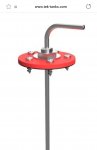
Maybe you could replicate one of these from common brass fittings then screw a separate pickup tube into it. SS-WTB Stainless Steel Weldless Tank Bushing Kit ("Blind" Bulkhead)

www.solocoastalsailing.co.uk
 
If you look at, for instance, "stand pipe for eberspacher heater", you'll find what you're after. Maybe only 600 long, but could surely be extended if required. The ones that I see are made to fit on the top of the tank, with no access to the inside. I used something similar when making a dedicated tank for kero for a heater, out of a 20 litre container.
 
Thanks Plumb, I'll have look at that idea in may be practical.

NormanS, I've looked at the Eber offering but it states for use with metals tanks only, and as you point out its's only 600mm long.

251226894000
Eberspacher heater double fuel standpipe 6mm x 600mm
600mm stand pipe with fuel tank return connection
5mm ID
Plasee note;
For use with metal fuel tanks only


Martin_J, the self tapping screw approach doesn't work with the Vetus tanks, that's how the original Vetus tank fittings worked and Vetus had to change the design. The tanks on my boat had self tapping fixing for the connections and the thread stripped, I tried helicoil inserts and they stripped as well, I also tried threaded inserts (made for use in wood or GRP) but the thread was too course for a wall thickness of 5 to 6mm.

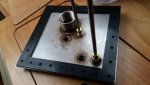
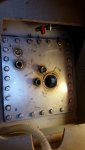
The solution I came up with for both the water and the diesel tanks (they are identical), was to make a SS plate fitting, difficult to describe in words, but here goes:

A square 5mm SS plate 200mm x 200mm, with SS nipples for filler pipe, vent, and standpipe, drilled and then welded into the top.
A square 5mm SS plate "picture frame" 200mm x 200m with a 25mm (I'm not quite sure if it was 25mm or 20mm) frame width.
I clamped the plate and the frame together and drilled tapping size holes for M8, then opened out the holes in the plate to M8 clearance.
I also drilled and tapped 2 @ M4 holes on opposite side of the frames, these were used the hold the fame in place until the top place was located.
I the placed the frame on the tank and marked and cut a square hole in the tank, and then drilled the tank to take the M8 bolts.
The frame was then inserted into the tank, it fitted diagonally through the hole, and secured it with M4 counter sunk set screws.
I then cut a 200mm x 200mm frame of diesel resistant 5mm neoprene rubber to act as a gasket, and used a bit of no nail to temporary fit it to the under side of the plate.
Place the plate on top of the holes and secured it with M8 set screws and washers with a dab of high temperature sealant to stop the diesel working its way up the threads of the set screws.
That was done if 2014 and has work leak free ever since.

fuel tank connection plate 1.jpg
fuel tank connection plate 2.jpg

I don't seem to be able to find the photos of the frame.

Although it's a lot more work, I'm going the go with a mini version of the main the larger version described above, because, although it's over engineered in many ways, I know it works, and I don't have confidence in any of the commercially available alternatives I've seen so far.
 
You could use a VDO sender clamp kit, and make a top plate from metal that could have whatever standpipe you like mounted in it. This would only need holes drilled in the tank as the clamp kit sandwiches the tank between the inside and outside plates & gaskets.

It's basically a small version of the access hatch mentioned above.

VDO sender clamp
 
The big square plate system is best: I did very similar but probably not so well engineered job on a Jeanneau diesel tank, and it's the only thing that works well. Things like self-tappers that may work OK in rigid tanks just don't work for long on slightly flexible rotomoulded tanks. Nor do the standpipe kits with small "squared off circle" inner bits like Fuel Standpipe

My original leak was from one of those fitted by the Jeanneau dealers to install an Eberspacher when the boat was brand new. It took several years to leak, but it did, and then several more years of various leak-fixing attempts to finally cut a big hole and put in a multi-bolted plate. That also lets you get the black gunge out of the bottom of the tank. If you've never opened up your tank I think you may be surprised to find nearly a pint of dirty water and slimy black gunge at the bottom. In my case it was along wth the plastic drillings from the muppet who installed the Eberspacher standpipe.

I really really wish modern production boat fuel tanks came with a bottom drain. And properly engineered access plates. But they don't.......
 
Last edited:
Top