Fitting a electronic anchor windless Halmatic 30

The extra weight of the 8mm chain serves a purpose, it gives a better catenary and roots you boat better in variable conditions, you have a greater safety margin against wear. It's easier in the hand.

.

The suggestion to downsize to 6mm is usually accompanied (as in post#25 by a recommendation to use a long snubber to compensate for the loss of catenary in heavier wind conditions. If you have an electric windlass you would not normally manually handle chain.. Of course if you have good 8m chain and the windlass already, the benefits may not be worth the cost of changing.

 
Realistically you will only downsize your chain, as Tranona suggests, if you need new chain and re-galvanising is not an option (because the old chain is too far gone, or the cost of re-galvanising too high). Ideally you would like to consider the options when you need both a new chain AND a new windlass.

If you opt to downsize chain, keep the windlass and thus need to buy a new gypsy - there will be savings for the new chain - smaller chain is a bit cheaper.

When we down sized I did look at the cost of a new gyspy, roughly stg250.00, and decided to buy a new windlass rather than invest Stg250 in a 20 year old windlass.

Jonathan
 
IMGP0049.jpeg

This crudely is the maths for nylon vs chain.

The use of catenary or elasticity is to absorb snatch loads, either the catenary of the chain straightens or the nylon stretches. When the tension is released the energy Is released by the catenary having a bigger
'sag' or the nylon releasing some of its stretch. The energy both catenary and elasticity 'absorb' is that of the moving yacht - in the extreme a snatch load.

Upto about 30 knots (300kg of tension) the two rodes 30m x 10mm chain and 10m of 10mm nylon have the same energy storing capacity, roughly. Beyond 30 knots the nylon continues to stretch but the chain 'looks' straight and can no longer offer any ability to absorb snatch loads. Basically the increased tension in the rode will be accepted by the nylon and transferred directly to your anchor in the case of chain. The nylon will continue to stretch - until it fails.

You could of course deploy more chain, 30m of chain is not much - but maybe there is a yacht behind you or a rather inhospitable bit of rock.

But the graph is simply to show a comparison of the WHY not to necessarily be realistic. You will never anchor with rocks nor another yacht that close behind you. :)

In addition if you do use a snubber the nylon and chain work together, both will accept some of the energy as the gust hits - but that combination of nylon and chain is a bit like extending the rode - so you can use nylon where there is less room aft.

10mm nylon has a UTS much less than that of the chain - but the chain is still your fall back. The rope is not there to hold you, though 99 times out of 100 it will hold you - the nylon is chosen for its elastic properties not its ultimate strength. The snubber is in fact a consumable, like your sails or halyard (so carry a spare). As the length of chain in there graph is not necessarily realistic - neither is the snubber (we use 30m snubbers) and if you deploy your snubber from the transom, along the side decks, having a 15m snubber would not be difficult - with only 5m of nylon forward of the bow roller for a yacht 10m long. If you secure the snubber at your sheet winch - your snubber can be even longer as you can then extend your snubber, from the cockpit (in you jimjams if the weather is poor), simply by easing out more snubber (you need to have a decent lazy look to do this and a longer snubber).

If you have less chain than you really need a snubber offers you the ability to use a shorter scope without the cost of more chain - and I know which is cheaper.

Jonathan
 
The extra weight of the 8mm chain serves a purpose, you have a greater safety margin against wear.

This one of those furphies that become more true with repetition. I have never seen any data to support the idea.

I was intrigued and tested for it. I've been testing my Armorgalv coated chain (Thermal Diffusion Galvanising TDG) against Hot Dipped Galvanising HDG. TDG is better because it is harder and my coating spec is higher (thicker) - and I check it.

I took 6mm, 8mm and 12mm galvanised chain and hung them on a length of steel under our cat. The chains were all galvanised and all, roughly, the same length. The chains were allowed to be dragged along the, silica, seabed. I measured the weight of the chains weekly, washed in fresh water, dried in the Australian sun and then weighed. The wear rates were similar but if asked to be more committal - the larger links wore more.

This one of my many test pieces, not the test for chain size wear but testing for the galvanising process - same testing concept. I hang the test pieces between the two hulls - so side to side - and as the cat is subject to wind it moves back and forth. I set the length so that the samples are always on the seabed, we have max of 2m tides. When we actually sail - I simply lift the device and it sits on the trampoline. The 2 rusty chains are, or were, black painted HT chain, no gal.

IMG_7585.jpeg

This is logical as wear is due to friction and the heavier chain will wear more.

However a bigger influence is the quality of the galvanising.

People also suggest the catenary of the heavy chain is more beneficial, I've answered that with my graph, but if the heavier chain is subject to 'more' catenary - it will be on the seabed for longer - and suffer more wear - n'est pas? I could not think of a simple test for the latter.

Jonathan
 
With my 8mm chain, wind over 18 knots means that there is no catenary. For the average cruiser I suspect wear where it affects strength isn't an issue.


You should consider heavier chain.

Depending on weight of chain, windage and displacement 20 to 30 knots has been suggested as the limit of useful catenary.


.
 
You should consider heavier chain.

Depending on weight of chain, windage and displacement 20 to 30 knots has been suggested as the limit of useful catenary.


.

No depends what scope he had deployed. If he had little chain deployed even 10mm can be straightened at 18 knots.

At 30m deployed 8mm chain, 5:1 scope all the chain is off the seabed at around 17/18 knots (the last link, the one at the anchor is just kissing the seabed). 8mm x 30m x 5:1 is not ridiculous. This is not 'steady state' - the yacht will move back and forward and some chain will cyclically be on the seabed - but wear, abrasion, will not be significant. It 'looks' straight at about 30 knots (and there will be no abrasion). In real life you would not be in an anchorage exposed to 30 knots (we would move if possible or deploy more chain). Our garden is steep and allows me to set this up and make the measurements. It will vary slightly with the size of yacht but assumes that the yacht is about right for 8mm chain. It all changes, gets better, if you use a snubber.

My tests for abrasion have the chains constantly dragging over the seabed. In real life either the anchorage is calm, and not much abrasion because the yacht does not move much OR the winds are over 17 knots and there is not much abrasion because the chain is not on the seabed. In my tests I can expose bare metal in about 6 weeks - for chain I know will have a life of about 1,200 days at anchor. The chain near the anchor does not suffer much abrasion, because it does not sweep the seabed very much, the chain. say 10m from the anchor does sweep - but it often is lifted from the seabed. We mostly might aim for a 5:1 scope - but the part that actual suffers abrasion is never the same as we might deploy more or less chain (depends on depth) to achieve that 5:1 scope. Hence the 4 year life of chain.

Anchoring in smelly mud, its acidic, and not washing the chain correctly might be a cause of greater gal loss than abrasion.

Jonathan
 
Well, a number of points have been raised, or rather re-raised, these posts can get repetitive.

1) The fact that catenary has a limit is often revealed to us. In fact: " the anchor chain was bar taut" is a staple of Edwardian sailing literature. We all know this.
In uncontrived conditions, with a reasonable weight of chain, you can expect to have a useful contribution in 20 to 30kts.
In protected waters 20 to 30 kts is a lot of wind, maybe a gale, or worse, at sea.

2) We have been using supplementary warps on anchor chains a long time, ever since synthetic lines became increasingly available after the Second World War. I doubt if there is any yachtsman cruising under sail who is ignorant on the subject.
However, we have regular monographs on the topic of anchor springs, telling us what everyone has known and practised for 50 years.

3) By downsizing to 6mm chain you reduce your margin of error in manufacturing, in service and the supply chain (He he). Can you really be sure if the vendor gives you what he says it is, or the manufacturer supplies what he says he has, or the steel supplier? You can insist, but it will never be cheap.

Here is an illustration:

A snap taken from Ebay ( which I am sure Colin of this parish will not mind sharing - it is still open to bids standing at just c£60 right now).

It shows 60m of top quality 8mm chain which due to a manufacturing defect has one corroded link in the middle. The corrosion seems to have undercut the link to some extent though not so much that I won't be bidding. Had it been 6mm chain I would leave it - because the margins are finer in long term service.

1662801706034.jpeg


4) In the previous post I said heavier chain "roots" the boat better. In other words she is less likely to sail around her anchor or, if doing so, it will slow the action. We have all seen multihulls anchored to nylon tacking furiously at anchor.
I spent a memorable night this summer, in a French river, motoring at anchor for four hours, avoiding shearing boats. I only scored one hit and my last thought was wishing I had 6mm chain to speed things up.

5) I believe that heavier chain allows the anchor to set better, in theory it should be so but in practice who knows? I feel it's a definite advantage when anchoring under sail, where digging in is sometimes a slower "pot of tea" business.


The question asked was "What's not to like" (about changing from 8mm to 6mm chain on a 5 ton yacht). Neglecting the expense, those are some of the things that occur to me. If I was starting from scratch I would consider it but to present it as a done deal is wrong.

.
 
Well, a number of points have been raised, or rather re-raised, these posts can get repetitive.


2) We have been using supplementary warps on anchor chains a long time, ever since synthetic lines became increasingly available after the Second World War. I doubt if there is any yachtsman cruising under sail who is ignorant on the subject.
However, we have regular monographs on the topic of anchor springs, telling us what everyone has known and practised for 50 years.
.

Every one knows about snubbers - this one knows? Is this your idea of a snubber? If he is an example of knowing and everyone - ......?

IMGP4561 2.jpeg

There is hope that with some repletion owners will understand about snubbers - and maybe even use one, or better a bridle

IMG_1574.jpeg

Your experience in a French river seems to suggest that you disprove your own comments and the above is an example of a cat waiting to sheer - no bridle.

People don't know - that's the problem.

I accept my many examples (how many would you like?) are cherry picked - a bit like your example of a badly corroded chain link - how many such examples to do you have? I have many of poor or no snubbers

And larger chain, a large shackle, a large swivel each or a combination will reduce the ability of your anchor to set correctly. Anchor makers over the last 2 decades have moved toward thin shanks - because thick shanks reduce anchor performance - it does not stop at the shank.

How many examples would you like of everyone not using a snubber or a snubber so short or so thick it offers no elasticity . I collect such pictures. The 'anchor' industry has known about the detrimental effect of rode size on anchor performance - University Professors have built their reputation on the work.

Dream on. :)

Take care, stay safe

Jonathan
 
You should consider heavier chain.

Depending on weight of chain, windage and displacement 20 to 30 knots has been suggested as the limit of useful catenary.


.
8mm chain is heavy enough and has more than adequate strength. I normally use between 3 and 5 to 1 scope depending upon conditions. When mine was a straight line it was about 5 to 1 and in calm waters apart from the wind. I can't see heavier chain helping with digging in unless you throw the anchor over the bow and leave it.
 
Well, a number of points have been raised, or rather re-raised, these posts can get repetitive.

I know I should not complain but I do get upset with people who read something and then complain they read it last week, last year, 10 years ago etc etc and that the knowledge has been known for decades.

If the author of this article

Safety at Sea: Surviving a Powerful Storm in the Med

had read a few articles in the yachting press, there was another one (yes repetitive) in YM last year, he would not have needed to have a storm snubber (his everyday snubber could have been, simultaneously, a storm snubber. Interesting that YM thought to publish an article on snubbers - surely after 70 years since WWII they would know EVERYONE knows all about snubbers - and uses them. If the same author had read posts here, a number of them, he would have known his chain hook was suspect and another (much cheaper) design would not have bent.

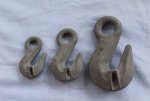
Just one of many better chain hooks, not forgetting rolling hitches.....
IMG_4989.jpeg


The owner and his partner on Blaze was half way round the world on their circumnavigation. Have you that experience under your belt - but they are not using a snubber.

Everyone? (Yes I have more pictures of - EVERYONE)

Tasmania On route 08 118.jpeg

I was a true neophyte at the time - there was a Storm outside the anchorage and bullets were whistling through the gaps in the trees - sufficient to bend our swivel - we learnt the hard way, unlike EVERYONE, who know these things (swivels are mentioned repetitively as well). I was grateful for the posts that put us on the straight and narrow - and am happy to perpetuate the doctrines (and offer a.....Boomerang - as a swivel replacement, I went a bit further and thought to offer a 'better' swivel (or device to replace a swivel - on which Vyv might post.... later).

Authors of posts, or articles in the yachting press, cannot determine if their work is read - but they are sincere, they are trying to impart knowledge and are trying to make sailing more enjoyable and safer. You, amongst others, find some posts boring - no-one obliges you to read them, you pay zilch for the opportunity to read them and the authors are true Philanthropists - they are unpaid. If one person reads and embraces the content - the author's would be happy.

Wingeing is unnecessary.

But if you can do better - please, please feel free. Most of us have gaps in our knowledge - take the chance to try your hand and be pro-active. I for one will applaud your efforts, I for one will encourage you to post more - with supportive content.

Take care, stay safe :)

Jonathan
 
Top