
Gixer
Well-Known Member
Eight I think

Agree using a ply plug the same thickness as the bulkhead. For strength chamfer all edges front and rear. I would make the plug about 1/4" smaller all round. Hold in place with a couple of wedges when aligned. i would start from the back lay up some glass at the four corners and let it go hard. Remove the wedges, continue laying glass around the gaps let harden. From the front fill with epoxy mixed with some fibreglass wool so it doest run (I am assuming the hole is verticle) continue until flush, giving a very strong if not stronger repair than the bulkhead.The "right" way to do it would be to layup some glass on a flat bed (table top with some plastic sheet over) to make a grp plug, but I'm sure a bit of ply will work just as well, and will be a lot quicker to do.
Looks very similar. I usually buy my FG from a company in Ireland, they do both the epoxy and the polyester. The name escapes me but they are a very good one stop shop. I made a black tank from marine ply to fit under a bunk directly under a hatch to allow a pump out pipe to connect to it. It was an odd shape as you may imagine, all the insides were several layers of epoxy, all the corners and joins had a 2" radius in epoxy, for which I used the filler so no 'slump' occurred during hardening. The radius guaranteed the tank contents could all be emptied with just one flush of water. This was advice form our resident Australian FG expert of 40 years. I think this is the company, but there are many more local I am sure. HomeThanks Freedom35,
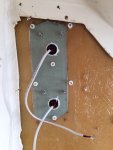
I'd really like to make a GRP plug but after my test I don't think I can make it thick enough. I might go back to the ply but use the plug I've made as the front panel to cover the repair and keep in neat.
Never seen fiberglass wool, i'll try and get some.
What about this stuff?
West System 402 Milled Glass Fibre Blend Filler 150g



Just a note : Make sure the Teak is well impregnated with preservative .... teak does not like freshwater such as rain .... but is better in saltwater.